
Dev. Trajectory: Kent Johnson

Development Trajectory Series
This is now the third installment of the development trajectory series, this time turning to a story that isn’t quite so positive in Kent Johnson.


If you’d like, feel free to check those out. Next up, and last in the series, will be Cole Sillinger.
The Big Picture
Where to start when it comes to Kent Johnson? By almost every measure we have available to us, Kent Johnson had a poor season. In fact, across scoring metrics, the worst season of his career.
So what happened? Has he been a fraud this whole time? Was last season a complete scoring-bender fluke? Does he just not have it? I suppose many of those questions are different flavors of the same but to each of them I feel comfortable answering: no.
Now, this might take a bit of time to wade through. I pretty much broke the video editing software by dumping literally all of the Kent Johnson clips into it as I sorted through them (around 1 hour and 30 minutes of clips) but there’s absolutely a coherent story to be told through this season’s tape.
It was well and truly a brutal season. I really don’t think we need much data to get that point across, Kent Johnson’s tearful exit interview and healthy scratches probably says as much.
The biggest drop, and we did indeed predict some of this, was in Kent Johnson’s scoring. We can point to the lack of James van Riemsdyk or his unreasonably high shooting percentages being good reasons to predict regression but nothing said it would be quite this vicious.
At 5v5, Kent Johnson shot 5.68%. Last season, he shot 20.43%.
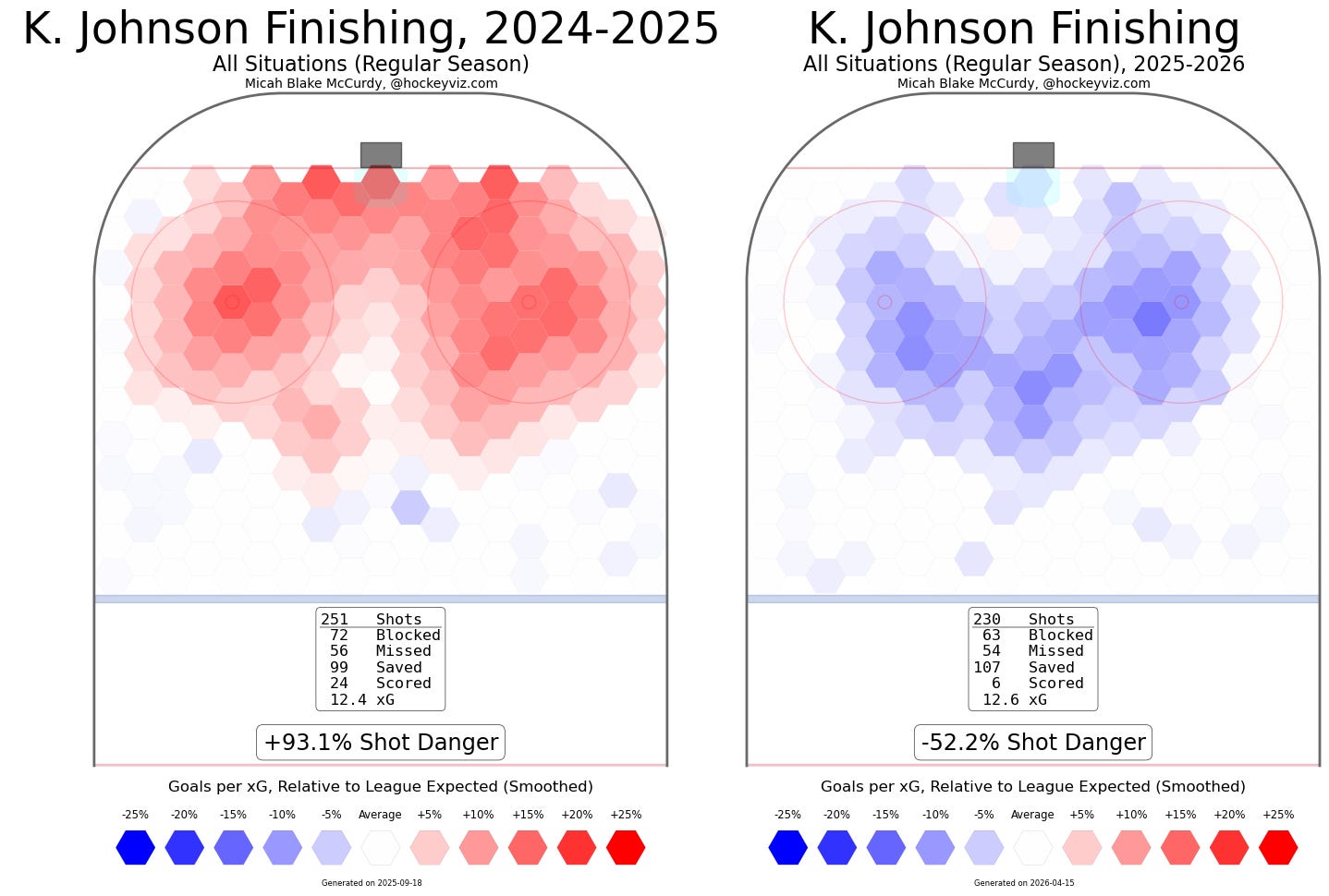
If you want a single answer as to why this season felt so dreadful and hopeless, there’s you answer right there. In all-situations, Kent Johnson had just about as many chances, or “cumulative chance danger” or however you’d like to qualitatively describe xG, as he did last season. Considering he played in 76 rather than 68 games, you might believe he performed slightly worse under the hood. You’d be wrong. Despite playing 8 more games, Johnson played 170 fewer minutes in all situations. A little nonsensical math later and we I can say that he would have had to play 89 games this year to reach his minute total from last season. A 21 game difference from that bizarre lens.
Kent Johnson had a couple of bursts of ice-time, namely when Bowness relied on his assistant coaches to tell him where players should be, but mostly saw incredibly little actual play-time. That has a big impact on a young player but we’ll get into that later.
Dean Evason loved Kent Johnson last season. He relied on him to carry some, frankly, poor linemates to decent results. He did not like Johnson this year. Bowness, somehow, seemed to like him less.
I don’t think it’s fair to place all of the blame at his deployment’s feet but it’s at least fair to recognize that limited minutes, especially with quality linemates, is going to make any sort of “game correction” more difficult.
Puck IQ Relative to Competition Performance Data
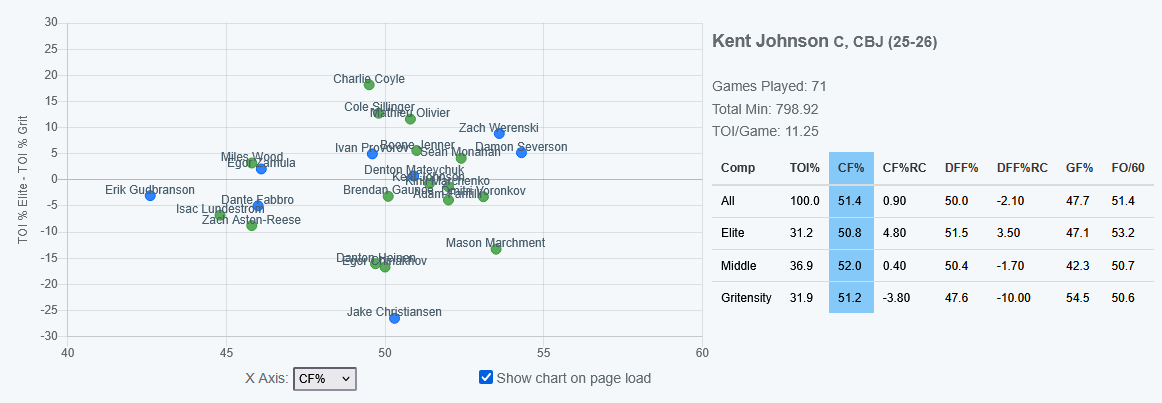
On the topic of deployment, I did want to point at an interesting observation. While I can’t quite say how total time-on-ice effects some of these numbers, I do want to point out that Kent Johnson wasn’t particularly sheltered this season. I assume that plenty of time with Boone Jenner and Sean Monahan likely influenced both coaches but it remains worth pointing out. Split out by different competition levels, Kent Johnson performed better against more difficult competition, especially relative to the team. He got scored on (or didn’t score) but the underlyings weren’t so bad. Considering the Zach Werenski of it all, and the general team dominance from an underlying xG share perspective, there’s perhaps enough reason to believe it wasn’t necessarily Kent Johnson related but that he didn’t explicitly lose is good too.
Puck IQ RelC - January 12 to End of Season
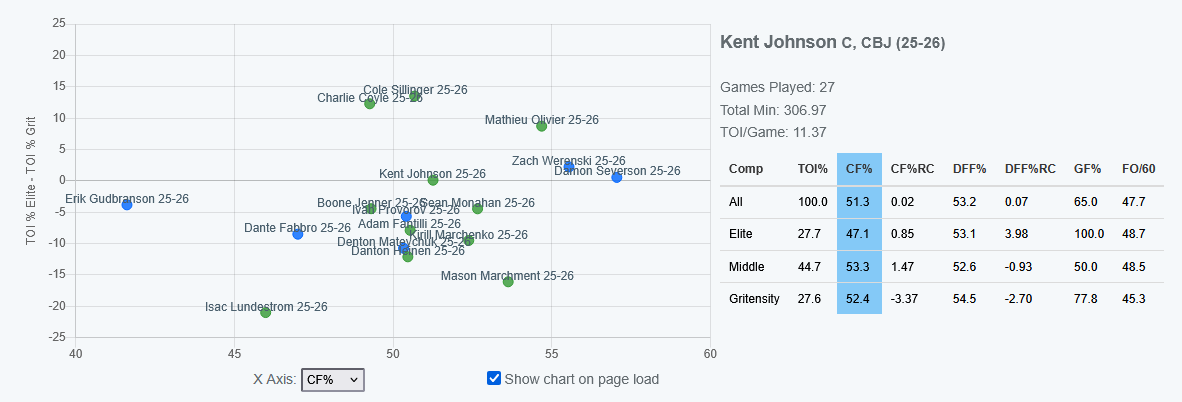
Under Rick Bowness exclusively, Kent Johnson was… less sheltered? And also wasn’t scored on? Seems suspicious considering the coach really had a hard time playing him. I don’t really know what to make of the competition impacts, perhaps there were teammates that made a bigger difference and perhaps the extremely limited time-on-ice makes up the rest of the difference.
PuckIQ 2024-25
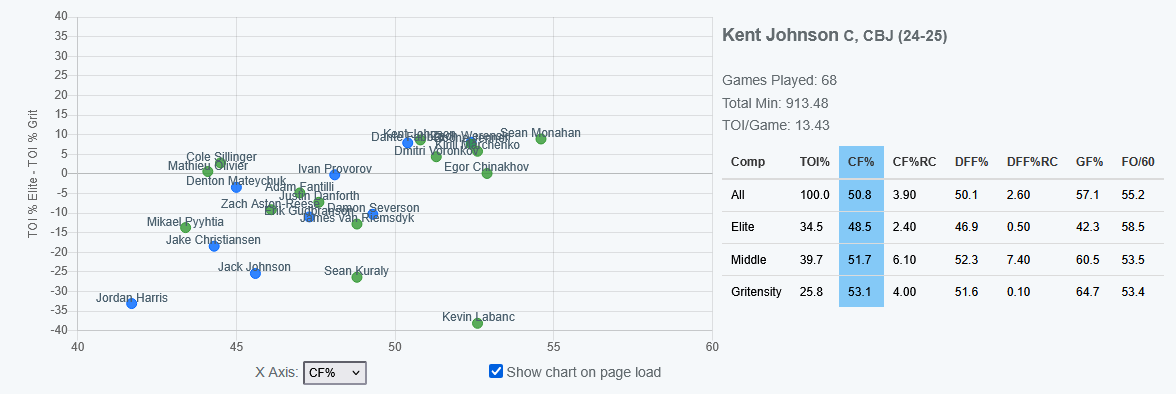
Compared to last season where Kent Johnson was in the small group of very high performers, and the only forward in that group that didn’t play as part of the Monahan-Marchenko domination complex, it still remains a step back.
In 2024-25, his most common teammates were James van Riemsdyk followed by Zach Werenski, followed by Fantilli, Fabbro and Sillinger. Johnson dominated in the late season minutes with Boone Jenner. In 2025-26, it was Monahan and Provorov, followed by Werenski, Jenner and Mateychuk. Kent Johnson was fantastic with Denton Mateychuk and late season Conor Garland but horrendous with Fabbro, Gudbranson and Christiansen. Perhaps Kent Johnson’s “niche” just makes more sense with the first group.
This will be a continued theme relative to Kent Johnson. I don’t really have good explanations for the aggregate results though there are some logical throughpoints via playstyle that we’ll see soon enough.
Skill Domain Breakdown
In order to better understand the ups-and-downs or perhaps skill-wise projection we’ll have to take a closer look at AllThreeZones and really the tape in its immense entirety.
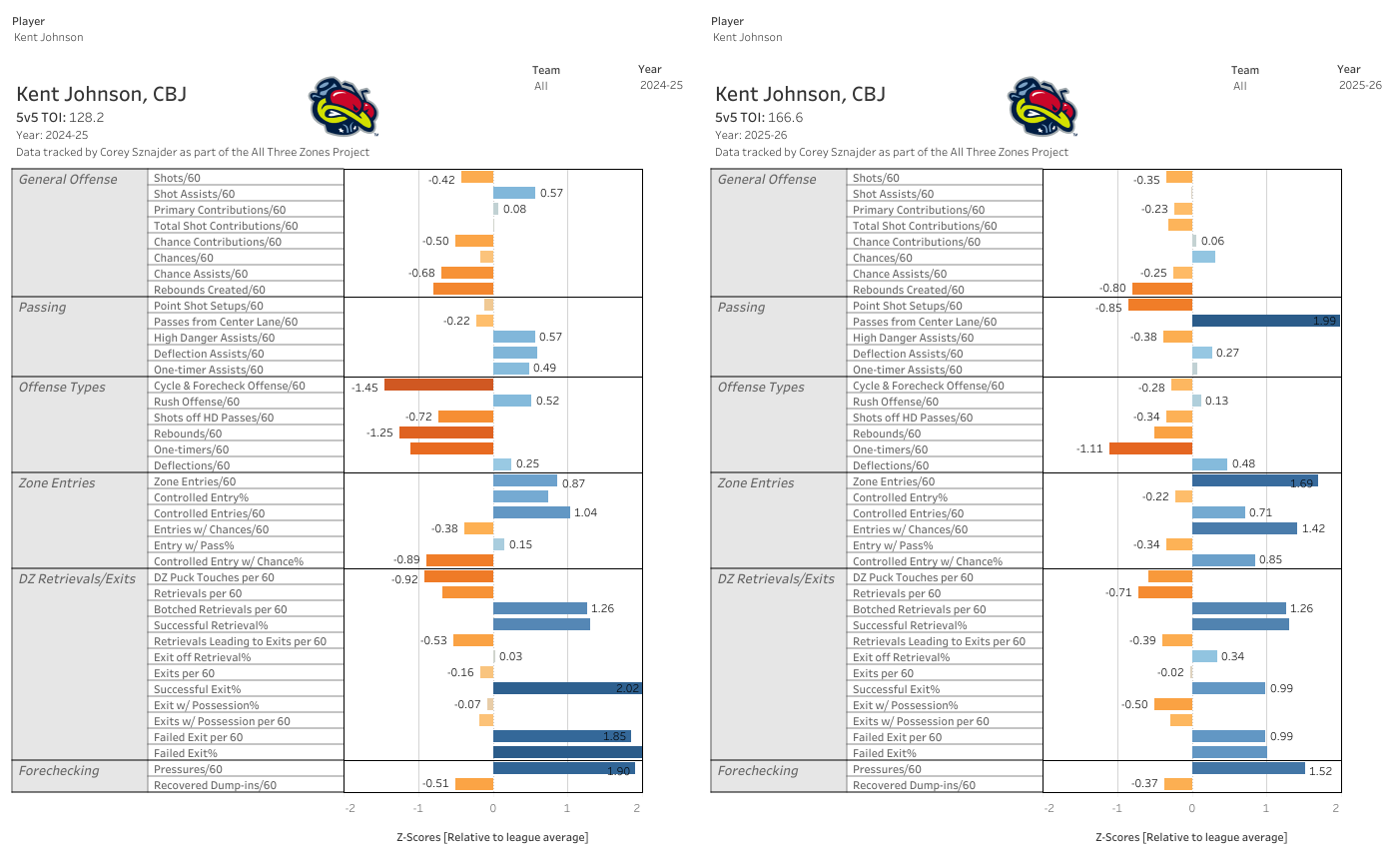
Compared to Kent Johnson’s last season, from an underlying microstat perspective, there’s really not that much altogether different. A couple of key changes highlight the moderate renovation in his game but the bigger one remains the lack of significant offensive contributions. While he did become more chance oriented, most of his passing metrics died. Given the nature of these hand-tracked stats, perhaps the only real difference is sample size.

The more interesting observations come by way of his transition involvement. I touched on this a bit already when it came to some of the season-wrap microstats but he was responsible for a high volume of entries.
His general exiting and efficiency stayed the same, or took slight hits all considered, but he mostly transversed the neutral zone and got the puck in. He was not precious about carrying it in specifically but did create more chances and passed the puck a ton from the middle lane.
Mostly, though, the aggregate looks quite a lot like the previous season. That’s part of what makes this all so confusing. Perhaps this was some genuinely rancid luck, or some collinearity trick from the models?
Generally, his approach this season indicates prioritizing safety rather than challenging players for the purpose of direct creation. The Blue Jackets wanted to lean into forechecking as a team identity this year and Johnson obliged.
Kent Johnson’s season can almost be split into parts with respect to his approach which perhaps also points to the change in coaching dynamics. Early in the year, he basically played center while in transition. The very early games with Coyle and Olivier that went even as far as the offensive zone where he basically never moved to the wall and constantly held the middle of the ice off-puck. They didn’t connect very well, no real fault of Johnson’s, and things continued to change.

Kent Johnson was shifted alongside Fantilli and Jenner and the line generally looked pretty good. Except they had a big problem: they got scored on a lot. It appears, if you take ice-time and role assignments from coaches seriously, that the staff believed Kent Johnson was the reason they got scored on so frequently. From my observations, that wasn’t really the case, especially considering Fantilli and Jenner continued to get scored on. From there, the season spiraled. There were brief glimpses of hope just after Bowness’ hiring and just after Garland was acquired but with every successive change, Bowness grew more frustrated.
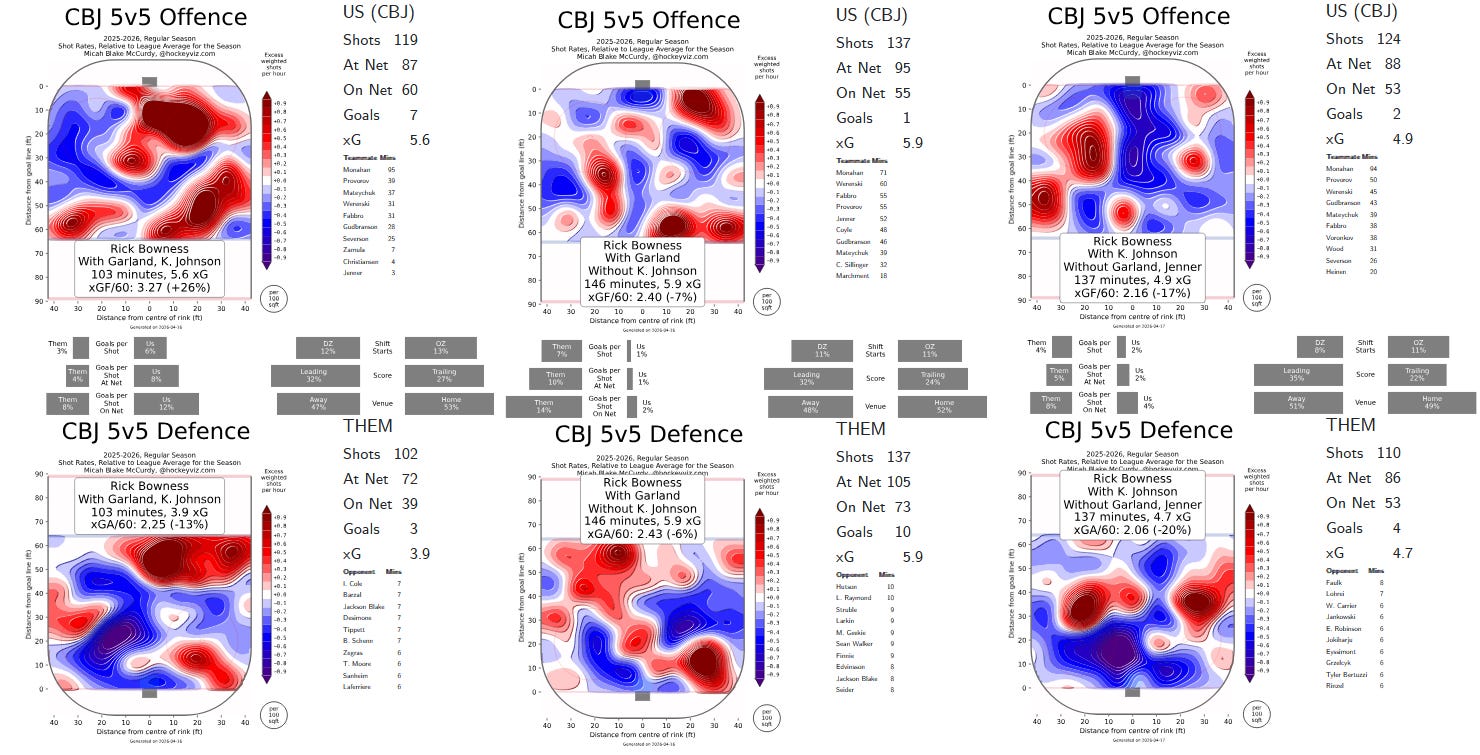
Alas, we were left with this piece of work. I digress for now, we’ll see more what exactly that all meant later.
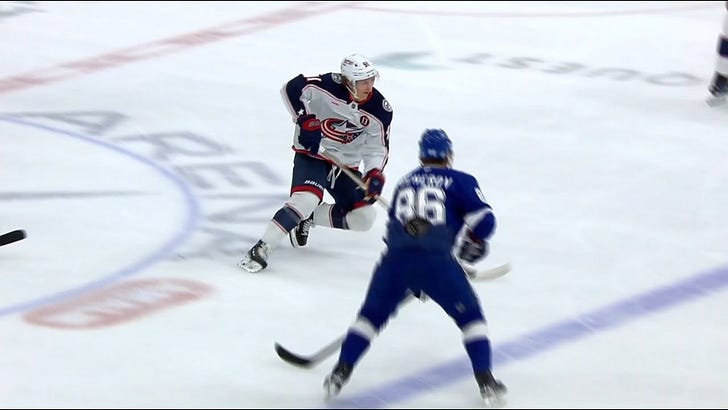
Kent Johnson’s identity as a player remains quite clear. If I were to distill it into a single phrase, it would be something like: perimeter play designed to open the middle. Essentially, as the breakdown above alludes to, he seeks to attract defensive attention (bodies) to the walls or toward himself so that he can make plays around it and then skate into the space created. Sometimes he plays or passes directly into the space, or creates space for others to move into, but mostly he attempts to set up some dominos that might pay off a few events later.
Generally, the base principles of Kent Johnson remained the same. There was certainly a lack of top level performance but also more expression of skill in different areas than we saw in plenty of the previous seasons.
Given that Kent Johnson has such specific patterns and approaches to his game, I figured it would make sense to offer the tape and then perhaps some commentary on how it’s different and how that might be impacting his overall contributions. Given how specific his gameplay is, and how generally successful it is, we should look for the answer on why he can do these things and still not come away with impact.
Transition
Defense to Offense
I think the best starting point for Kent Johnson has to be his work starting on the defensive side of the puck. Not to say specifically his defensive zone defense but how he manages the transition from defense-to-offense. Via the AllThreeZones data, we can see that while he’s not prolific he’s very efficient. He eliminates the “big mistakes” in puck moving that coaches just generally don’t tolerate.
This mixtape is a general mix of all of the areas that could be construed as defense to offense but really it’s just some of the earliest moments possible for transition. Sometimes there’s actual defense involved but many times it’s simply transition play to get out of the zone.
Kent Johnson is generally good at creating exits and shows a variety of ways to create from that position. While many of the above middle-exits come from holds into curling and regroup routes, he can bump pucks off the wall or send it crosslane if the option is there too.
He’s also diligent as the first forward back and has the capacity to quickly convert a defensive takeaway into transition going the other direction. I wonder if he could be more involved but that might require an actual and legitimate change to center rather than simply frequently fulfilling the puck-carrying duties.
Last season, Johnson was much better from a total transition prevention perspective (the first domino of the defense to offense transition) and I think that had a lot to do with some of the forecheck changes, and perhaps some of his battle-losses, but might also be explained by some significant time with Monahan and Jenner who aren’t quite as good as their veterancy suggests.
Johnson’s neutral zone tracking (backchecking) is generally good and especially so when it comes to preventing easy plays on forehands. His lack of physical dominance means he has to play smart, and he usually does, but it sometimes means he doesn’t have the outright snatching → counter arc that some of the top players in the league do.
The Blue Jackets’ system typically don’t encourage overly many forward touches low in the zone. They are there, especially when certain defensemen are on retrieval duties, but it’s not an emphasized aspect of their systemic transition. These early touches often start on the half-wall which brings a different dimension to the options and involvement.
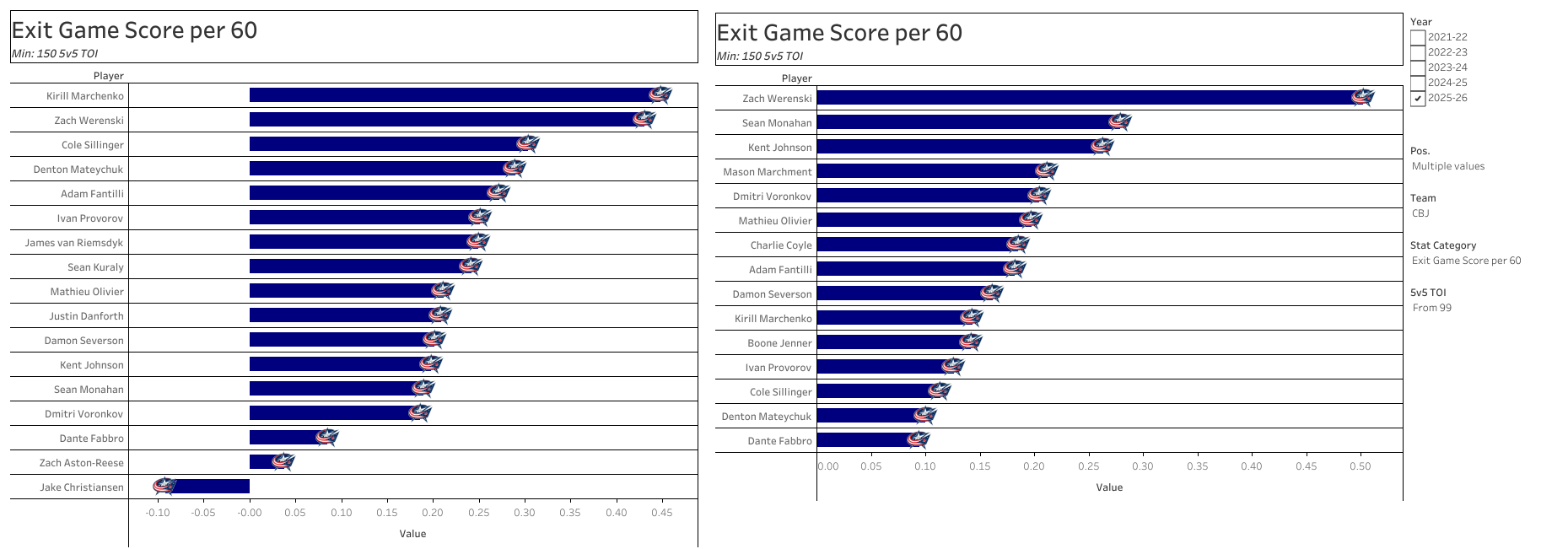
The same was true last season. The left side here is last season, right side this season. As we can see, Kent Johnson was a much better generator of exits, in regards to total score, this season. In fact, it looks like both he and Monahan had a much more significant role at getting pucks out in the first place. Notice, too, that James van Riemsdyk was good at this role specifically as well.
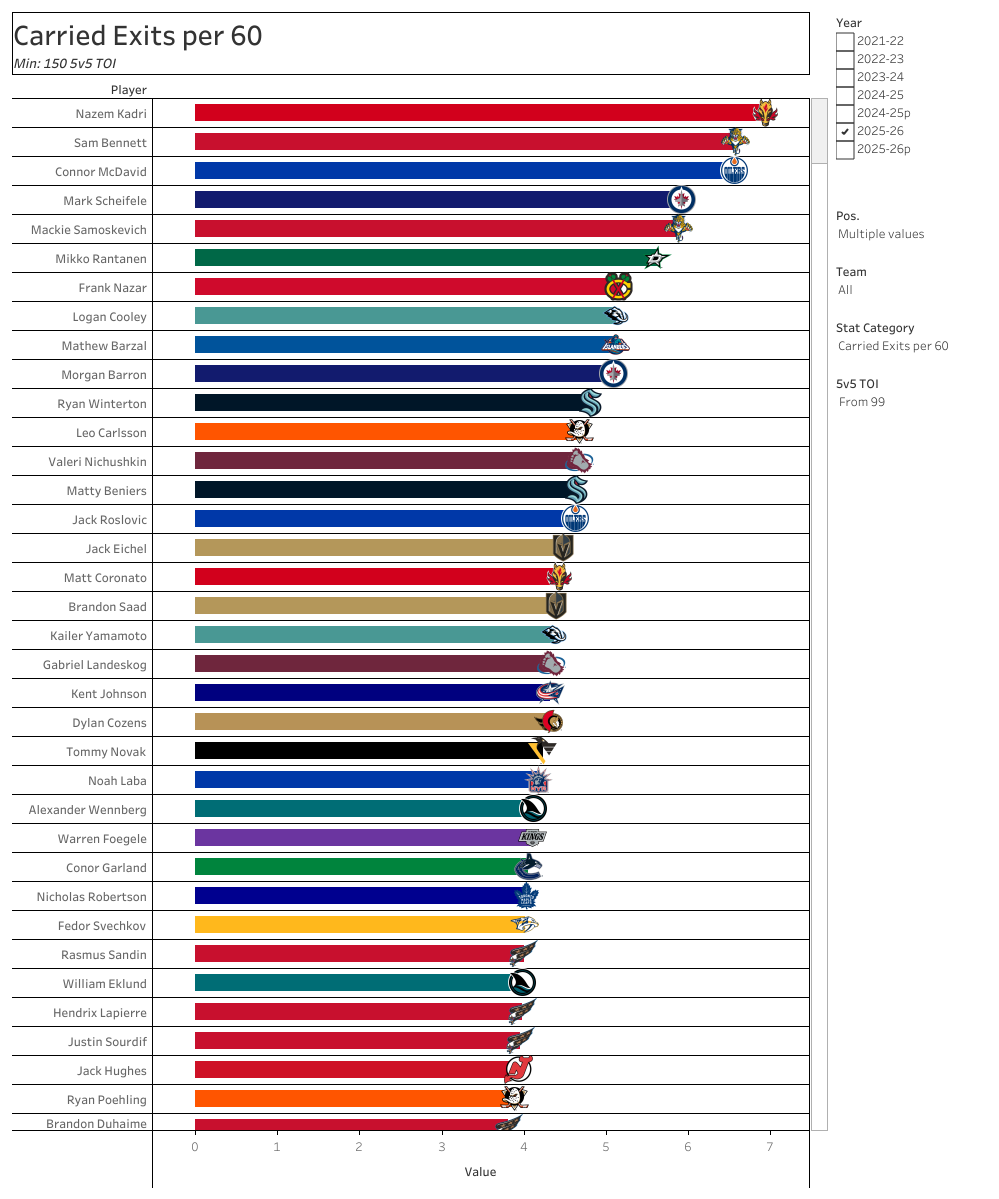
This year, Kent Johnson was genuinely one of the most voluminous exit puck carriers in the league. We generally prefer passed exits for reasons I think you can see above. The most successful carriers are all top skaters: Kadri, Bennett, McDavid, Scheifele, Nazar, Rantanen, Cooley, Carlsson, Beniers, Eichel. Johnson doesn’t have that level of threat.
Given the above tape, it’s not like he’s completely lacking in this dimension. He does default to regrouping and carrying and we’ll see the downstream consequences of that style in the next section.
Middle Lane Neutral Zone
Kent Johnson’s “default move” is to win the middle of the neutral zone. He does this frequently with some very interesting, nearly effortless, handling moves to beat the first player. On regroups, that’s usually a really fun lightning quick touch through the triangle. On defensive zone exits, he has a really cool “step over” underhandle where he gets his vision forward while organizing his feet. He’s a tremendously skilled player with advanced ideas.
The reason you might notice that very few of these situations lead to anything particularly dangerous is that he likes to slow the game down and regroup coupled with his not particularly threatening skating. What these mean is that very much often he’s playing the game in even number. These aren’t particularly threatening situations, especially against prepared NHL defenses but this is a sort of tradeoff.
If you want to know why Kent Johnson is a “defensive” player by most impact metrics, the trade of pace and direct attacking for security, and willingness to play for territory rather than outright attack probably explains most of it. The first clip, against Minnesota, is a completely fantastic example of him winning the middle, kicking wide, attacking behind the defense and then establishing zone time.
I wonder, personally, if Johnson needs to find better pass timing, harding skating or otherwise challenging the middle to draw more space so that he kicks it wide to a player with a little more space. In a sense, I think he can sometimes allow his wings to get stopped at the blue-line and doesn’t manage their speed quite well enough. We’ll see plenty of examples that demonstrate his ability to get them the pass early, so it might just be situational, but I do think it’s possible he’s still exploring how best to handle some of these situations and outcomes are more senstive because he isn’t a dominant skater.
I do think there are some linemate effects at play. Johnson is doing the transporting but generally passing wide to a stationary Sean Monahan or Boone Jenner or maybe even one of the fourth liners. Nothing explicitly wrong there except that Jenner and Monahan aren’t exactly skilled wings when it comes to entry tactics. Frankly, pretty much only Mason Marchment has effectively solved these more stationary attack positions.
As I see it Monahan is already a fantastic center whose skill revolves around support timing in the middle. While he can soak pressure and is a great playmaker, there are specific layer passes or off-wall wrinkles that he doesn’t show at the blue-line. I wonder if the nature of wing play is a little too specialized. At the same time, I think you saw plenty of Monahan return passes miss Johnson because he wasn’t quite bursting through the window as much as the pass anticipated.
There are situations where Johnson does find danger, though, and they pretty much all involve one of two things: Conor Garland or a Defenseman.
Garland’s slot attacks really complemented the space and attention that Johnson drew. I think it also works simply because he’s right handed. The same opportunities do not exist for a left-handed player, especially coming from the strong-side toward him, when Kent Johnson is on his off-wing. The shooting and pass reception angles are just entirely different.
Similarly, when a defenseman joined as the trailer there were just more options in appropriate space. Kent Johnson created space in the middle with his post-pass drives just not usually enough behind the defense (as in getting a return pass or really threatening a defender). That means that if a defender was joining from behind, especially if they also find a semi-middle lane or had built speed, Johnson’s somewhat-slow creation really built the opportunity for them.
I think the third clip (Buffalo) really demonstrates this principle well. Notice the reception footwork to prepare his vision. In the neutral zone, he crosses with Fantilli into the middle, passes it wide and then literally drags the defender out of the slot where Mateychuk arrives. It wasn’t a direct attacking creation, and I wonder if he could have attacked Zach Benson in the middle to improve the sequence a bit more, but this is clearly a player who intentionally deforms defenses for the benefit of the whole.
I don’t want to spend too much time here but we can say there are plenty of factors that could help bump up direct danger from these situations. Some of the friction comes from Kent Johnson really owning center duties while mostly playing with an actual center who doesn’t necessarily have wing specific skills. Marchment would have been awesome to see but a right handed wing who can read off blue-line passing plays could help greatly too. If Johnson manipulated his pass timing to attack more directly, or chained his skating with handling/passing a bit more (his backhand really does come off quick), or even the team found more creative post-entry routes (like driving in front of the wing so they can attack middle) perhaps they can eke out some more chances too.
Quick Link
The other fast option is to simply already be in the neutral zone and to make quick plays into space. Johnson is great, perhaps better, here as well.
Early Dean Evason systems really encouraged this and Kent Johnson was honestly great at it. He attacked up off puck quickly and really exploited the layers that early movement created. As an advanced neutral zone player, you might say wing, he really pulled defenses and passed through the defense into the middle.
Similarly, he was really eager to surf the defensive zone blue-line and find quick links with activating defensemen. These aren’t really major plays but yet another thread in the tapestry of “dragging defenses and passing into space” and one that might be really interesting if he’s to find more time with Zach Werenski, Denton Mateychuk or even Damon Severson.
Entry Delay
Given the relative even-numberedness of many of his attacks, Kent Johnson is a prolific user of the “delay” plays just after entry. He has a variety of ideas from this situation and frequently does it on both sides of the ice. This is, perhaps, the biggest example of his ideas around dragging and drawing pressure and passing through it.
The more interesting is when he’s on his off-wing. I think you can really see his skating, deception and manipulation shine and his quick-touch backhand really works well. His footwork and stickhandling skill is simply stunning.
He also has a somewhat default idea here and I wonder if it could be improved. When he can’t find a direct passing lane, he really moves in a way to attract attention and then rims the puck low to a retriever with speed. The first clip is a perfect example. The idea is present and it certainly works but he leans on it often and it doesn’t really improve the conditions that much. In the end, Kent Johnson teammates have to peel pucks off the wall a little too often.
This isn’t an idea without merit as I’m sure you can see in some of the clips. The idea is to get players, and defenders, moving down with them which helps open the slot to quick off wall plays with defenders in motion instead of planted in the slot. It is perimeter play designed to open the middle, though that access is a pass or move or two down the line instead of being direct.
These specific delay plays, or at least the idea of playing through delay, is designed to create speed differential and open the slot. You’ll see players like Kucherov and Eichel do this frequently. In Tampa’s first round loss against the Canadiens, you did see Kucherov turn over the puck frequently in trying to find delay passes against a fully committed backcheck. Perhaps it’s not a crutch to be leaned on overmuch in that environment or perhaps some simple movement-based tweaks can ameliorate over-reliance on it.
Creative Ideas Post-Entry
Kent Johnson is also capable of acting creatively without the use of overwrought patterns at the same time. I hope this whole “set” or sequence really illustrates that he is an adaptable player that doesn’t necessarily lean on patterns.
He’s at his best when he finds quick options and builds passing plays just after entry. That requires available players to be passed to, of course, which is a double-edged sword. He’ll need to play with players who read space the same way but that also means he’s sensitive to conditions at the same time. The best players, especially wings, find ways to buy time for their teammates to get into the right positions. Johnson’s board skating and edgework is certainly slippery, so the elements are there, but he’s perhaps a bit too easy to push off the puck.
Generally, and this is visible in the third clip against Minnesota, I’d love to see him bounce off the walls near the blue-line and surf across the zone a bit more. This sort of movement really opens up passing lanes through layers and I think that would fit Johnson’s skillset quite well. It’s not an “everytime” situation, and requires getting pucks near the walls rather than full-carrying, but it’s a very powerful tactic.
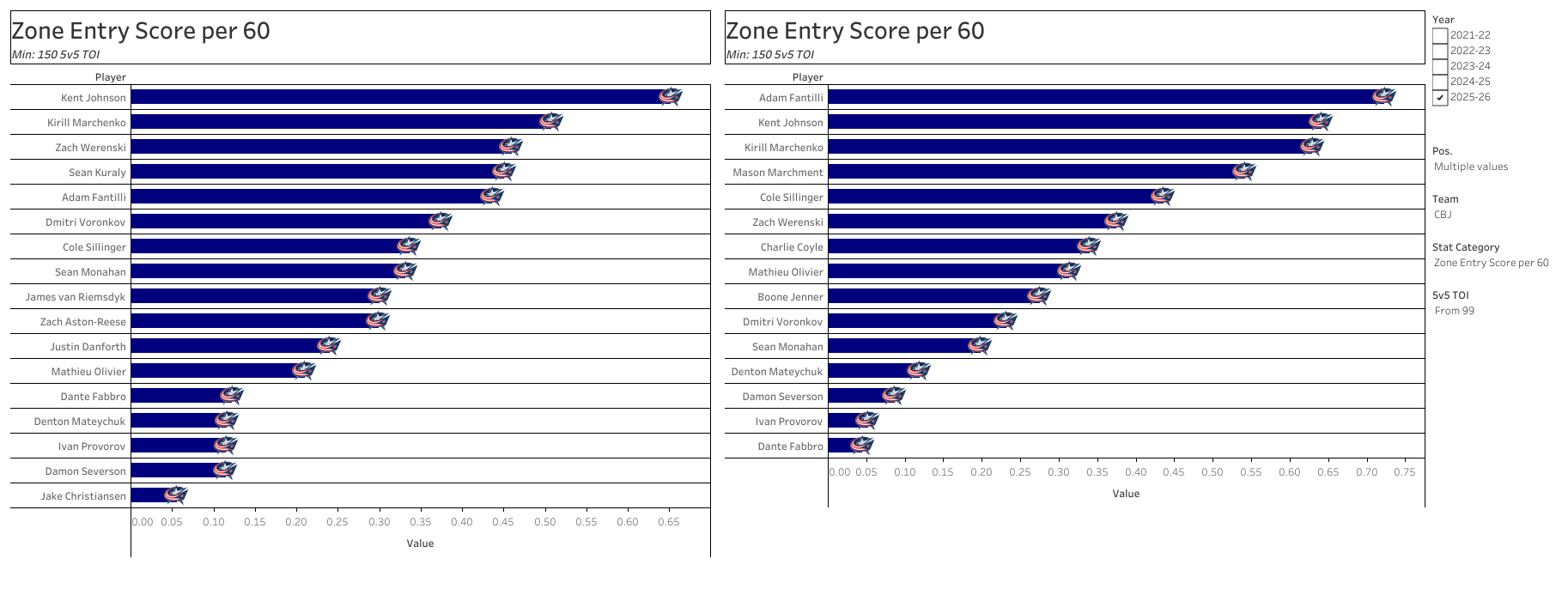
Supposing that AllThreeZones data is an adequate sample and not simply selected too many of the good games, we can see that I might just be splitting hairs here. Kent Johnson, year over year, created the same total “Entry Score” both seasons. Last year, he was clearly the best controlled creator. This year, though his raw numbers did not change, he slid down to second best as others got better.
Offensive Zone Improvement
An absolutely vital and completely critical area of improvement for Kent Johnson was his capacity to generate shooting opportunities out of in-zone situations. I am happy to say that there is definite and legitimate improvement on that front. Unfortunately, it doesn’t look like it’s all the way there yet.
Many of the above AllThreeZones metrics focus mostly on individual shooting contributions relative to the “offense situation” metrics. If you take a look at his AllThreeZones card, though, you will notice an increase in his “cycle and forecheck” offensive contributions. It went from “unplayable” to “below average” and at significant cost to his rush offense, at least so it seems.
There might be something to be said about the entire team bending in this direction but I’m at least still happy to report that we saw some evidence of improvement in a critical area.
Halfwall
The biggest area for opportunity from last season was the in-zone half-wall. He had a tendency to sort of freeze and stymie the play where his battle-losing really snuffed out many opportunities before they could even get started. As the season progressed, he found some better ways to create and we’ll see some of those here as well.
All of the same principles of his transition offense are at play from this specific area: draw players, move the puck, attack the space. What improved this year was his capacity to stay in motion and to attack back down the wall.
Last season, he received pucks and when he couldn’t find a play drifted up toward the blue-line. From there, he had a specific decision-tree: throw the puck at the net, rim it low or hand-off to a defensemen.
Each of these worked very well inside the Blue Jackets’ below-dots scheme and especially with James van Riemsdyk who is something of an expert at peeling pucks off the back wall and getting to the slot. He would change side behind the net and either direct the puck for a rebound or pass to a player slashing into the slot. Similarly, Johnson’s drift up into pucks-at-net really played to both his and Jenner’s strengths there. This upward motion, though it didn’t feel particularly good, really did draw players away from the slot.
When it comes to defensemen, the general idea played here very well. Notice just how many times Kent Johnson dragged a player up the wall, handed the puck to Werenski or Severson and they found open sticks in the slot. It set up the Philadelphia goal.
Similarly, the Dallas and Ottawa goals come from the “draw space” principles as well. He stays at the half-wall (fumbles the puck) to attract two teammates, quickly rims the puck to the corner to an open player (both times Boone Jenner) who then finds a dot-pass that is scored for a goal. In a Montreal clip he did the same but also beat his check to the slot at the same time.
The ideas are certainly there. Last season, they were there too but too often he had to wait for a player to surf into the nearby passing lane and usually was just eliminated from the play. His increased movement, and especially the cutbacks down the wall, helped him serve his role just that much better and helped him buy time when players weren’t reading the off-wall rotation or weren’t in a position to help just as much.
Backwall and Slot Driving
Under Rick Bowness, perhaps as the result of being assigned “wing” status more often, Johnson got much more heavily involved in playes below the goal-line. He’ll never be confused for a power forward in this location, certainly no Dmitri Voronkov, but he showed marked improvement in his ability to time battles, win pucks, escape checks and complete good passes.
Still, it feels like there’s plenty of room for improvement. These small spaces are extremely high leverage and even inch-wise improvements in pass accuracy can pay massive dividends. Especially in some of his handling-slot-driving sequences, I think he loses a little bit of his critical vision and gets stuck on that idea. Opening his mind to slip passing plays inside these moves, like in one of the early sequences against Dallas, could be the difference between ineffective pad-stuffs and high danger setups.
Late in the season, this slot passing reached it’s fever pitch. His ability to pivot off of contact lead to a couple of sequences with extremely high danger passes into the slot including many ending on the sticks of Boone Jenner and Sean Monahan including the single sequence against Florida where he found each of them in succession.
As much as the coaching staff has continually placed emphasis on Kent Johnson’s need to gain weight and win battles, it’s clear that he’s got enough handling ability to win these engagements if he keeps motion. I don’t think more weight would hurt necessarily but I don’t think we’re going to see a point where he’s an above-average “battler” by any measure.
The framework for more improvement is there but the road forward isn’t necessarily an easy one. If we’re going to pull anything out of this wall-play, it might be that Johnson need a player who has a similar mindset when it comes to building these plays. Given his propensity for rimming the puck, someone who can peel pucks easily off the back wall and has a mind to get pucks into the slot might be the best. Monahan can be that, though we’ll see if his finishing returns. Otherwise, that sounds a lot like Fantilli’s year-over-year improvement dimension and an already strong suit of Dmitri Voronkov at the same time. Conor Garland, for what it’s worth, might also be a match in terms of playing a more movement oriented approach rather than a stangant net-front and heavy cycle game.
Forecheck
In the data, there weren’t any real measurable improvements to Kent Johnson’s forechecking but it’s also one of the most difficult aspects to measure through direct tracking statistics. Generally, I think he’s quite dilligent with a strong desire to get his job done and especially to surf on top of the formation and hold space well. I think it’s possible that this season, as F3, it’s very possible that he got in battles more often, lost them and then that eroded some of his ability to stop transition in the neutral zone.
In any case, as the team leaned more into forechecking and attacking just after these turnovers, Kent Johnson also grew in this capacity.
In these post-turnover opportunities I think we get to see some of the best pure playmaking from Kent Johnson. I suppose that’s natural, in some way, because there’s often quite a lot of time and space available. Still, there seems to be something unique about his understanding of teammates’ locations and how quickly he can move to access the passing lanes to get the puck to them.
In previous seasons, and even some of the above backwall passes, it’s really his awareness of open players that you wouldn’t expect a player to find that are the result of his best plays.
There’s an interesting wrinkle there where sometimes it feels like Johnson doesn’t have the same through-defense vision that some of the elite playmakers do. I think we’ve seen some of that already with his play-selection and what feels like tunnel vision inside his slot drives and I think we’ll see that in some of the following chance clips as well. He doesn’t always make the right plays or find the “highest danger” option of a given situation when in possession of the puck but he does have an uncanny ability to exploit players that are otherwise lost to everyone else on the ice. It just so happens than many of these times are just after turnovers.
Shooting Chances
I think with the finished data above, you can probably already tell what some of these clips are going to look like. Johnson’s finishing was abysmal and that doesn’t even capture the posts he hit as they’re technically not shots on goal.
In any case, Kent Johnson was entirely snakebit and a literal repeat of this season probably ends with plenty more goals than he actually scored.
In order to actually get those goals, he’ll simply have to decide and act more quickly. He had an outrageous amount of his rush chances, especially those in the middle distance, blocked because of a slow or indecisive release.
His post-chance from the Garland around-net setup demonstrates a really fantastic skill, to adjust to preserve shooting space, that should pay significant dividends if he continues to find himself in that situation. Early in the season, the Blue Jackets in general ran a little too close to the goaltender at moments. That specific footwork, the ability to massage a foot or so of space to improve the passing window, will be the difference between high xG totals and actual goals.
Wasted Opportunities
In a similar vein, Kent Johnson had a quite frustrating number of very high threat slot opportunities that never ended in a shot attempt. Pucks rolling off his stick, falling over or just passing up the opportunity. These reduced in number as the season wore on but they’re really just not things you can let happen to this degree. His preparation to act just needs to be better. In some cases, we can probably chalk this up to some sort of “luck” or maybe part of the “snakebite” but hopefully we don’t see this sort of thing again.
Special Teams
Kent Johnson lost his powerplay spot this season after a year where it looked like he was finally growing into a true PP1 quarterback. While I think it’s clear that he wasn’t quite as dialed in to start the season as he was the last, the Blue Jackets sorely missed his capacity to create entries.

Last year, the Blue Jackets had one of the most interesting entry units in the NHL. Werenski, Johnson and Marchenko were near unstoppable at gaining the zone and getting into formation. While it was indeed Zach Werenski driving a good portion of the variability that ultimately promoted success, Johnson’s sublime handling created a lower-pace threat that completely subverted what entry-kill units were prepared to stop.
His post-entry curl drop pass to the defender is something that I haven’t really seen any other player use and it’s a brilliant exploitation of the situation in front of (behind) him. It didnt’ disappear this season either.
As the season wore on, Johnson’s role ultimately went to Adam Fantilli, both in terms of entry carrying and in-zone play controlling. What’s not clear is the path forward for these two youngsters. Fantilli took a much more dominant in-zone driving approach which leaves only Marchenko, Coyle and Marchment as options for Kent Johnson to take. If Marchment leaves, perhaps problem solved, but coaches really like when more “battle oriented” players in those more fluid and interior positions.
If we’re being ruthless, it’s not like Fantilli’s puck-dominant approach made for a fantastic powerplay. Through the year, it was still a mediocre-at-best unit. But he’s the 1C, young, projects to be a big goalscorer and has much more physicality. Ultimately, it’s easy to see him sliding to Marchment’s spot as well though neither he nor Johnson really possess the spatial playmaking that he shows in flashes either.
On the same respect, you might notice I included basically the only shorthanded shift that Fantilli and Kent Johnson got this season. They created a brilliant shorthanded chance but were scored on in the aftermath. While neither are really stellar defensive players at this point, the penalty kill unit remained terrible. Perhaps both players take it upon themselves to step up into this role and impress the new assistant coahces in some way.
Defense
I dont know that I saw a lot of direct criticism levied directly at Kent Johnson’s defensive acumen. Usually, it was “doesn’t win enough battles” which isn’t an exactly a false observation. Still, I think it’s wise for us to examine this aspect. Generally, I think we can interpret his lack of sheltering as advocacy enough but peering further doesn’t hurt.
Generally, I found Johnson to be an adequate defensive presence. There are times I think he’s excellent, when defending high coverage as an attempt to create a turnover, and there are some specific cases where I thought he got overeager and overestimated his ability to make a difference and times when he got a little overly puck focused and lost his check (though I think this is literally the entire team save Coyle and Werenski these days). Some of these situations exposed the Blue Jackets to direct danger.
The most direct examples come from his reads to overload puck carriers after “trigger points”. On certain cutbacks, Blue Jackets forwards have permission to break from formation to win a puck and create an exit. Johnson abandoned his middle-ice weakside responsibility to jump into these opportunites but was often late, or slow, and it allowed good scoring chances.
Otherwise, there are plenty of examples of plus coverage from him. He covers options early, is disciplined in the “collapsed” coverage when the puck is low and is an eager communicator. Late in the season he can often be found instructing some of his fourth line teammates where to be in the zone.
Goals Against
The biggest reason for negative impact, and the first event in the negative spiral of line deployments, was a poor tendency to cede goals against.
I have collected a smattering of these goals against. While I have no desire to absolve Johnson of all-blame, so many of these goals had extremely little opportunity for interaction. Especially on very many of the Jenner-Fantilli-Johnson line goals against, Johnson did nothing wrong and was the least involved and still he was the player who ultimately had his role stripped. Fantilli’s backchecking, Jenner’s puck management, many of these things didn’t seem to get the same scrutiny as Johnson’s puck battle losing. In a few of these cases, though I’m sure this is true for many players that I’m not aware of, Johnson literally hopped on the ice and instantly ate a minus while still in the neutral zone.
In any given on-ice situation, there are five other players on the ice. We don’t have a great way of divvying blame, especially considering one of the others is a goaltender, so it’s reasonable to assume “20% blame”. Perhaps Johnson still lives up to that number adequately but really it seems more accurate to say that these goals against were perilously unlucky.

Johnson had the fifth worst RAPM goals against impact on the team. You did not see coaches criticizing or stripping much ice-time from the players in front of him. I suppose you did from Wood and Garland late.
From both the offensive and defensive perspective, the actual goals went against Kent Johnson. While we also have other data that confirms that he wasn’t exactly a plus in either of those categories, it’s easy to assume that this is a nadir that will not be repeated.
Isolated Impact and Cohort Comparison
Isolated Growth Curves
Some of the earliest work I ever did was utilizing Evolving-Hockey’s RAPM Model to demonstrate Kent Johnson’s impact and year-over-year growth despite continued disparagement from the coaching staff.
The biggest picture remains Corsi which is, generally, a fantastic method for sussing out which players control the game and “drive play” at the fundamental level. Generally, the top players at driving corsi differential are often among the top game controllers by reputation as well. It has the added benefit of being the most voluminous metric, meaning a single on-ice corsi event happens the most frequently, which means it helps peel away some of the sample issues.
From the corsi-driving perspective, Kent Johnson had a down year. He was still technically positive relative to league average and did post the second best season of his career. At the top-level, this is the only metric we can really say this for.
Notice that I have returned the interactive DataWrapper plots, so feel free to explore plenty of the other players to see some of the volatility inherent to each of these metrics. Plenty of these top-wing cohort players have down years around this time, though few are quite so bad as this one.
When we compare him to Kirill Marchenko, we can perhaps see that his young age still affords him plenty of time to turn it around. His play-driving last season was tremendous but plenty of that owed to playing with quite poor teammates and carrying them to (situationally) great results without winning necessarily (he had a 49.4 xGF%, 48.31 SCF%, 50.77 CF% and a 57.14 GF% last season.
Expected Goal impact has pretty much always been the weakpoint for Johnson and this past year wasn’t really that different. Though it’s probably his worst, at least relative to Marchenko, there are actually a few now-elite players who had worse D+5 seasons.
As much as we can point to luck in the cases of actual goals, it’s clear that the underlyings dropped as well.
As a young player, Kent Johnson always seemed to have a knack to tilt the goal differential in his direction. He maintained that standing until this past season when it completely plummeted. I think I addressed the dual-factors contributing to this decline above but it’s worth mentioning that it’s certainly not good.
The good news, at least for him, is that this struggle too was not uncommon. Jake Guentzel, Martin Necas, Mikko Rantanen and Mitch Marner all suffered similar actual goal impact drops. They didn’t necessarily lose their roles at the same time, save for Necas, but most of them played alongside elite centremen at the same time too. Jordan Kyrou, Sam Reinhart, Kevin Fiala, Andrei Svechnikov and Brandon Hagel all had worse at some point in their careers. Nonetheless, this is not somewhere you want to be competing.
The general volatility of single-season RAPM Goalst Impact is perhaps why it’s not taken as absolute gospel and perhaps offers evidence that Kent Johnson might just be alright.
If you look at Johnson’s point production perhaps some of the struggles and issues with goal differential are explained easily enough.
One of the bigger reasons for the reduced minutes was his demotion from the first powerplay unit and the further reduction in minutes that came by Bowness’ “allowing” of the first unit to get pretty much all ice-time available (and also briefly removing him from the powerplay entirely for some reason).
New Cohort, sG and Microstat Comparisons
I created a “new” cohort to include some different “feeling” players, aligned with some of Johnson’s trajectory and AllThreeZones skills. If we doubt Kent Johnson, it does not make sense to compare him exclusively with “franchise wings” and if he likes to play “center” so often, perhaps there are others that make sense too.
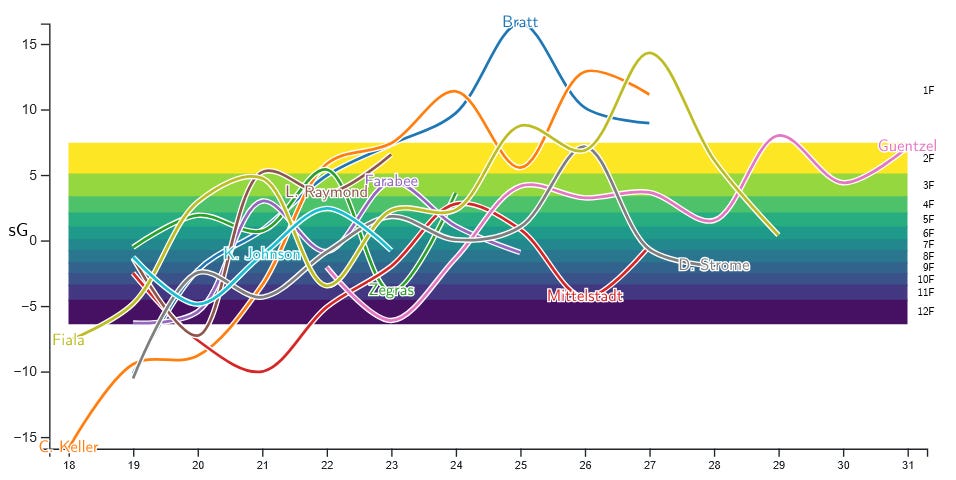
This season was obviously bad for Kent Johnson who couldn’t follow-up a gigantic breakout with more underlying improvement. That, at least in part, looks like it might remove him from some of the Raymond, Bratt, and Keller trajectory that we all certainly hoped he’d be on. Jake Guentzel provides encouragement in longer development timelines.
Otherwise, Joel Farabee, Casey Mittelstadt and Dylan Strome might offer a glimpse into the “never quite escape” middle six possibilities and those three, along with Trevor Zegras and Kevin Fiala, all changed teams shortly after their larger “dip” seasons.
Considering the position of the Blue Jackets, desire for a “culture change” and need to win absolutely right now, the org might just have similar feelings to those that ultimately moved from those players.
Casey Mittelstadt and Martin Necas, though he’s no longer included in this cohort partly because of skating speed, were both held until they had positive seasons and were eventually traded for positive contributors for their teams this season. Maybe Waddell has learned that particular lesson too.
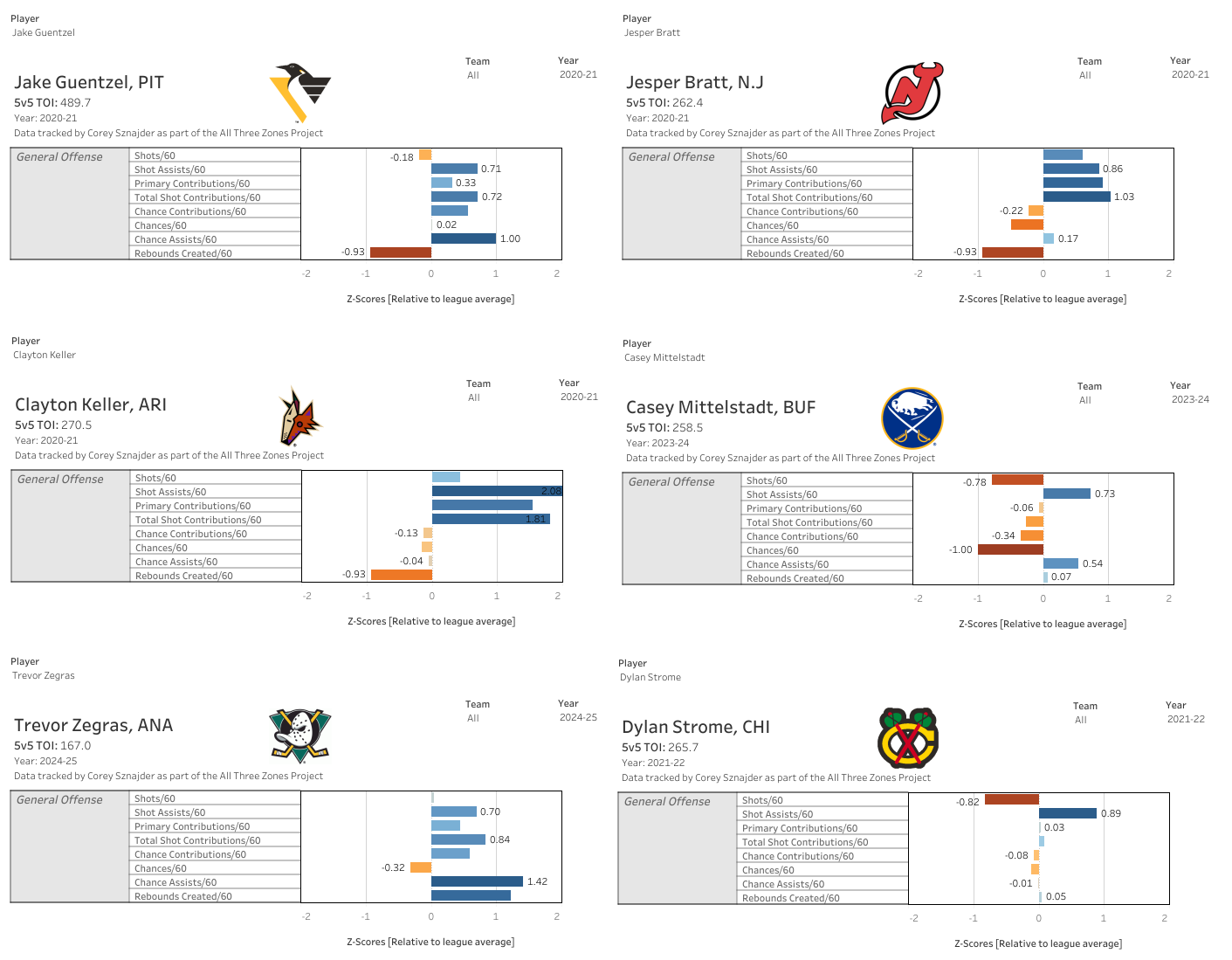
The biggest “concern” with Kent Johnson were, or are, his final touch offensive contributions. While we can perhaps write off some of it is a preference for creating lower event, yet more controlled, offensive environments it’s not clear that this is a style that has been otherwise matched by some of these contemporaries. The best players from this smaller group frequently found volume of final touch contributions over all else.
The above selection is a smattering of season through their careers, mostly skewing towards developmental seasons. Johnson compares most closely with Strome and Mittelstadt. If we were to look at them now, especially the best in Keller, Guentzel and Bratt, we would see much larger and all encompassing blue bars in the offensive category.
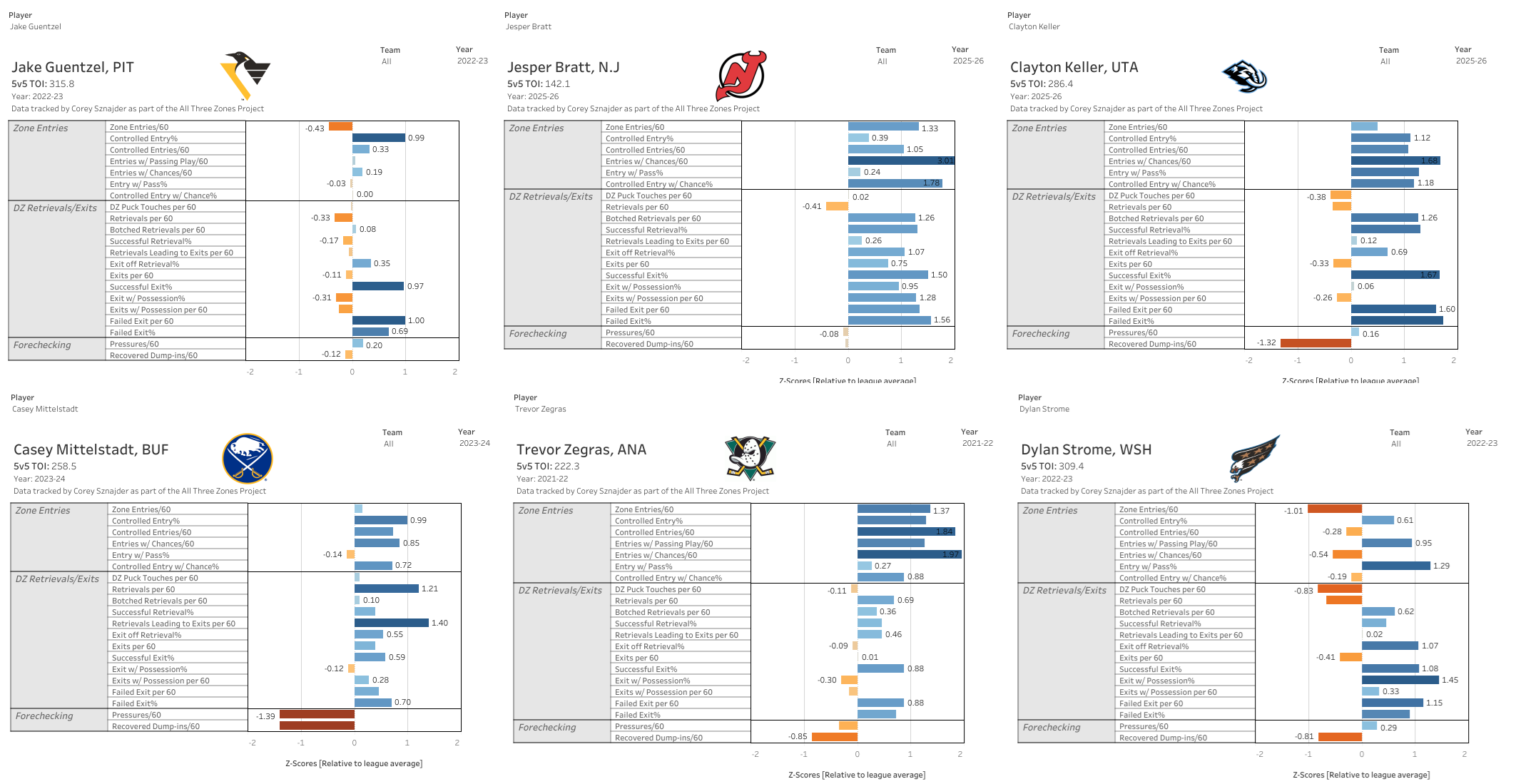
Likewise, I have taken a new collection of data from more recent seasons to compare their transition profiles. Johnson’s demonstration of defensive zone transition efficiency over volume isn’t exactly a common match. Clayton Keller, perhaps, is the only direct comparison. When asked, he’s fantastic at generating exits but mostly leaves that burden to Nick Schmaltz.
On the flip side, though, he (and most of the rest of this group) prioritizes controlled entries over volume at the same time. Kent Johnson, as we know, was somewhat the opposite this year. Generally, he was adept at creating opportunistic chances when available but was eager to ultimate cede control and put the puck in forecheck situations. That’s something else to consider: Kent Johnson’s forechecking data is far superior to any of these players.
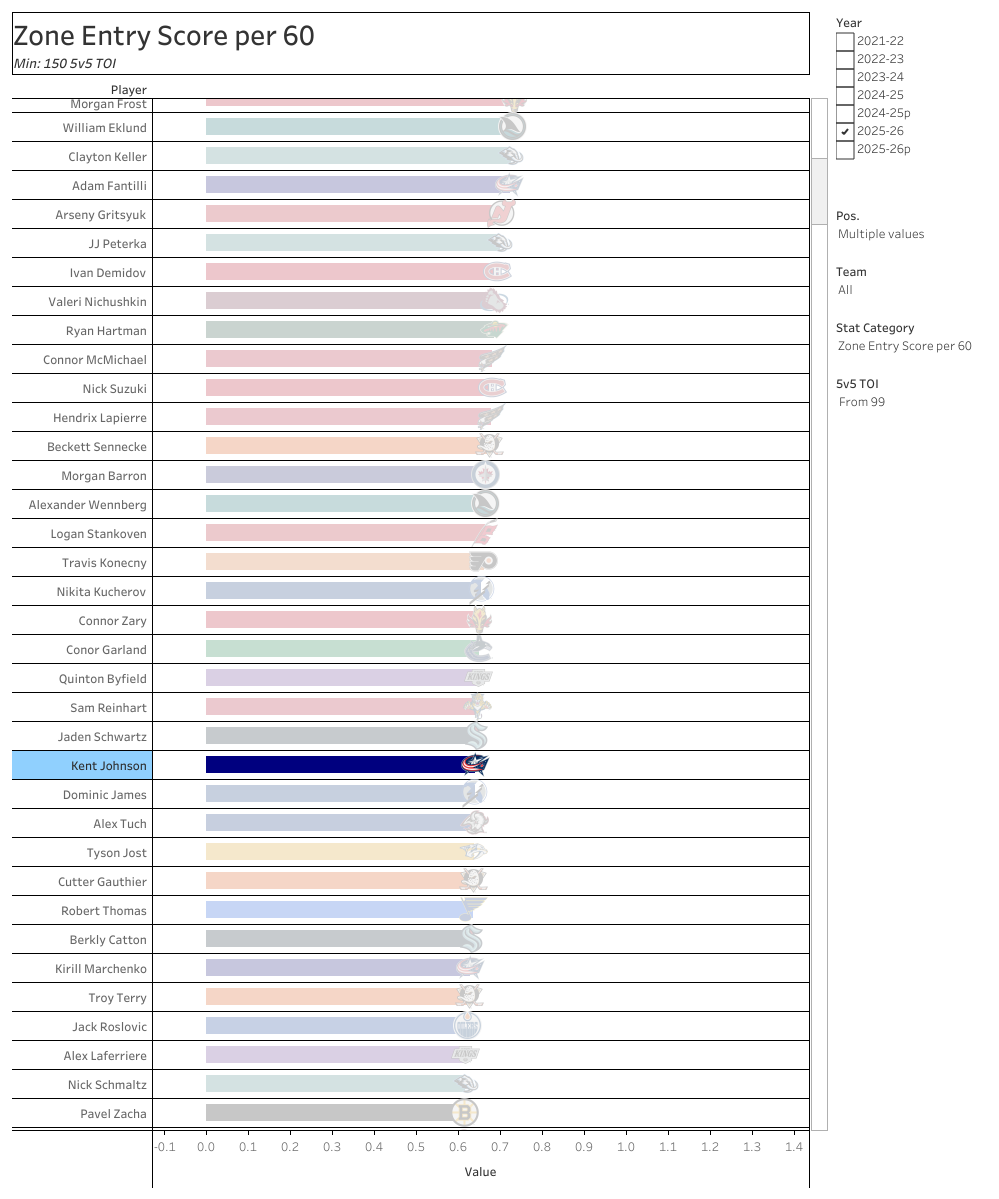
The bigger picture places Kent Johnson as a still fantastic (though certainly not elite) creator of entry offense. Clayton Keller remains at the top of the viz, alongside Adam Fantilli, but Johnson is near plenty of positive (albeit most complementary) players in this regard like Stankoven, Kucherov, Konecny, Garland, Terry, Marchenko, Thomas and Alex Laferriere.
If we take the gestalt of all of the above data, including the similarities in HockeyViz’s single season sG breakdowns, Kent Johnson probably compares the most with Casey Mittelstadt at a similar age. He’s the only player of the above cohort that grades out as a positive “defensive” contributor like Johnson does. I imagine for many that comes as a shock, and maybe it should, but there are plenty of similarities. Both are conventionally undersized, creative skaters and passers and played down the lineup up frustrating mushy-middle or otherwise poor teams.
Future Considerations
While Kent Johnson’s season, on the aggregate, was quite poor there’s plenty of evidence to believe that it really shouldn’t be this bad ever again. He was tremendously unlucky in far too many ways.
Similarly, he might have ceded some agency in on-ice impact by way of playstyle. Whether it’s coaching or personal preference, Kent Johnson placed emphasis on slowing the play down and carrying the puck. His conservative puck management meant he didn’t expose the team to too much direct danger but it sometimes meant the “conditions of play” were eroded without too much benefit. In this case, next season could be better if he was allowed, or encouraged, to play directly for offense and utilized some of his deeper and quicker advanced play connecting skillset. Even at the University of Michigan, Johnson didn’t really play this way so there’s reason to believe it might be a little bit inherent to his personality.
Within the tape this season there were hints at already-on-roster solutions to many of the “slow carry” problems. When Johnson played with Fantilli, both players came back to help regroups and build plays. This was perfect as it meant that Johnson wasn’t controlling the center and passing to stationary wings at the blue-line.
When Johnson played more “wing style” later in the season, Garland’s speed and darting into middle space gave him someone to pass to off the wall that he often didn’t have with some of the other combinations. Even later in the season, Johnson found Monahan there plenty as well.
Generally, Johnson has found excellent chemistry with Mateychuk and Werenski. He moves very well to get forward activating defensemen involved. His “safety” might make this aspect leveragable and thereby encourage their significant acumen in this arena.
While I think a healthy Sean Monahan who takes more of the center- carrying duties might just be everything he needs, I think the roster might have better use of both players. I do not think we can ignore that Monahan-Marchenko had a dominant partnership of a different flavor than the Blue Jackets saw this season.
To that end, it really seems like the best use of Kent Johnson will be for him to relinquish some of these puck-dominant characteristics (or build systems for more options earlier) and instead lean into being more of a complement to Adam Fantilli. They’ve already shown so much rush creation chemistry and their partnership could offer a sort of tactical diversity to the roster that is something different than both Monahan-Marchenko and even Sillinger-Coyle.
While the framework for better play is certainly there, it also looks like the difference between elite players and Kent Johnson might be contained within the moments between these sort of data points. He has a ton of skill and can find a ton of creative plays, but he’ll need to be better. He’ll need to erode blindspots to find better passing lanes, keep his eyes open inside some of these delay and slot-driving moves, look to create these earlier and perhaps attack with more courage and skill in order to break down defenses in the way that is easy for teammates to take advantage of.
The question, ultimately, is whether Rick Bowness as the coach will allow this sort of diversity, or encourage the more risky forward attacking game that many of the high-end Johnson-wing comparables played at this age. Johnson is harder to like than many players Bowness has already found difficult to play. His more conservative defensive system might mean that the value in unlocking activating defensemen is largely wasted.
There is plenty of time for Johnson’s fantastic work ethic to endear himself to whatever the new coaching staff is. It certainly won’t be this bad but the biggest question heading into this offseason is whether that step forward comes with the Blue Jackets or someone else.