
Development Trajectory Series: Adam Fantilli

Though the Blue Jackets haven’t made the playoffs for the last few seasons, and thereby are somewhat stuck in the mushy middle, they’ve been getting some big contributions down the stretch from some critical young players. Both this season and last, though, have been somewhat different in terms of the who.
Don Waddell has an interesting off-season coming up, perhaps made more critical by the significant contract handed to Charlie Coyle and the top-end dominance of Zach Werenski and Kirill Marchenko. The top-end cohort of this team is ready to win but their youngest group, who will certainly be the driving force of true contention, has been inconsistent, at best.
Starting with this breakdown of the Franchise-Pillar, I’ll take a look at all of the youngest and most prominent prospects already on the Blue Jackets this season.
Adam Fantilli
The apex of the Blue Jackets’ rebuild took steps forward this season toward becoming a legitimate first line center. By deployment, and by some measures of on-ice performance, he was the top line center already.
What betrays those demarcations of his 1C status are the general terms of his deployment. Fantilli took the top-center role from Sean Monahan after a tepid scoring start from both parties. Once again reunited with Kirill Marchenko, this season didn’t necessarily feature the breakout 5v5 scoring observed last year and in it’s place radically better chance and possession metrics.
The Adam Fantilli of 2024-25 was a wickedly flawed player with some non-negotiable weaknesses in terms of non-highlight reel playmaking and very poor stopping power on the forecheck. While he scored a ton, and really owned that domain, he wasn’t able to exert any game control or really help Kirill Marchenko stress the opposition.
In many respects, this season was the opposite. Adam Fantilli patched all of those major holes, though we should be clear that he did not suddenly become a cerebral playmaker, while unfortunately struggling to finish at the same rate.

If we check in on the objectives from last season, we’d be happy with the progress.
In Order to Be A Franchise C He’ll Need To:
Improve as a Play Driver
More Efficient Transition
Better Integration in Forechecking and Stronger Stick Takeaways
Build Plays with his Teammates
Find a PP1 Role
Increase Strength
Leverage Physicality
Dominate on Forecheck
Fantilli checked pretty much every box. There’s definitely more work to be done on those last three specifically but the first two bullets (and sub bullets) showed measurable steps forward. There’s plenty more improvement to be found but the seeds of a very positive development curve may have just been sown.
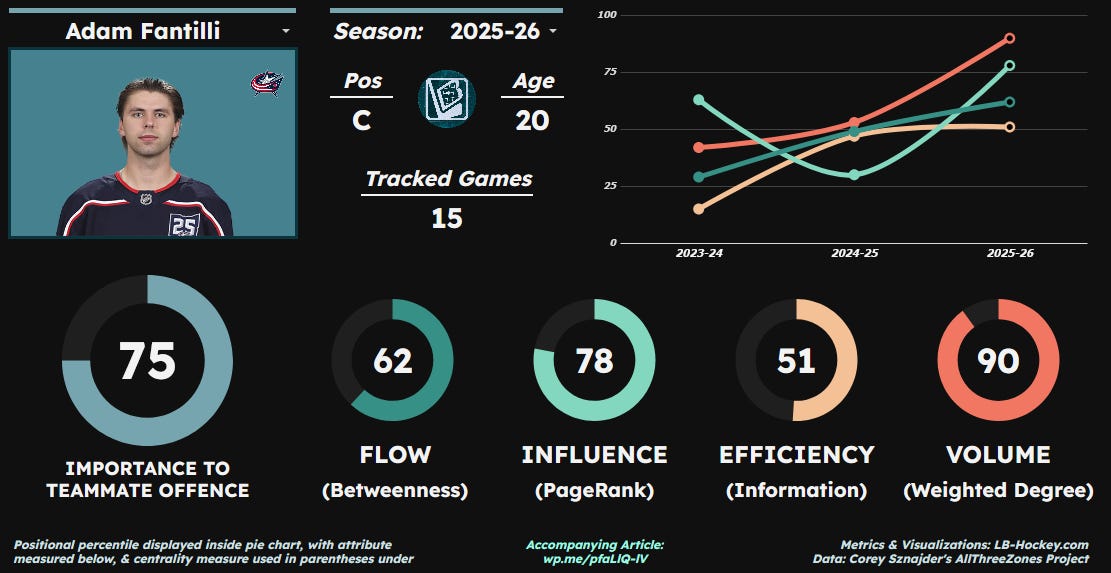
Most critically, his integration as a playmaker was significantly improved. While these separate aspects of his playmaking networked-ness may be alien to you, they’re easy enough to sum up quickly. (You can read more here at LB-Hockey.com and the tool is entirely free).
His greatest two aspects are Influence and Volume. This suggests that he was a key piece in terms of the volume of both puck-touches and resulting playmaking. Influence means that he was regularly linking prominent players on the team. Time on-ice with Kirill Marchenko, Mason Marchment and Zach Werenski will certainly do that.
The others, efficiency and flow, speak to the more critical areas of improvement for him going forward. That he is so strongly involved and with such important players means that improvements two the other two aspects, which might speak more to quality of playmaking, might have significantly positive effects. Perhaps we’ll touch on this later.
What’s fascinating is that the major drivers of his step forward were all noticeable in the very first game of the season. We could simply watch this small mixtape of his performance in that game and we’d have a good understanding of the general drivers of his improvement: better play-linking in possession, better timing into forechecks and the most-used improved wall-play and off-wall passing.
Defense to Offense, Forecheck and Off-wall Passing
Last season, Adam Fantilli was a problem (derogatory) on the forecheck. He was late into contact, his stick placed poorly and altogether just far too easy for the opposition to get through.
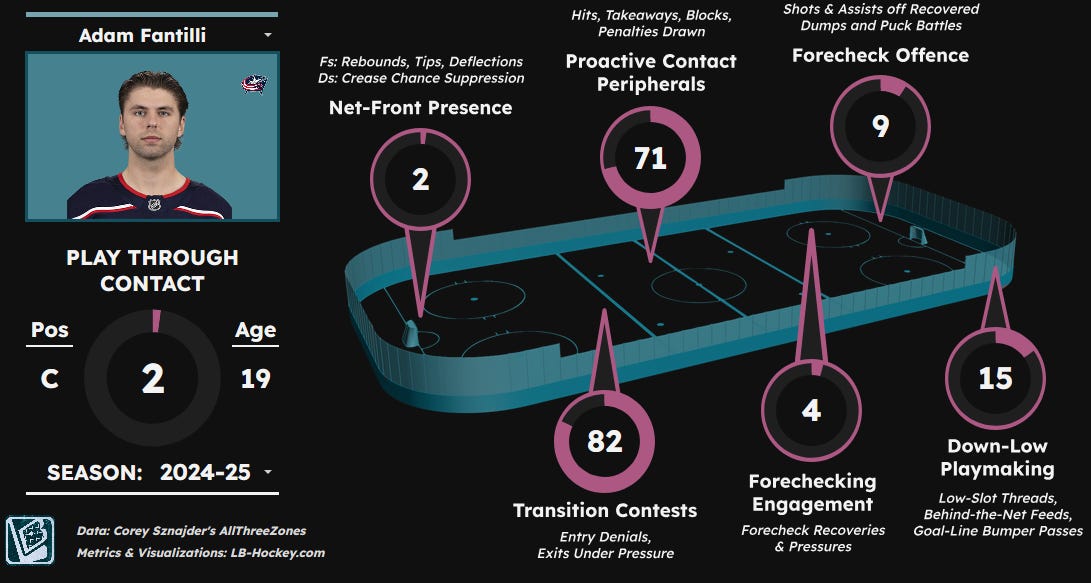
This past season marked a step forward for him especially when it comes to direct forecheck measurables.
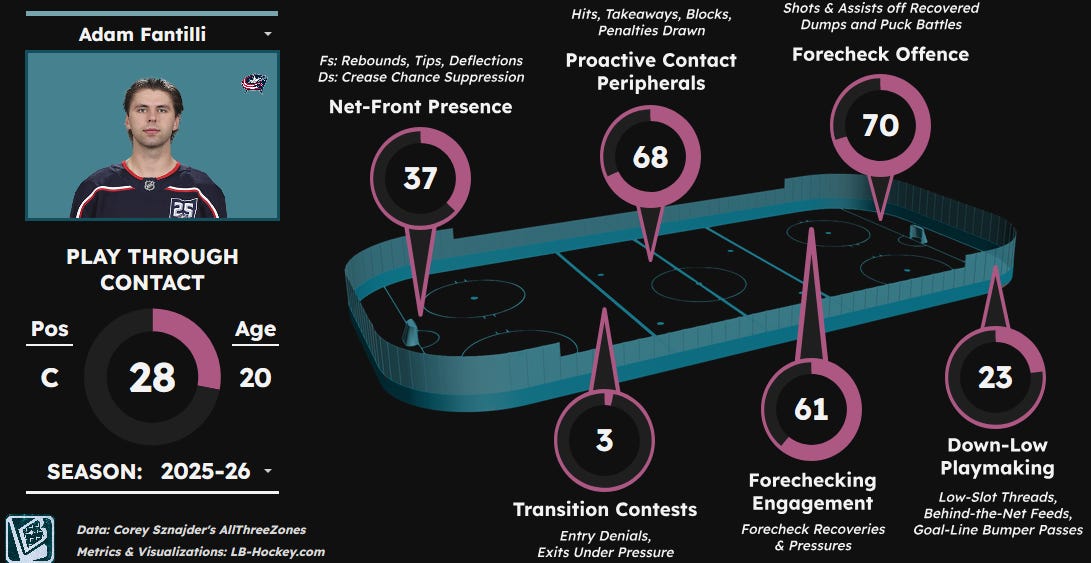
For a player who is regarded as a “power forward” he still has some strong issues leveraging his bounteous athleticism to impact games at the highest level. Some of these issues stem from puck management, or a perhaps overeager risk-profile, but we can at least take solace in this direct improvement.
Fantilli’s timing into battles on the forecheck still has plenty of room for refinement, and especially some of his puck pursuit and pressure, but the flashes were all pretty much there through the season.
While there’s plenty of work to do with respect to his play in the neutral zone as noted by “transition contests”, it too improved. There, the meat of playdriving and control (linking defense to offense) emerged a little bit. There are certainly clips where he tracks well, wins the puck and finds a teammate.
The real driver of his success inside this domain was ultimately his wall-play. His stickhandling has always been excellent and was now used to manipulate the puck along the walls, peel it off, and do so at a pace that enabled him to make that next play with a bit of separation.
He is not yet a complete product by way of forechecking, and I imagine he’ll need to find more to become the actualized version of Adam Fantilli, but big steps nonetheless.
In Possession Play Linking
Fantilli was never really a poor playmaker per se but it’s safe to say he wasn’t really a regular one. By that, I mean that his playmaking ideas all centered around creating goals, or chances, and not necessarily part of a more continuous threat-building process. This season he didn’t really change that but he certainly amended his habits toward giving his teammates the puck earlier and exchanging pucks more often.
Like forechecking, this is still not an area of completeness for the young center. I think the proof is in the playmaking data above but there are plenty more areas that didn’t make the clipping that demonstrate that he’s still perhaps overly reliant on delay-plays, forcing passes into difficult positions and through those perhaps exposes the Blue Jackets to some big danger through the turnovers that result.
Finishing Woes
The biggest reason that this season felt so different from an Adam Fantilli perspective was simply that not all the goals went in. He was a lethal finisher, nearly historical for his age, especially because of just how many goals he scored at 5v5.
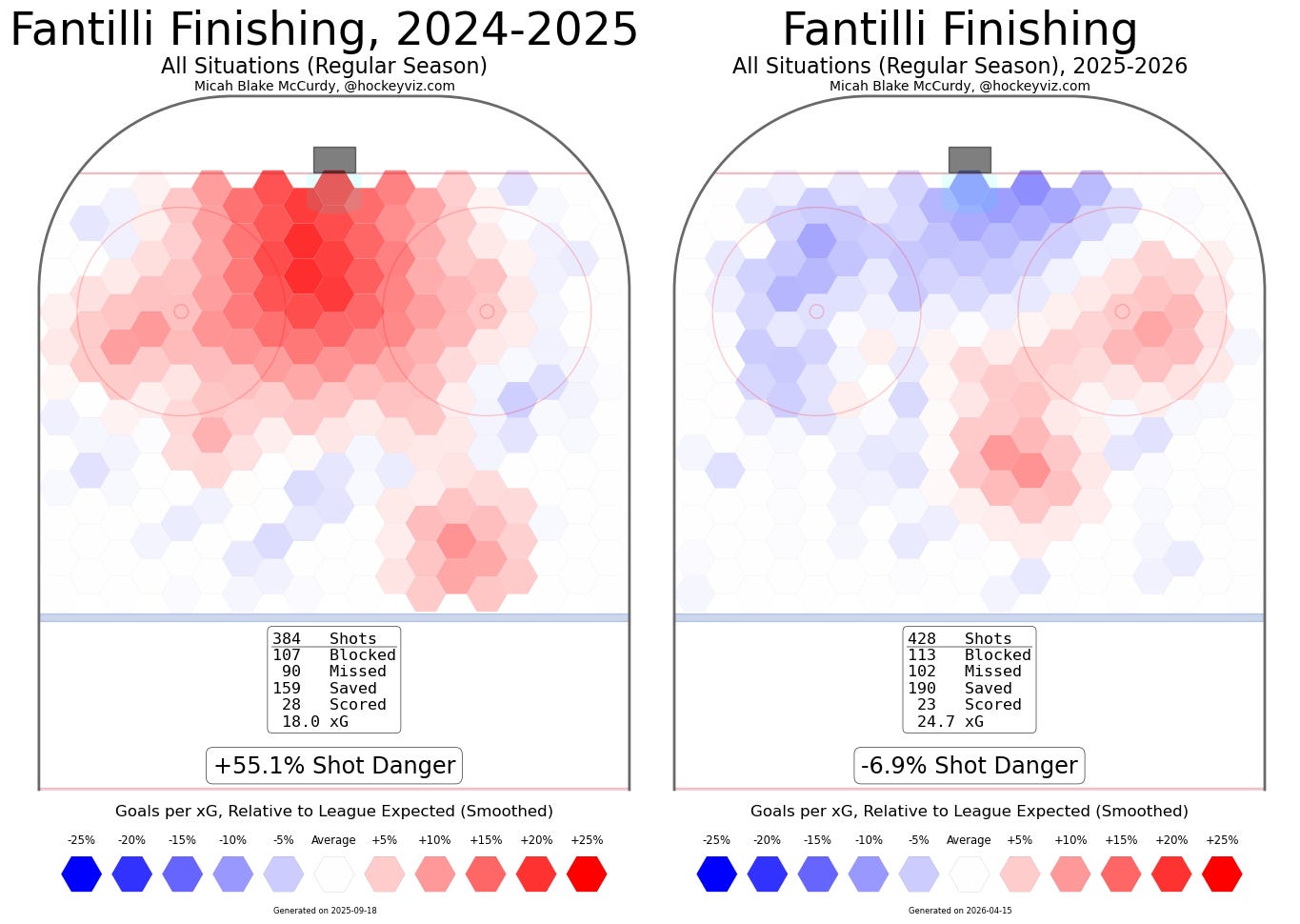
The HockeyViz finishing maps tell the story quite well but they don’t quite take us all the way there either. In his young career, Fantilli has been a brilliant 5v5 scorer. For all of the flaws we have observed, especially relative to some of his peers, the North Star of hope was the brilliant scoring.
This season, Fantilli did not have close to the same impact as a pure scorer. The Blue Jackets, in general, didn’t really either. It was easy enough to foresee some rate-scoring ebb but when you’re dealing with very high draft picks and obviously special talent, enthusiastically predicting a decrease in scoring is difficult.
In the end, Adam Fantilli was a slightly below average finisher this season. It is perhaps not reasonable to expect him to finish at the level of 2024-25, and there are specific improvements to be made of his game in that domain from this past season, but we have to think goalscoring will be a special talent of his moving forward.
Scoring chances will always feel like they should have gone it more than their statistical likelihood, as such mixtapes like the above will probably always have you feeling like he could have scored easily more than thirty. Still, I think it’s safe to say that with time Fantilli will be able to convert many more of these chances and return to his previous rate-scoring stature.
Powerplay Integration
One of the “weapons” that perhaps blunted negative impact of Fantilli’s “struggle” to score was his increased presence on the powerplay. The Blue Jackets, generally, lost a lot of their overall effectiveness on this unit compared to the highs of last season. While Adam Fantilli is pacier, he never quite captured the pure entry brilliance that Kent Johnson found last season. To be fair, Kent Johnson didn’t really either.
In any case, Kent Johnson’s departure allowed Fantilli to assume his position on the right half-wall which was far more comfortable. No longer was he trying to fill the role of Sean Monahan without any of the same methods of impact. As the season wore on, the Blue Jackets finally found some changes to the in-zone structure that helped create some different looks. Inside those changes, and perhaps far too late in the year, Fantilli really found something that looks like it could be the centerpiece of an interesting PP idea.
Fantilli’s downhill attacking from the point created a series of interesting looks. It’s not totally disimilar to some of the rotations with Werenski had Kent Johnson found last season but he’s just a different style of downhill attacker.
Fantilli isn’t totally there yet as a PP attacker but, alongside some of his other improvements, I think it paints the picture of a player who will have a central place on the team in the years to come. Last season, he was an outright drain on the powerplay. If he’s to be a franchise pillar, he’ll have to have a strong place and be able to impact all-situations. The leap forward into legitimate weapon isn’t necessarily easy to predict.
Post Olympic Break Improvement
The line of Marchment, Fantilli and Marchenko didn’t ever quite get to the complete coherence and dominance of a true power-on-power top line, they remained altogther too inefficient and perhaps too diverse in their approach, but they really leaned into eachother and connected as a unit.
Adam Fantilli was a significant beneficiary of this environment which really enabled him to display all of the improvements he made both heading into this season and throughout the year. As the season wore on further, and many aspects of the team wilted, Fantilli emerged as more than a simple beneficiary of this line’s chemistry.
While much of this season represented something of a consolidation and reorganization of Fantilli’s gameplay and ability, this last ending stretch showed that he’s also ready to be much more.No longer was his game exclusively bits and parts of excellence but, at least more frequently, shifts that orbited around his ideas.
This mixtape contains the highlights of this critical stretch of play. Within, you’ll see the re-emergence of the “freaky” stickhandler who has smoothed the rougher routes and ineffective headfakes into something altogether more effective. His defensive and neutral zone improvements turned into timely disruptions and counter-attacks. His pucksharing and simpler spatial playmaking allowed teammates to actualize the advantages his presence was creating. We even saw more occurences of his very unique extended-reach puck corralling leveraged for impact.
The end result is a collection of very exciting sequences and a player who rose to the occasion and relished the spotlight. While the Blue Jackets couldn’t get it done, Fantilli was one of the few who finished stronger than he started.
Current Standing and Trajectory
Adam Fantilli competed with Kirill Marchenko and Charlie Coyle to be the most deployed forwards for the Blue Jackets on the year.
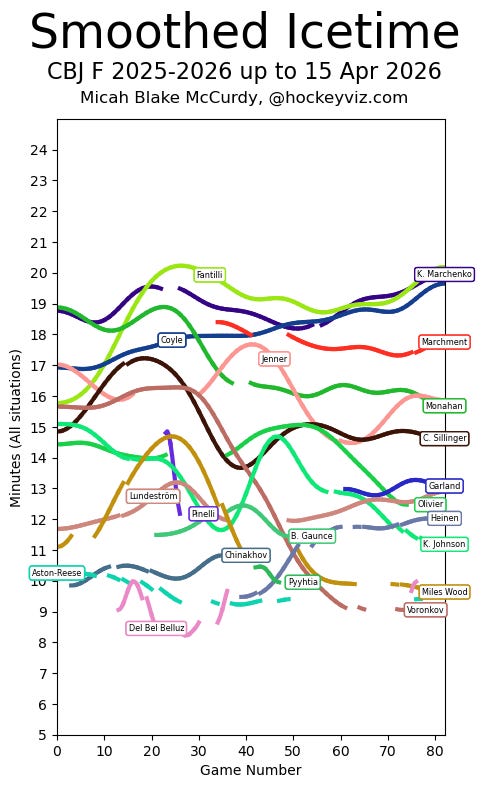
While the role and ice-time suggested that Adam Fantilli is a 1C his underlying performance didn’t quite live up to that suggestion.
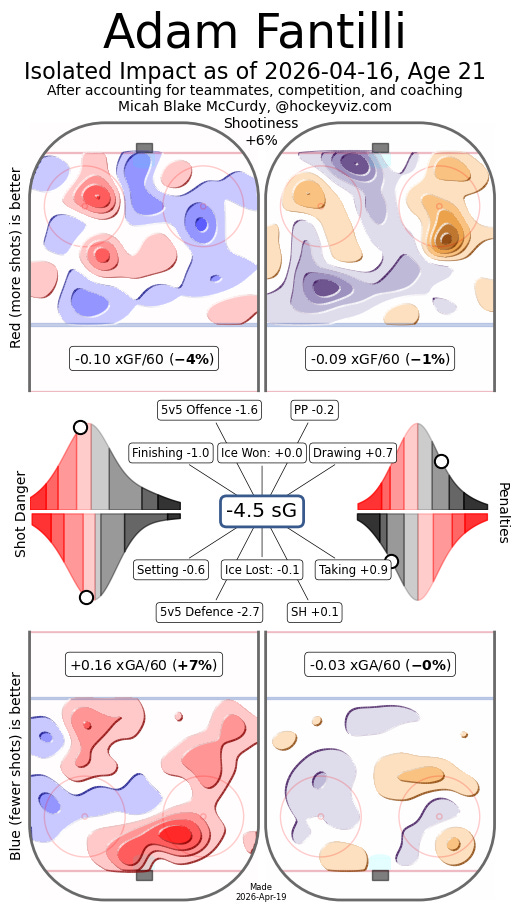
Before we go further, I think it’s important to explain that the above data is individual impact on the above situations and that we should consider that differently from actual contributions and performance. A nuanced difference, and one that I should really break down further at some point.
We’ve covered a bit of the ups and downs of his underlying data up to this point, so I figured it’s a good time to present the bigger picture all together.
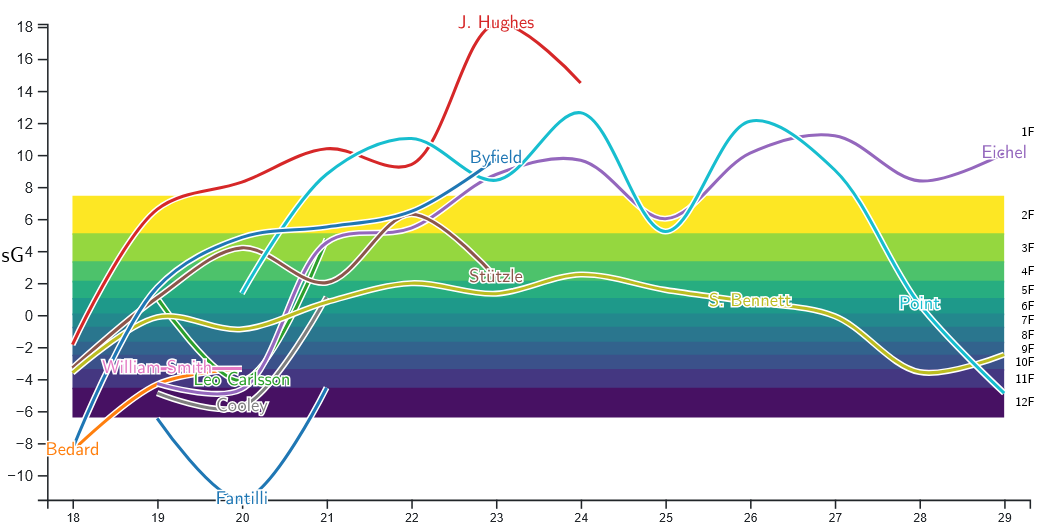
Using HockeyViz’s sG plot by age, I pulled out a selection of young, highly drafted 1Cs or otherwise important comparables. You’ll see a similar selection in my updated EH RAPM Cohort plots from Datawrapper as well.
Unfortunately, I can’t really clean up the amount of colors and noise so we’ll just have to do our best.
Notice, that Adam Fantilli did experience a large leap forward commensurate with many of his contemporaries in his Age 21 season. He improved by about the same amount as Jack Eichel, Leo Carlsson, Logan Cooley and Elias Pettersson did. Still, he’s much lower relative to them because he simply started from a quite poor position.
There are a couple of factors influencing this overall rating. Many of the above players did not get to play with teammates as considerably talented as Kirill Marchenko, Dmitri Voronkov or CBJ Mason Marchment and certainly not as much as prime Zach Werenski.
It’s entirely possible that Adam Fantilli deserves a better sG rating. In order to believe that, you must then be willing to downrank any of the above players, or even Kent Johnson last season. Most likely, you would be asserting that Kirill Marchenko is something around a second line wing or that Zach Werenski doesn’t exactly deserve that tippy-top rating.
Not worth being overly concerned with now but enough to mention that, like last season, the Blue Jackets stand to benefit significantly from any amount of improvement that Adam Fantilli makes. The late season bump, should it portend a greater leap next season, could get him back on track and newly aligned with his peers.
The other publically available options with respect to “underlying” play-driving all tell about the same story. Adam Fantilli is at the bottom of the cohort with respect to general play-driving.
On one hand, it’s already a good thing that Adam Fantilli could take so many minutes and could perform very well on a line. Marchment-Fantilli-Marchenko had completely sterling underlying numbers across the board with one caveat: competition and deployment. Rick Bowness really wanted offense from this line but didn’t particularly trust them in difficult situations. In fact, he completely warped his teams’ deployment specifically to get them better offensive opportunities.
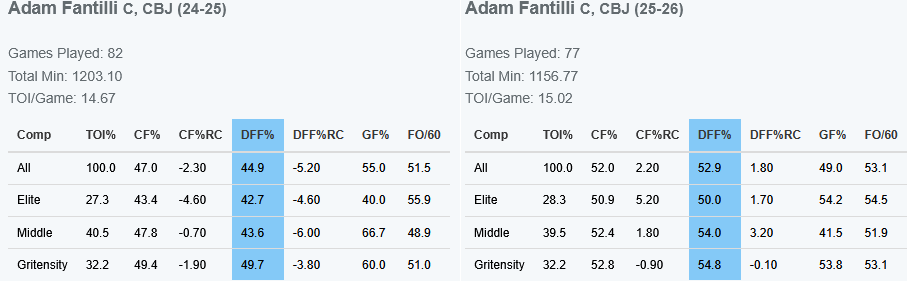
Relative to last season, Adam Fantilli’s deployment against certain levels of competition remain unchanged. That he’s under 30% CTOI against Elite competition suggests he was sheltered a little bit from those players. Kent Johnson, a hardly trusted player, received a more even distribution of competition and this trend was only exaggerated after Bowness joined.
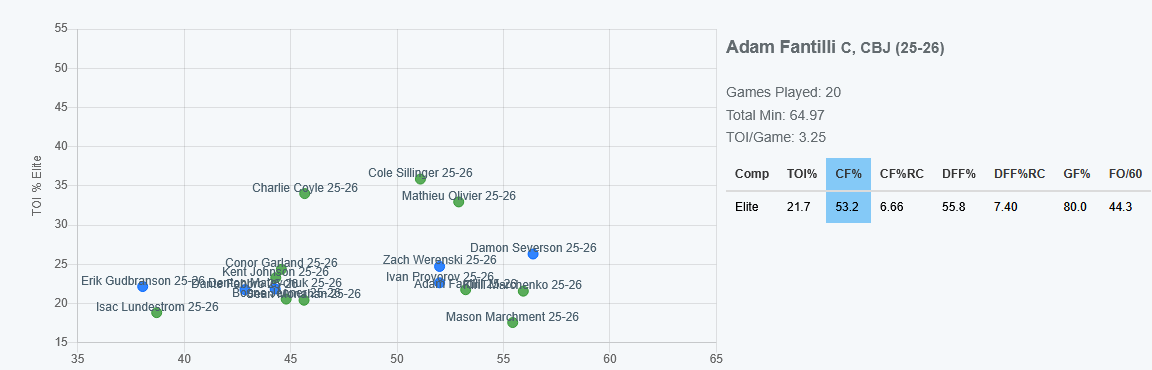
Diving deeper and it looks more like Bowness had a problem with Marchment specifically, who saw 17.6% of his TOI against Elites where Johnson, Marchenko and Fantilli ranged from 23 to 21% respectively.
My point isn’t to say that Fantilli necessarily had a problem but that his “isolated impact” might be lower than you expect partially because his environment was much easier than you’d think in terms of teammates, zone starts and even competition.
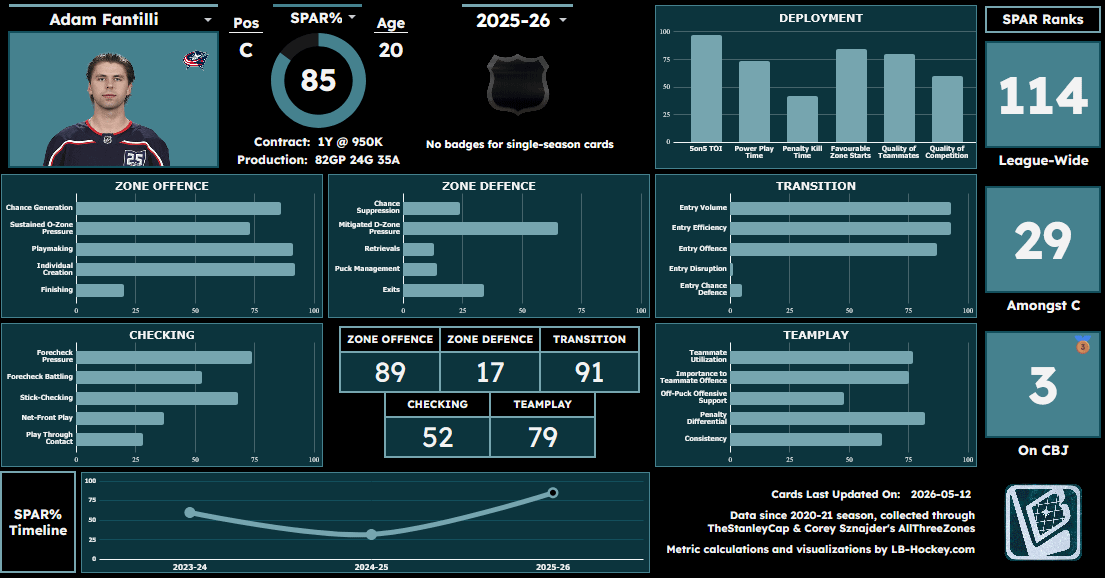
The above isolated metrics aren’t necessarily the be-all, end-all either. LB-Hockey’s model, which includes AllThreeZones individual contributions, grades Adam Fantilli out as a fringe first line center already. He had absolutely stellar rush creation metrics and had no problem creating a healthy helping of scoring chances from every situation.
Frankly, I think that his individual contributions by way of AllThreeZones being close to sterling, with some notable weaknesses in terms of neutral zone checking and perhaps some forechecking, while his actual impact lags far behind paints the total picture well.
Steps Forward
Adam Fantilli took a fantastic step forward as he adapted his game to the new demands of Dean Evason and Rick Bowness. His inability to truly dominate games is perhaps one of the critical factors that prevented the Blue Jackets making the playoffs. The questions “will he get there?” and “when"?” naturally follow.
The answer to that is difficult. Development, I believe, is non-linear and that means
The Blue Jackets this year demanded forechecking. Adam Fantilli adapted to those demands but might have had too far to go to be an individual dominator in that domain. He played alongside fantastic teammates and, eventually, found a fantastic role as the game temperature turned up.
Still, it might be true that playing him in such a packed environment alongside Marchenko and Marchment asked him to play a way that’s outside his current ability. The growth was stellar but impact doesn’t come from individual contributions but how they service the other skaters on the whole. On that front, Adam Fantilli still has some growing to do.
This selection of poor plays from the cursed Bowness crashout game perhaps do a good job of encapsulating the room for growth. To get better, he’ll need to significantly improve some of his play selection which should have knock-on effects on his neutral zone defending as well.
We should mention, of course, that Adam Fantilli did have a problem this season of actually getting scored on. He, along with Miles Wood, regularly got exposed when it came to actual goals. Perhaps there is a goaltending-randomness claim there but perhaps an exposure to mistakes is the more likely root cause.
There are a couple of routes around this improvement.
First, his skating, pressure and timing into forecheck battles must get better. If he helps contain forechecks earlier, his neutral zone looks will be easier if they exist at all. Marchenko is already elite in this regard, and made hay with an excellent pursuit/battle timer in Sean Monahan, but Fantilli lagged behind and the sum of their impact left room.
Second, better and more efficient playmaking after entries. While we saw plenty of growth in this regard, there were also plenty of very poor turnovers from Fantillli through the year. He had a bad tendency to make turnovers high in the zone, or to force plays into the slot, that means free exits if not scoring chances for the other team. You can’t really backcheck well if you’re behind the play because of your own turnover.
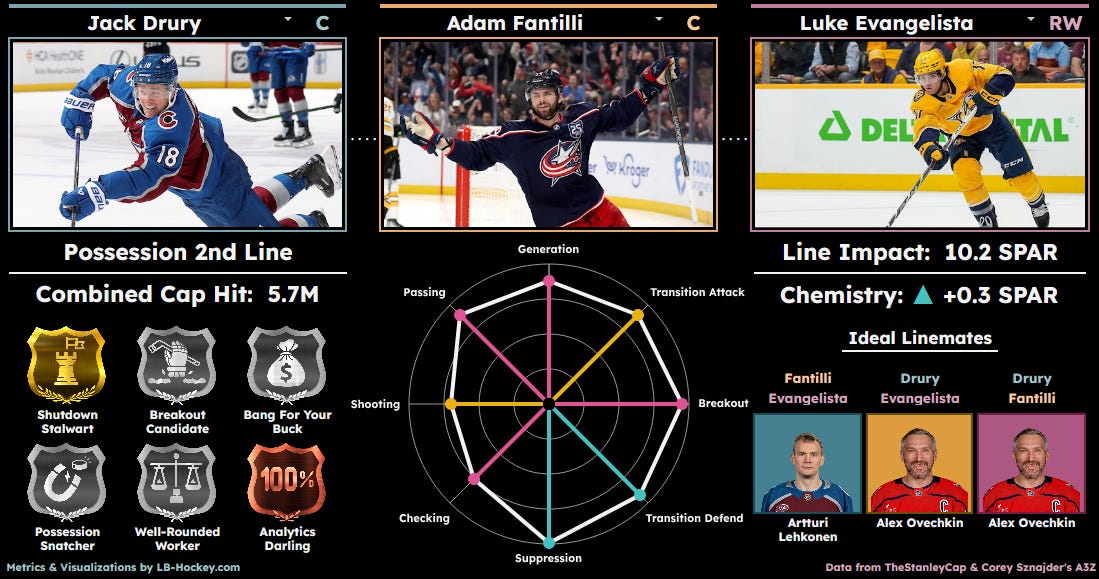
Third, perhaps better insulation or different deployment. Perhaps separating him from Kirill Marchenko, and thereby each of them being able to drag the on-ice play in their preferred direction, means Fantilli’s strengths and weaknesses can be catered to (elite forward attacking, subpar exit generation and suppression and subpar neutral zone checking). While there is so much good tape of them working together, the bigger film review really showed how much work Marchenko does as an unquestionably elite forechecker and how much further Fantilli has to go to help establish that specific on-ice identity.
Perhaps I am moving too eagerly and too soon but I think Fantilli’s ascension as a stand-alone force is necessary for the long-term outlook of the club. I readily admit that a measure of forecheck timing and puck pursuit will be necessary, and Marchenko’s playstyle a very helpful complement to develop those skills alongside. Still, the best Fantilli-complement (perhaps supplement is better) would be able to play him into forward spaces while rotating behind in the aftermath of his attacks. In some cases, those are some of the same things that Marchenko also wants.
All told, it’s much more likely that this upcoming season is the one where Fantilli is more prepared to become the 1C that the Blue Jackets need to take them to the playoffs. He’s behind the curve a little bit here already, so there’s no saying exactly how the situation plays out, but he’s got a fantastic offseason practice group and is well within the critical period of leaps forward.