
Drawing Pressure and Creating Space with Kent Johnson

I recently published a big Kent Johnson mixtape over on YouTube. I haven’t really put a ton of effort into getting the channel off the ground there, evidence by the lack of picture for my account, but it’s at the very least a place where I can put videos that can theoretically also be shared other places.
This video was a bear to breakdown because I had just so many Kent Johnson clips accumulated over the season. It’s thirty minutes long, which is a ton but hopefully helps stimulate the senses in the middle of the hockey-drought that is the summer.
This mixtape only really covered one, albeit gigantic, aspect of his game (transition and build-up) and didn’t even really get into the meat that was some of his offensive creation, especially on the powerplay, or any of his forechecking work.
I am not necessarily here to give you that again but to further explain and break-down aspects of his mixtape, look in the description for the themes of the specific sections, so that I can talk a little more about it and then further demonstrate one of the fundamental patterns of his game: drawing pressure to create interior space.
I don’t know if we can go so far that it drove his breakout, I think that’s likely a combination of his off-season skating output upgrades as well as refinement of puck-handling, but it’s certainly steps toward crafting his on-ice identity as expressed through Dean Evason’s systems.

Last off-season, I wrote a ton on Kent Johnson’s style. It’s interesting to read it again through the lens of this mixtape too. The same skills were apparent last year that this year he has honed and crafted to greater success. Moving him to his off-wing and giving him permission to truly control the center of the ice drove him to greater heights this season.
I won’t get into it too far on this breakdown but outside of defensive zone coverage, Kent Johnson plays nearly exactly how you’d want a Center to play. His position as defensive zone wing (with center responsibilities starting as soon as he touches the puck and everywhere else on the ice), though, does give him some fascinating options that perhaps help him drive offensive results even better than the defensive burdens of a traditional center. It’s a fascinating position for a player with an ever expanding repertoire.
On Build-Up and Play-Driving
I think it’s worth defining what “Build-Up” really is and why this specific aspect is something that’s important to talk about. The concept comes from soccer, as many advanced hockey analytics do, and is used to describe the possession play that transports the ball up the pitch before the “offensive phase” meaning attempts at shooting or scoring.
Build-up applies the same way in hockey but is a bit more difficult to parse out partially because of how quickly all of these separate “phases” interact. I think, ultimately, the idea is still intuitive enough. I am using to mean, things that a player does that promote offensive zone possession but that don’t necessarily lead directly to goals/shooting.
Disentangling this aspect from forechecking is difficult. If you can dump the puck in and pick someone’s pocket, that promotes offensive zone possession just as much as carrying the puck through the neutral zone. If you can block a pass, you’ve clearly taken a step towards offensive zone possession but not as dramatic as a full pickpocket and counter-attack.
I don’t want to get too far into the proverbial weeds here, but I do want to move forward and help explain how “play-driving” or “tilting the ice” and “build-up” are intertwined. I think there’s nuance to Kent Johnson’s somewhat idiosyncratical statistical profile that is best explored in these weeds.
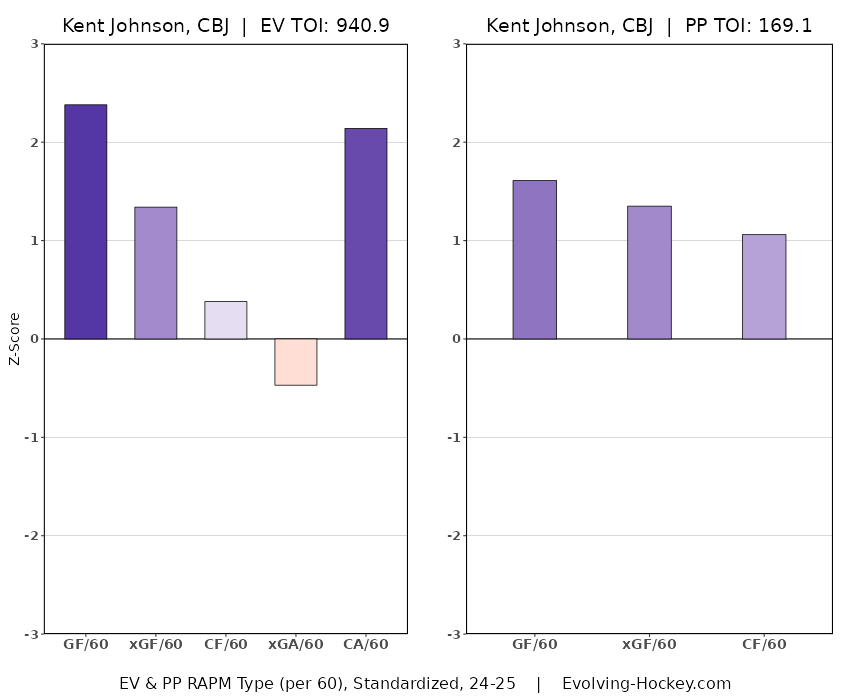
From a “play-driving” perspective, Kent Johnson was one of the best players on the Blue Jackets. Relative to deployment, teammates, competition etc, Kent Johnson promoted possession as much or more than any other player. He was very much on par with Kirill Marchenko, Sean Monahan and Zach Werenski.
Going down the stretch, Kent Johnson was simply one of the best players on the Blue Jackets, no doubt helped significantly by the torrid chemistry he shared with Adam Fantilli and James van Riemsdyk on the season ending winning streak.
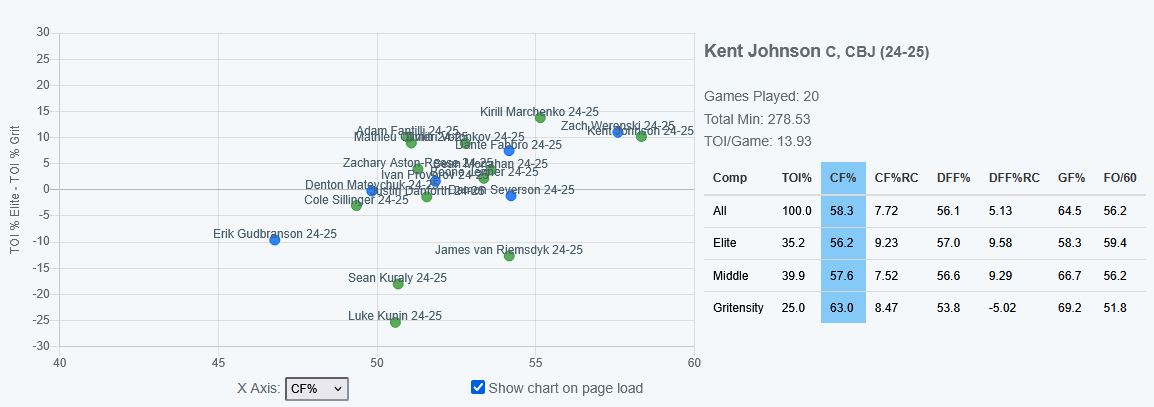
According to PuckIQ, who breaks competition into three separate buckets, Kent Johnson was firmly unsheltered and performed well in all measures. From a possession perspective, CF% being as near as we can get to measuring it, Kent Johnson might have been the best Blue Jacket through the final stretch.
What’s most interesting, especially in the above RAPM chart is that Johnson’s play-driving impact doesn’t necessarily come from generating a huge amount of shot attempts, though he was still great in the other offensive measures, but from suppressing shot attempts against.
While this has implications for the likelihood of a repeat season, defensive measures are more prone to volatility than some of the offensive measures, I think has explanation and sheds some light on Kent Johnson’s style specifically.
Now, specifically, I think Kent Johnson comes by these metrics honestly. That doesn’t mean they are directly repeatable or not prone to variance but there are other signals that point in a positive direction.
As much as Kent Johnson struggled to get primary assists at 5v5 (important because they are more repeatable and less prone to noise than secondary assists), only getting 8 on the whole season relative to his 19 goals, his passing ability still helped create a ton of offense.
Before we get too far into the mix, note that Kent Johnson is not in the complete upper echelon. He is 70th and 80th percentile in Passing Importance and RAPM Corsi Differential. There’s plenty of room for him to grow and he will indeed need to if he wants to be a major contributor to a Blue Jackets Stanley Cup.
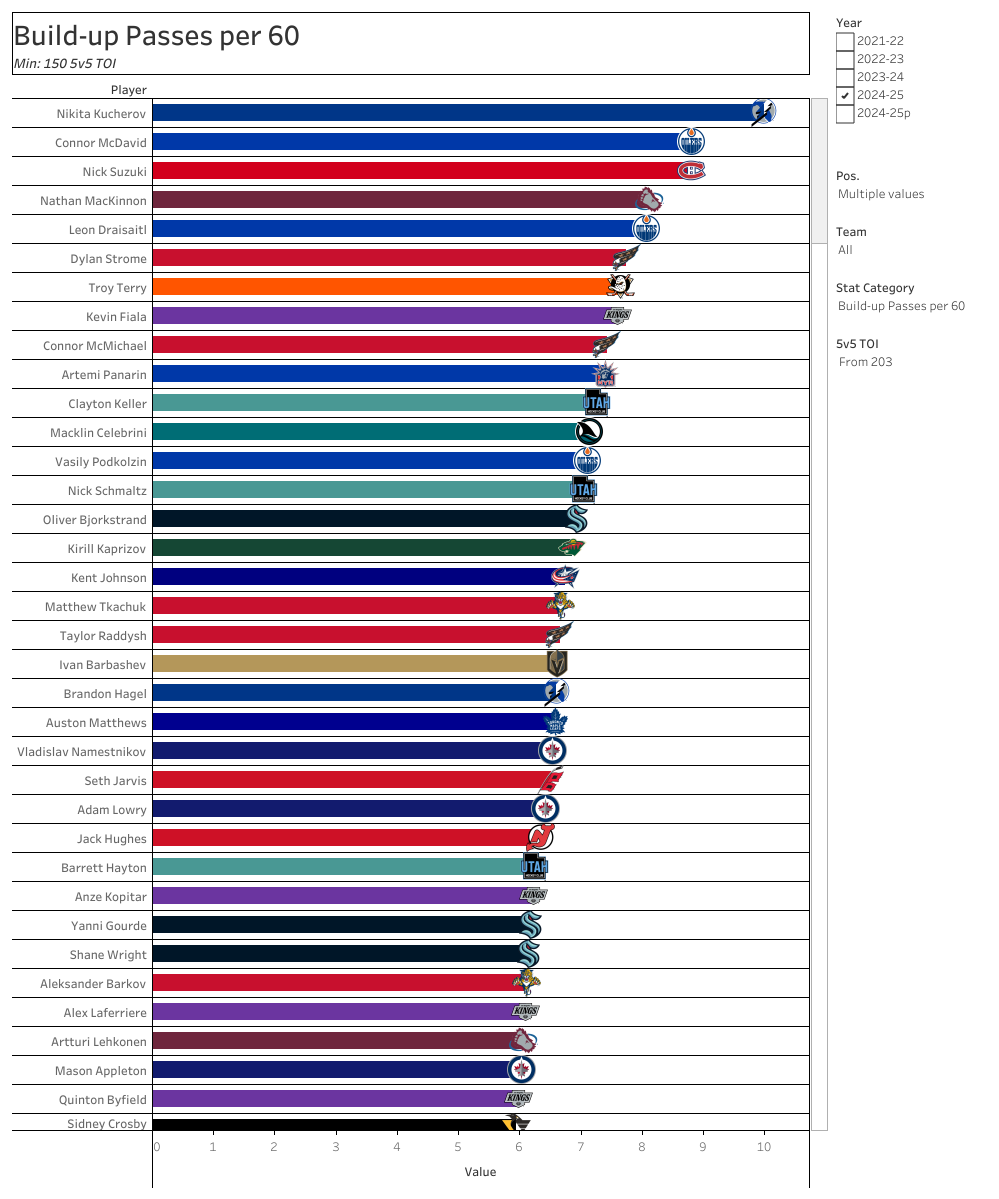
He achieved this passing importance, we can assume, because of his absolutely fantastic ability to build the play through passing. We have seen his ability to skate through defenses but the resulting passes are perhaps equally important. One creates the other actualizes.
Given the trend in the observed scatterplot above, it’s safe to say that he combined these abilities to help drive play. From here, let’s take a deeper look under the hood at how he drove these results.
Transition from Defense to Offense
Talking about defense in hockey is difficult because of how intertwined it is with possession and perhaps even certain attacking actions in offense. We can get confused about what “defense” ,or a heatmap in the defensive zone, means because often those are results of play outside of that zone.
With respect to Kent Johnson specifically, I also have a hard time finding where exactly to start in breaking it all down. For now, I’ll start at the very beginning, or just prior to, possession.
While I wouldn’t assert that Kent Johnson is an elite defender in the traditional sense, he doesn’t necessarily suppress shots against at the point of attack (he isn’t an in-zone triage the way you might think of Aleksander Barkov or Patrice Bergeron), he is a very proactive one who makes significant defensive gains because of that proactivity, angling and dictating the direction of players, and moreso because of his capacity to organize the transition phase surrounding a change of possession.
I think this aspect is critical insofar as it relates to actually driving play. Getting a stop is great. Getting a stop that you then convert into possession is better. Getting a stop that you convert to possession and then moving to a support position and transporting the puck up-ice is even better and that’s where we often find Kent Johnson.
If you’d like to follow along, go ahead and take a peek at the Defense to Offense Timestamp.
It’s not just that he does his job and helps promote stops, by angling players into defensemen or pushing puck carriers to their backhand, but also that he has the deception, handling, vision and passing to draw the “response” pressure (the first wave of actions taken by the team that just lost the puck to get it back again) out of position, beat it, and then move again to make the next play easy on his defensemen.
This particular skill is helpful in re-group situations but I think the funnest interaction was just how often Kent Johnson diffused empty-net situations in the neutral zone. He did it simply too many times this season, I believe I captured two above but remember other situations as well.
Where this aspect of his game, alongside the next section of the video titled “Solving Early Pressure”, is that it requires good hockey sense and awareness. Like Zach Werenski, Kent Johnson has good ability to anticipate changes of possession and move in advance of the play. This allows him to be prepared but also to scan the ice and create the mental map that might help him find solutions to pressure.
So while this aspect of opposition possession suppression may not be purely “repeatable” in a statistical way, Kent Johnson does show some habits/abilities that should be repeatable and are positive signs for growth in performance going forward.
Drawing Pressure and Creating Space
The core thesis of Kent Johnson from this past season was indeed drawing pressure and opening the middle of the ice. This, too, explains some of his statistical portrait and demonstrates areas for future growth opportunity.
Perhaps Kent Johnson’s objectives would be better stated, rather than drawing pressure for interior space, as deforming the defense and finding an advantage. That advantage doesn’t have to be interior space, though it often is, it can also be speed differential advantage, playing a puck into a numbers advantage or even giving to a teammate with better potential to create. Better yet is that he doesn’t necessarily actualize the breakdown or advantage himself but creates the conditions for it and then puts his team in the position to actualize it.
I think the above defense to offense video demonstrates this concept well, but let’s look at a specific clip just to really drive the point home.
Defense to Offense Full Shift
I think clip really expresses so much of his skillset all at the same time. It starts much earlier but demonstrates how he can operate fluidly through a variety of positions.
First, watch Kent Johnson’s jump from behidn the defense as he recognizes Jenner is winning the puck. He finds space in the middle lane but the pass goes cross-zone to JvR. He moves early to his forechecking position, where he could set the bracket with Boone Jenner on the weakside wall should JvR rim the puck, and Jenner drives hard as F1 as he reliably does.
KJ starts off on the weakside and probes for space, ultimately JvR elects to move the puck around the wall perhaps because two Red Wings moved to pressure him. Jenner’s drive wins him the puck and he puts it back. The Red Wings are now collapsing in their own zone and JvR sends the puck around the net to Kent Johnson, effectively changing sides.
From there, KJ cleanly picks up the puck, protects it away from Raymond’s pressure and casually drags him up the ice before rimming the puck again for a short change-of sides to Boone Jenner. You can hear Jody Shelley talk about the concept too.
Kent Johnson is the high forward, as he often was in a Dean Evason system that had him move upward and leave two at the net, and so he attacks downward to contest Seider’s recovery but is ultimately unsuccessful. He recognizes early enough and gets on top of Dylan Larkin which puts him in a good position for the backcheck.
He smartly contests the passing lane and takes advantage of the bobble from Larkin to recover possession. Here, he separates Larkin from the puck with his body and then instantly adopts a protective posture and shields Raymond from the puck again. Raymond isn’t coming heavy because he wants to change lines, whether Johnson is aware of that wrinkly is not clear but he keeps playing and drawing the pressure of now Kasper. He drags him further until he can slip a pass to Mateychuk and then beat the only check left up-ice.
The puck hold on his backhand into a quick pivot has become a favored move of his to get the jump and exploit the pressure he’s been drawing. He beats Larkin with a quick handling move and fends off his contact with great footwork and adjustments into it. There, he continues to attack through the middle lane. Unfortunately for him, Denton Mateychuk was also reading that he was taking the center role and the two young players created an overlap, neither really reading dynamically off the other.
If they had, perhaps one of them would have landed at the net for a creative scoring chance (either KJ recognizing Mateychuk early and going straight to the net after passing to JvR or Mateychuk recognizing that KJ was getting the puck and stopping where his slip pass ultimately went).
There’s still work to do for the young Blue Jackets forward but there’s a ton of exciting ideas to build on.
Rush Pressure Drawing
In the above clips, pay special attention to how Kent Johnson moves in order to deform the defensive formation and how he cleanly passes to teammates who are now in advantaged space. In the Pens clip specifically, Damon Severson and Yegor Chinakhov are both unmarked as the result of Kent Johnson stopping high in the zone and two Pens collapsing to him. It’s not necessarily that Kent Johnson knew this was going to happen but that he found the solution in flow. On a few of the rushes, Kent Johnson drags the defender nearest him and passes into the now open weakside attacker be it Zach Werenski or Boone Jenner.
Powerplay Creation Tendencies
In the offensive zone, and especially on the powerplay, he really pushes these concepts to their limits. Pressure drawing for interior opening is pretty much the whole thing. Perhaps better said as, pressure drawing and advantage creating (whether that advantage is territorial, spatial or teammate number’s advantage) but I’ll get to that in a minute.
On the powerplay, outside of the zone-entry creating displays of pressure drawing above in the mixtape (especially those where he dropped the puck back to Zach Werenski just after entries), Kent Johnson frequently moved into the high ice as a way to drag the penalty kill out of shape.
Take this clip for example. Frequently, this “expanding” motion from Kent Johnson served the purpose of opening the interior of the ice. Here, and often, Sean Monahan exploits this space with his brilliant timing and poise. It doesn’t turn into anything directly but it does have knock-on effects. Kent Johnson is now more open and Sean Monahan’s resulting down-hill motion opens the seam for Johnson to find Kirill Marchenko.
You can see the same sort of manipulation here as Kent Johnson drags the predators PK into the upper corner of the zone, drawing two players out of position before beating them to the interior with a pass to Boone Jenner.
In a different but related move, Kent Johnson here cuts quickly across the top of the Wild PK formation, collapsing them with a shallow line across the circles, which then opens a quick drop to Chinakhov and a resulting pass to Werenski, who scores on a one-timer, before the formation can really adjust.
Here, after a tough Chinakhov pass, you can see in real time Kent Johnson process the Buffalo PK, take a beat to make sure they open more space, and then slip the puck to Sean Monahan where he creates a dangerous Chinakhov chance. That isn’t the goal, ultimately they score after the recovery and quick moves around a collapsed Buffalo formation, but it demonstrates his process well.
Here, on the half-wall, he draws pressure more directly to beat it to Monahan, who gets it cross-ice, which opens the pass back to Kent Johnson who is robbed of a goal. Here, he essentially kicks off a chain of events that ultimately set up his own scoring chance. This, is the essence of Kent Johnson.
Offensive Zone
These same concepts play-out in the offensive zone at 5v5, albeit in a somewhat different way. In slower offensive zone possession sequences, Kent Johnson wasn’t as good as he was in build-up. He created a ton of his points off of rush and counter situations, whether those were exit kills or elsewhere, and off of possession situations on the powerplay.
Once in-zone, the defenses didn’t quite react in the same way as the penalty kill. Still, he did demonstrate the capacity to find some of the same situations through some of the same movements: the half-wall station and motion upwards into high ice. Each of these had different effects but similar results: playing the puck into advantaged situations.
This off-wall drawing to open the interior for Mikael Pyyhtia looks really similar to that Buffalo powerplay clip.
While I don’t think he intended to find the play that he ultimately did here, there’s a common theme of him continuing through plays and constantly moving his feet to keep defenders moving away from the middle of the ice.
Really, he wasn’t alone from this perspective but he was unique in his stylistic approach. Kirill Marchenko, Sean Monahan and the like were all very good at turning back down and simply playing below the dots and stripping pucks. While I think Kent Johnson is pretty good there as a slippery presence along the walls, he doesn’t have the strength to beat most NHL defensemen there. So, he resorted to other moves.
Kent Johnson, for whatever reason, preferred to move up near the blue-line and create from there. Now, I think there’s a ton of nuance to this approach not the least of it is how it interacts with Dean Evason’s systems.
When Kent Johnson carries the puck up from the half-wall, he puts himself in a vulnerable position. A turnover means a counterattack chance which means he has to make smart plays. To mitigate this risk, and to create an advantage of their own, Dean Evason asks two forwards to go the net-front. Partially, because that’s the bail out option and partially because the back of the net can be used to change sides should that puck be rimmed instead of shot for a rebound/tip. It’s important to note here that the Blue Jackets had a ton of good net-front players. Sean Monahan, Boone Jenner, Dmitri Voronkov, James van Riemsdyk, Justin Danforth and Mathieu Olivier are all tough to handle in that role.
Take this play in point. The rush slap shot aside, watch Kent Johnson post up at the half-wall, wait until he’s drawing a defender and then throw the puck into vacated space in the middle of the ice. Mathieu Olivier, ready for the puck to come in that direction, makes a fantastic play to create a scoring chance from the space pass.
One of the key themes, demonstrated above in the single clip Detroit breakdown, is how often the Dean Evason offense wants to use the back of the net to change sides. What this does, in effect, is force the defense to respond to the point of attack changing multiple times in quick succession. This means that if there is any error, and even if there isn’t, windows of passing opportunity will open and the recent exchanges, high-to-low and then cross-ice mean there will be downhill motion for shooting opportunities.
Take this clip for example. Johnson draws attention at the entry, two Pens converge trying to create counterattack offense from a kill entry. Kent Johnson doesn’t make a fancy play but instead puts the puck into the back wall and into a momentary 3 on 1 situations with Provorov, Jenner and van Riemsdyk. They don’t find it but Provorov changes sides behind the net and finds Denton Mateychuk for a downhill shooting opportunity. All the while, Boone Jenner is winning the net-front positioning battle thanks to moving point of attack.
Same concept here, where Kent Johnson helps get the play started. On entry, Johnson delays, drags the defense to him and beats it with a quick cross-lane pass to Zach Werenski. Really, the pass is not fully cross lane but to the weakside of the defense, which happens to be the middle, which allows Werenski, who had built a speed advantage, to win the weakside of the ice.
He doesn’t create much from there, but then Werenski uses the back side of the net to change side again where Kent Johnson, now lost after relinquishing the puck, finds a downhill shooting opportunity. No dice but I hope it illustrates how these sequential plays stack to help open lanes in the slot. Though Kent Johnson cashes in this time, he’s really most responsible, and apparently takes pride in, being the first positive motion that starts the feedback loop.
Wrap Up
Breaking down everything that goes into a breakout season is highly complex. I certainly find joy in detailing some of the nuance and breaking the complexity down into some more manageable chunks, and I hope you enjoy the fruits of this labor,
Kent Johnson, as a general theme, isn’t necessarily trying to break through defenses directly, though he’s capable of doing so when the situation arises, but undermine the defensive structure with his skating and pressure drawing then find the weakness and move the puck to where there’s an advantage. In the neutral zone, it’s usually pretty and sometimes obvious. In the offensive zone, sometimes it isn’t so apparent.
While primary points are usually a fantastic indicator of this exact tendency, and I am by no means suggesting that Kent Johnson is unique in his capacity to generate Real Secondary Assists, I do think that his capacity to create advantages and play the puck to them is perhaps more conducive to winning hockey games than whatever we learn by points on their own.
Ideally, play-driving and RAPM metrics do just this. I recognize that they are subject to some conflating factors, perhaps Kent Johnson gets too much credit for late-season Fantilli success or too much credit for Boone Jenner’s results upon joining the team, but I think it’s quite clear that Kent Johnson has indeed alleviated some significant burdens from his team and made the game much easier to play in many minutes for his teammates.
The guiding principle here is really the same as Kent Johnson’s creation in even other facets. In fact it guides him in all situations. We’ve seen plenty of the highlight reel clips of him doing it on his own but hopefully now you have a better appreciation of the smaller things he does before the highlight reel happens in all of the moments in between. He, fundamentally, plays with a trust that all he has to do is make good plays and his teammates can take care of the rest.
If I can break it down further, it points to a process, let alone on-ice performance, that is a far more stable predictor of success than any of these actual results based measures. Based on these underlying patterns, I project a big season from Kent Johnson in 2025-2026.