
Dev. Trajectory: Denton Mateychuk

We are now moving onto the second of the Development Trajectory Series. If you didn’t catch the first, we hit a lot of the late-season Fantilli tape. Now, we’ll move on to the second most-deployed young player and only defensemen of the group: Denton Mateychuk.
This one will feature some quite extended mixtapes, defensemen are sometimes hard to capture succinctly, but mostly because there’s just a lot of very interesting film from the young defenseman.

The Data and Cohort
Denton Mateychuk’s Sophomore Season looked like anything but a slump. He lost some of the coaching staff’s trust as it transitioned from Evason to Bowness but had an excellent and altogether productive season. His special teams time was ultimately sporadic but at 5v5 he both scored and drove play quite well.
Among U23 defensemen, Mateychuk’s 27 total 5v5 points ranks fourth. Though he’s 19 points behind Lane Hutson, he’s only 4 behind Brock Faber, two behind Matthew Schaefer and ahead of notable players like Brandt Clarke, Jake Sanderson, Owen Power, Luke Hughes, Simon Edvinsson and Simon Nemec.
This 5v5 scoring is, in fact, historically good. Among U21 defensemen in the last 10 years, this ranks 8th. Tied with Ivan Provorov’s 17-18 season (in fewer minutes) and ahead of any seasons that age from players like Rasmus Dahlin, Quinn Hughes and even Zach Werenski.
There’s a major caveat here that Mateychuk’s production is primarily driven by goalscoring, the best 5v5 goalscoring season of any U21 defenseman of the last ten years, which was buoyed by a 15 SH%. This is not a sustainable number (Cale Makar shot 10% at 5v5 at age 21) and, across more than a few metrics, shares some “unsustainability” with Kent Johnson’s 2024-25.
Not to worry here, though, Mateychuk did plenty more than simply score goals. In fact, his underlying play-driving numbers graded him out quite positively relative to D-men. Though he lost some trust under Bowness, he and Provorov put together some otherwise dominant on-ice chance share numbers down the stretch.

Of D-pairs with at least 200 5v5 minutes together, he and Provorov were the second best according to Evolving-Hockey’s xGF%. Did they drive that specifically? Probably not considering some of the outrageous chance impacts from players like Conor Garland, Danton Heinen and the CBJ top-line otherwise, but that’s an issue very many defensemen have anyway.
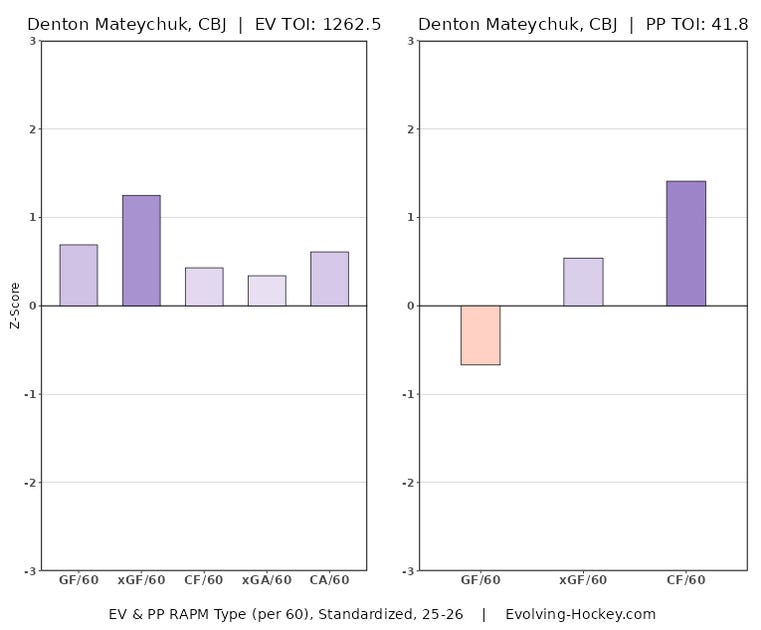
We can use Evolving Hockey’s RAPM to isolate his impact this season. Through this lens, Mateychuk is an all-around play-driver. There isn’t any one particular strong point, though his chance danger driving is the high point, but moreso a very well rounded impact altogether.
When looking at U21 performances via RAPM, Mateychuk grades out very well via his rounded impact but offers a different flavor than many other young defensemen. Most “all but guaranteed to be Franchise D” defensemen at this age were either outright dominant (Lane Hutson, Charlie McAvoy, Adam Fox, Matthew Schaefer) or drove corsi differential (Owen Power, Cale Makar, Zach Werenski, Quinn Hughes, Evan Bouchard, Jake Sanderson) without featuring success in the actual goals and chance share isolated metrics.
It’s worth noting that RAPM is a high volatile metric, though he shouldn’t necessarily be afraid of that volatility, but it should be part of the picture of analysis.
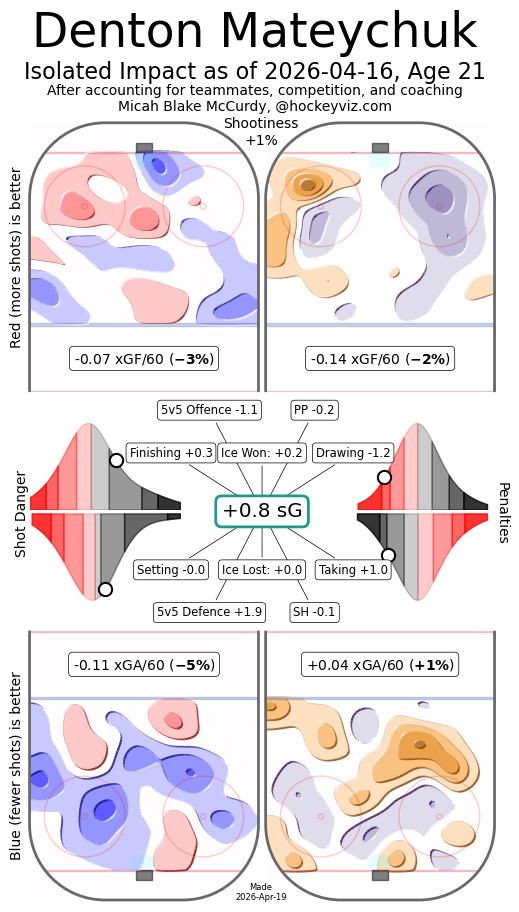
If we use HockeyViz’s isolated impact, which will also be somewhat chained to last season’s performance, Mateychuk grades out as a 3D or a high second pairing quality defensemen. This is, as far as I can tell, a pretty rare quality for a defenseman of this age and suggests he’ll be pretty good for the balance of his career.
While his defense comes out as the major driving force, the actual location heatmaps are somewhat interesting. He played his off-side, for at least portions of the season, and therein lies an increase in chances against and the corresponding opposite side an increase in offensive chances against. It’s foolish to read too much into location specifics but perhaps we can remark on how rare it is that he generated this value on his off-side as well.
Creating accurate cohorts is difficult enough in general but early-career defensemen perhaps only moreso. At this point, I think we’ll leave Mateychuk outside of that super top-end Franchise D cohort and instead put him in a grouping comprised of different levels of similarity. Apologies, I’m once again leaning on the ease of HockeyViz’s Career sG plots which come off as something of an overwhelming bird’s nest in this use-case.
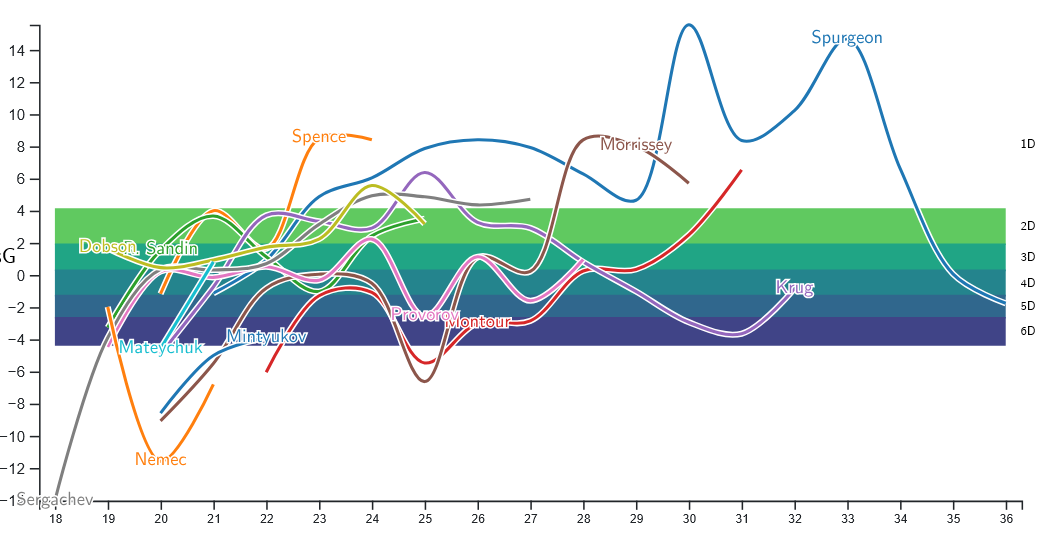
This cohort is primarily comprised of non-elite but high drafted defensemen in Mikhail Sergachev, Ivan Provorov, Noah Hanifin, Noah Dobson and more recent picks in Pavel Mintyukov and Simon Nemec. Similarly, I have attached some of the more appropriate size-oriented comparables in Josh Morrissey (though he’s bigger than you think), Jared Spurgeon, Jordan Spence, Rasmus Sandin, Brandon Montour and Torey Krug.
The more key concept between some of these lesser performing but still very valuable defensemen appears to be top-end skating ability. Werenski, Sanderson, McAvoy, Hughes, (intentionally not listed in the cohort) etc are all breezy skaters with massive capacity to influence the game across the ice surface. Sergachev, Provorov, Dobson don’t quite have that top gear or are otherwise lacking in some dimension.
The massive year-over-year growth of Mateychuk’s game certainly portends well for his overall career and, should he repeat this past season, might make him a top-pairing caliber player as soon as next year (when the 2024-25 impacts fade in relevance). Obviously, these two seasons simply aren’t enough data to be overly confident but there are a couple more factors that might differentiate him from some of the other “undersized” high performers, namely: coach trust and difficulty of competition.
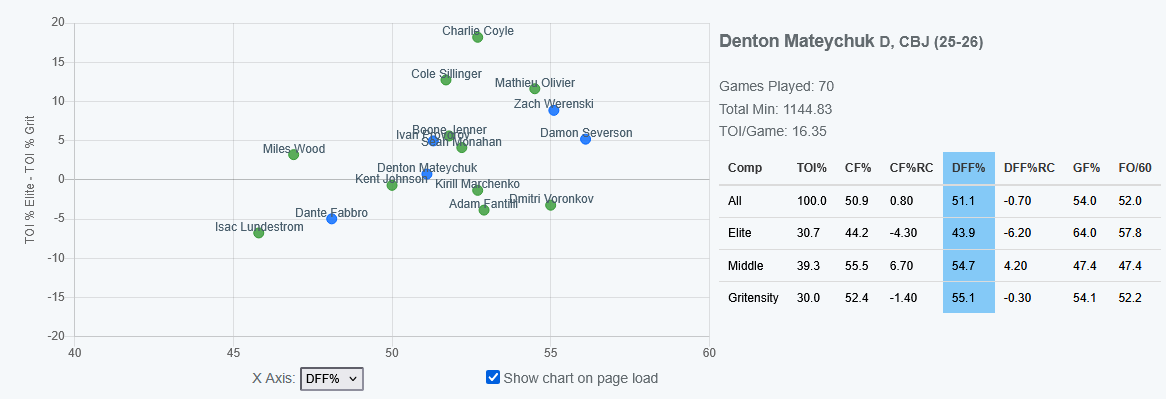
Mateychuk wasn’t particularly sheltered when it came to opposition competition. He didn’t necessarily perform well against this cohort, which is something for us to dig into later, but he wasn’t hidden from them either. Dean Evason appeared to have significantly more trust in Mateychuk than Bowness did, for whatever you find that to be worth.
In the case of Rasmus Sandin, Torey Krug and Jordan Spence, that wasn’t how they were deployed. Some of their early “high performing” seasons came against more sheltered matchups or only partial seasons.
Though the best math we can do suggests that competition doesn’t matter as much as we think, those two data flags open up the potential for impact by factors outside of our capacity to measure. Perhaps the coach is doing a great job hiding via on the fly shifts, perhaps there’s something we’re not quite measuring about competition impact or anything else it could possibly be.
Krug didn’t really have a full-season until age 22 and didn’t get full matchups until age 24. Josh Morrissey and Jared Spurgeon both received similar, though perhaps more difficult than Mateychuk, deployment this early in their careers and they appear to have turned out the best.
Stylistic Considerations
There are really two big aspects of this player breakdown. First, who is this player and what should we expect? Second, how does he do it and does the “how” have implications on the expectations? Utilizing the stats above takes us a good chunk of the way there but we’ve also left a lot of interesting data on the table.

If you’d like, I did plenty of similar work last summer on detailing many of the aspects of Mateychuk’s game.
We can turn to LB-Hockey’s integration of AllThreeZones data to help us take the next steps forward. Here, I’ll use a lot of Mateychuk’s tape and microstats to compare his “fitness” relative to some of the other high performing defensemen in the above cohort.
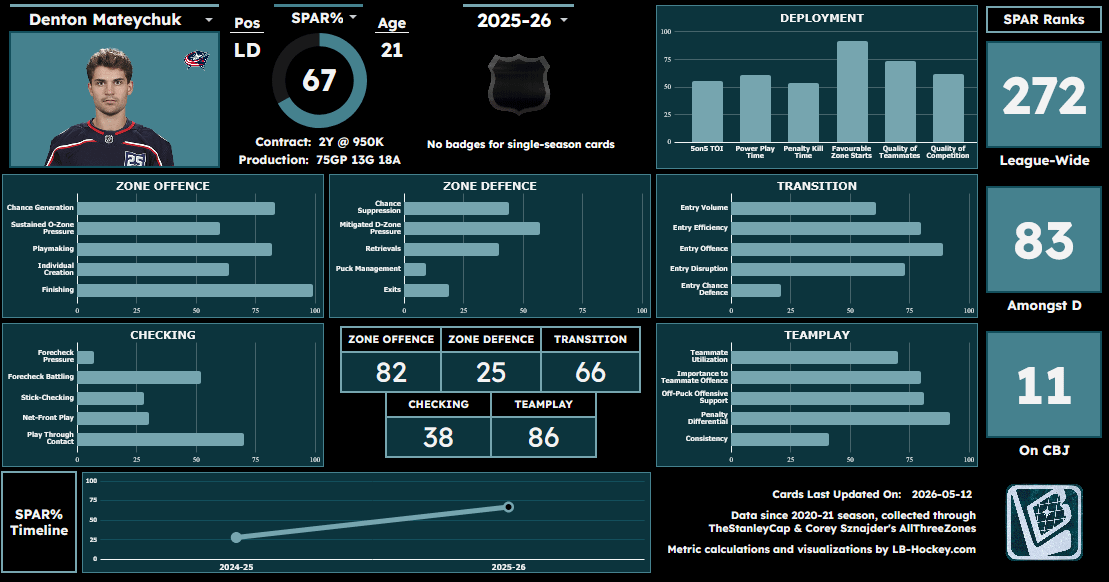
Here, Mateychuk is also graded as a quality second pair defensemen (if you assume there are 64 “first pair” defensemen in the league) from a single number value perspective.
Some key points to pay attention to here are the struggles at zone defense, especially puck moving, at stopping opposition transition and checking and the remarkable strengths in teamplay and offense.
I’ll start breaking everything down from here via the tape, and there is quite a lot of it, and sort of weave in the historical comparisons and what it might also mean for ultimate projection.
Involvement and Playmaking
I write this here to say that there is a very specific Denton Mateychuk “skill”, maybe “suite of skills” that explain these metrics incredibly well. Everything about Mateychuk improves the conditions of the overall play and renders the on-ice environment less-prone to disruption.
What made Denton Mateychuk a “potential paradigm-shifting” defenseman in his draft year was more on display this season that it was last and it makes him a brilliant player to watch closely.
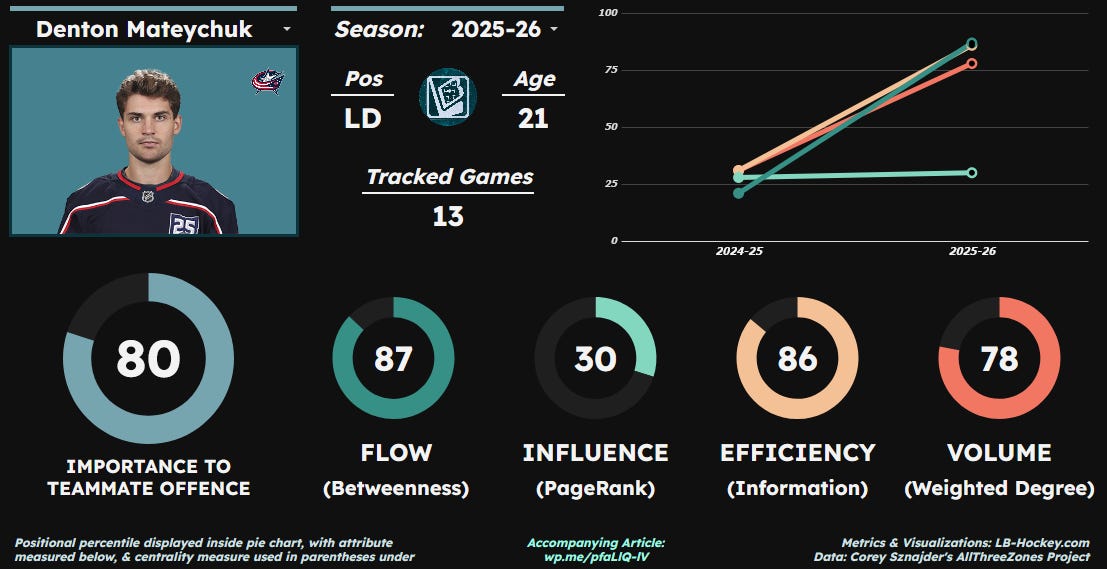
While Mateychuk’s first touches, and perhaps defensive zone involvement, took a bit of a hit this season his complete integration as a puck-mover to the team took a dramatic leap forward. Dean Evason asked his defensemen to contribute more to passing out of the zone, and less to directly hard-rimming pucks to wings, and that played heavily into Mateychuk’s strengths and growing confidence.
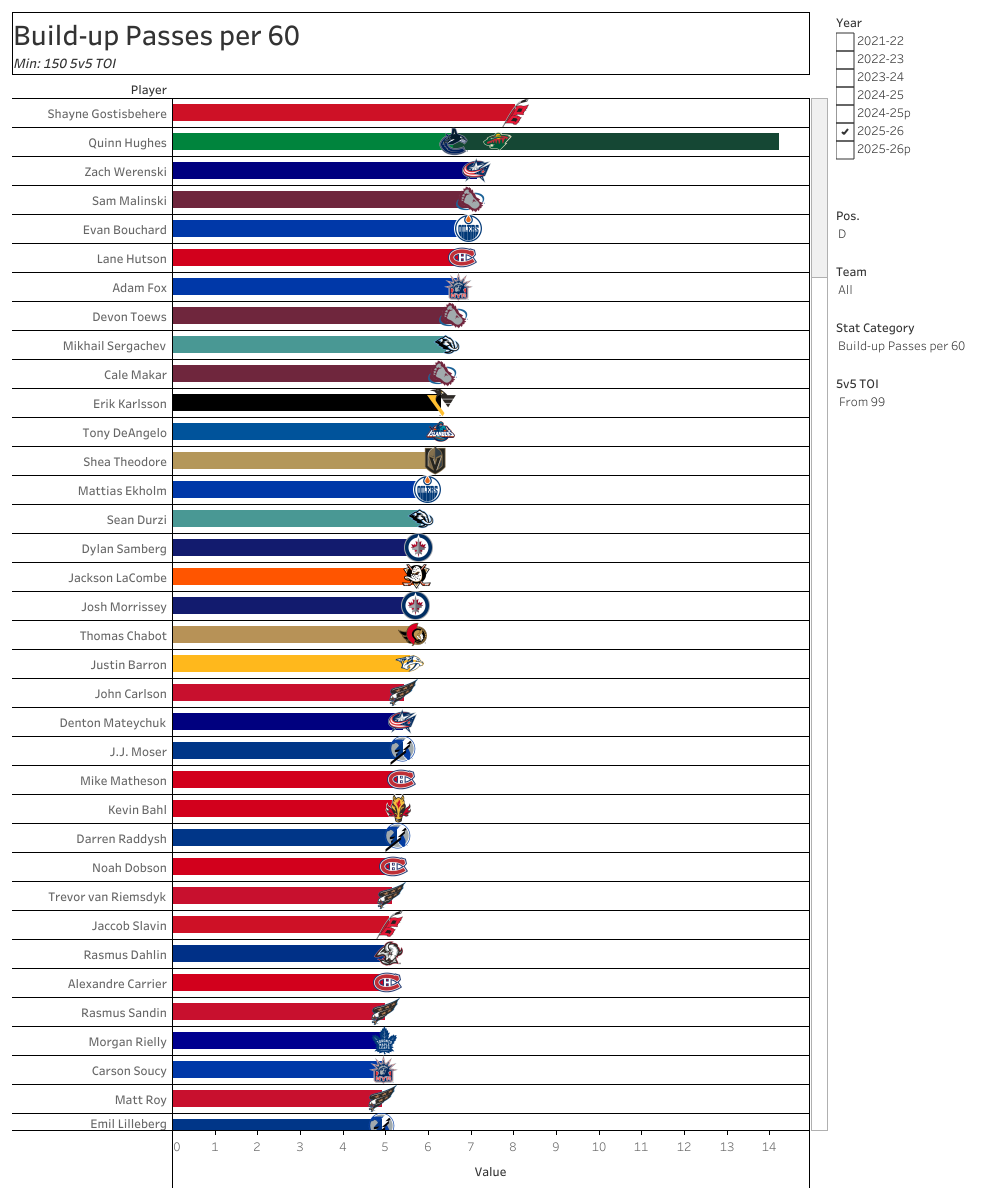
The end result was a Denton Mateychuk who was among the most involved defensemen in build-up in the league.
I do want to call to your attention a couple of important points relative to the playmaking network data. His efficiency and flow, basically his capacity to create team-connected passing environments and reducing the total errors via decision-making, were incredible. He lagged in Influence which, essentially, means he wasn’t regularly connecting high value players. Perhaps all that we need to see a full-force Mateychuk is time alongside better players where his “robustness of playmaking” could have significant implications of total impact value.
I though that I should perhaps work to cut some of these Mateychuk mixtapes down. Frankly I’ve been struggling with this aspect at an almost philosophical level as I chafe against the nature of conveying understanding of something through this medium. My instinct is to keep the full texture and depth and frankly I could not overcome that instinct with respect to Denton Mateychuk’s cornerstone ability here.
Above is 18 minutes of Denton Mateychuk jumping up the ice and getting involved in the play. I find it hard to accurately convey just how brilliant this set of clips is really. Mateychuk is perhaps 1 of 1 in his ability to read space and activate off-puck. There are more dominant players to be sure, the Blue Jackets have excellent examples of some of them, but none quite come by their impact as he does.
The fundamental move of Denton Mateychuk is to jump up into pockets of space. That’s not extraordinary on its own. But the sheer frequency with which he jumps into them, especially on neutral zone regroups, and at the same time the spacing when doing so is just brilliant.
He has an outrageous knack to find incredible pockets of support where he just makes playing the game easier for the puck carrier. He’s not always threatening the back-line, he’s instead insulating his team’s attack with brilliant timing.
I think the best illustration of just how good he is in this respect is how many times he lands on pucks just after something goes awry. He isn’t just activating for the space to get the puck but instead where he will be needed at the next step. He finds so many puck recoveries from unique routes and lands on so many rebounds because of this spatial anticipation.
I can’t say I watch the entire league and analyze every defenseman but his off-puck middle routes seem entirely unique and the number of goals driven from his drives down the middle lane perhaps already proof. That he’s already doing something different means there’s perhaps a ton more just to learn from him.
The top players all find their own way of doing things as a result of the unique interactions between their specific grouping of skills and how it plays with the environment in from of them. Mateychuk then might just be on his way. The questions that come out of this uniqueness are: what is he using to select these actions? what value do they have? how can we build around and support these tendencies? is this just a worse version of something else?
Offensive Zone Play
Mateychuk’s offensive zone play is a microcosm of the rest of his game. His vision and timing are excellent, his adventures deeper into the zone brilliant and, above all else, the wake of his movement creates just about as much as he does off of his own stick. So many of the above sequences end with a between-top-of-circles shot that come from his direct timing or space that he helped create by getting active deeper and deforming the defense.
A particular idea he has quite frequently, creating inversions near the blue-line, is yet to be fully tapped. Some of the clips were featured in the first mixtape but he has strong ideas on how to pull a defender toward him at the blue-line, find a quick pass and then sprint into the space he just created. The problem is moreso that his team and linemates aren’t necessarily prepared to wield that movement to great effect. Matthew Schaefer and Mat Barzal, though they’re both better skaters, are examples of what that can look like once chemistry and systems align around this concept.
His shot looks like something special too. Not necessarily in the way of Zach Werenski or Evan Bouchard but a tool that will both get a lot of use and be wielded effectively.
Improvements are there for the taking as well and this goes for the above too. While he’s got plenty of ideas and is brilliant up in the play, his handling range is somewhat limited. This might mean that some of these touches are less efficient than a capable forward and more often has to pull out of riskier situations. Mateychuk’s brain finds plenty of ways around this constraint but it just might be the difference between a pure slot-playmaker like Lane Hutson or Quinn Hughes and what he’s capable of ultimately discovering.
The Blue Jackets didn’t give Mateychuk much powerplay time at all, for reasons that are frankly difficult to understand, but his interchangeability and desire to play on every inch of the offensive zone suggests he could be incredibly interesting on a very movement-oriented and frequently switching unit.
Retrievals and Puck Moving
There are a couple of interesting points that might have more or less to do with A3Z sample size than anything else but it could also have implications on how best to set up Mateychuk to take steps forward.
If you reviewed the “Mateychuk is Primed for Growth” breakdown, you’d find that retrievals and defensive zone puck-moving were one of his biggest strengths. Compared with that limited sample of data from last season, Mateychuk’s LB-Hockey card this year shows something of the opposite.
In reviewing his tape from this year, and you’ll see that there is quite a lot of it, I don’t really see a problem with this specific area of his game. Perhaps a sample size issue but maybe even a systems issue as well. Not issue necessarily but a change in approach that might warp the data and maybe instead just be caused by the role-difference of more time on his off-side next to either Provorov or Werenski.
As the clips move into the puck-moving and regroup passing, I think we can come to appreciate his capacity to manipulate tempo and access pretty much every cadence of passing that would help solve any given situation. If he needs to make an instant pass to space, he can do it. If he needs to hold onto the puck to wait for a lane to open, he can do it. If the information in front of him changes while he’s waiting for the lane to open, he can amend his decision-making in real time.
A few of the clips above, especially with his regard to manipulate the players closest to him, should perhaps offer all of the explanation you need regarding his above puck-moving data. Safety and connection are all but guaranteed with how often he soaks pressure, deceives the nearest defender and astutely passes through to a teammate who now has a buffered pocket of space.
Is there room for improvement? Of course, but nothing that suggests that he won’t be able to make them.
Neutral Zone Defending and Aggression
The problem with Denton Mateychuk, writ large, is that his early action and eagerness to generate stops sometimes writes checks that his skating just can’t cash.
On one hand, this aggressive and early defending is how you thwart speed. On the other hand, most of the best defensemen in this regard (Hughes, Forsling, even Werenski and Heiskanen) have recovery skating with a couple of more gears than Mateychuk possesses. This means, generally, that he has plenty of moments where he exposes the Blue Jackets to big chance danger.
The first half of this mixtape contains film examples of Mateychuk’s early defending and how it can help stop possessions from building before it starts. The back half contains the evidence for his struggles against top end speed.
His skating and mind are great but he was a little too easy to exploit in certain entry defense situations. If you are exploitable, the best players in the league will find a way to exploit you. For a defenseman, that can be a problem. These struggles, such that they are, are likely what will prevent Mateychuk from reaching his “true potential”.
I don’t know that it will necessarily be a “problem” for the rest of Mateychuk’s career but, without improvement in some skating or judgement vector, it will become something of a give and take. He, or his coach or team or deployment, will have to adapt around that weakness rather than him becoming a pure all-situations play-driver.
In some sense, there are some general 1 on 1 defending issues as well though they didn’t necessarily make the clipping. He’s on the smaller side without exceptional strength which marks another point against him when it comes to “potential for exploitation”. So far, we’ve seen his “compete” do a boatload of work for him when it comes to compensation and a fantastic desire to win body position and create points of leverage. While that compete is excellent, it can come with it’s own exposure concerns.
Largely, the volatility and exposure created by his motor are something not worth being worried about. He does bite off more than he can chew, but like a young and talented playmaking forward who “tries to get too cute with the puck” I think we can see that it’s a factor of Mateychuk actively exploring the limits of what he can accomplish. As he gains more experience by way of information gathering, he will adapt and he’ll be better for it.
Final Considerations
Now that we have covered the final details of Mateychuks’ tape from this season, I think we can return to the “cohort” above empowered with more specifics. While the sG graph is important, we can take a further look into the microstats for some potential development avenues. I will include two more defensemen who didn’t make the previous cohort, Gustav Forsling and Mackenzie Weegar, primarily for symmetries sake.
The rest are as follows:
Jared Spurgeon
Josh Morrissey
Rasmus Sandin
Brandon Montour
Jordan Spence
Torey Krug
These seasons are chosen as representative seasons of the player and not necessarily the best and/or worst season that they played.
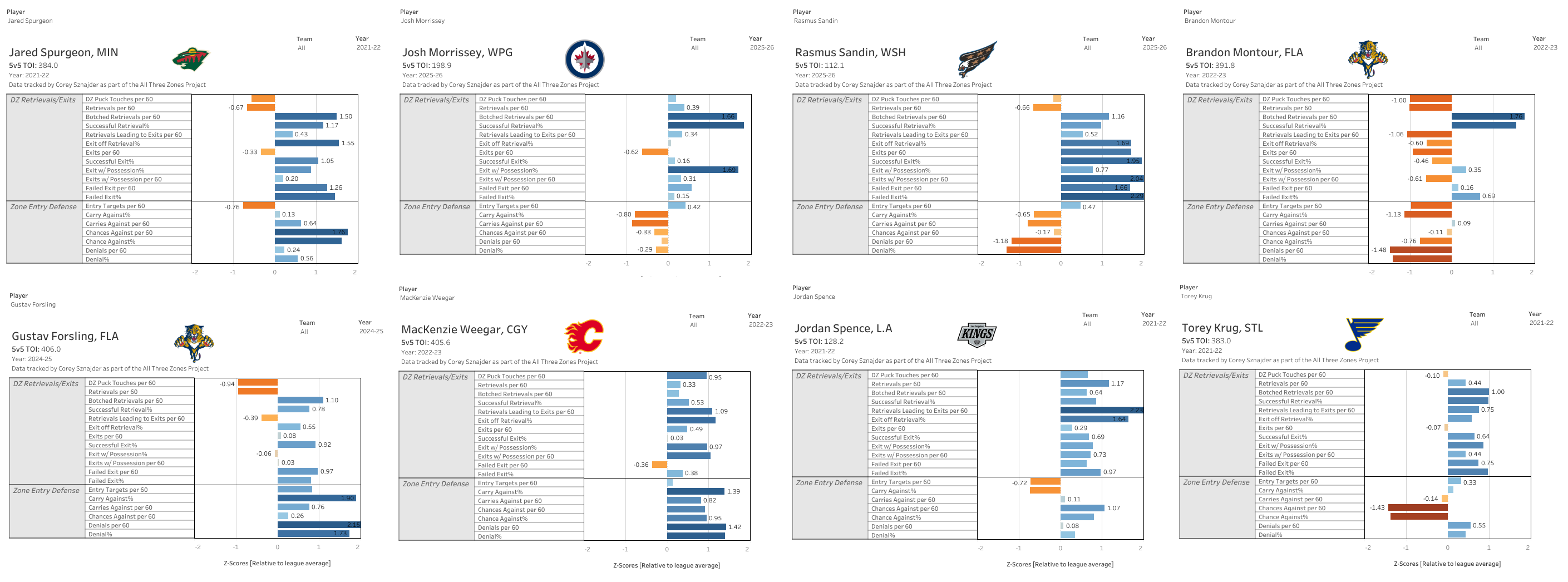
Apologies for the large image. I have condensed each of these defenseman’s AllThreeZones playercards into exclusively the puck-moving and entry defending sets. Mateychuk has the potential to be a special offensive defenseman and while I think that likely has a big impact on his ultimate effectiveness, it’s within these domains that he presented weakness this past season and therefore might remain the gatekeepers of his ceilling.
Each of these players, save for two I suppose, are well rounded and excellent puck-movers. Given what we’ve seen from Mateychuk, it’s likely he ends up in that category. I post this here mostly to show just how good even the lesser reputation players like Jordan Spence and Rasmus Sandin are. Should Mateychuk not address some of his greater concerns but show expected progress in this dimension those are good comparables.
Should be ultimately become only his offensive attacking dimension, Brandon Montour may offer an ultimate mid-range comparable. While he did score a ton of points and did win a Stanley Cup, he did so from a rare specialist role. He played on the second pair alongside a specialized neutral zone stopper and didn’t see top matchups.
The rest of the defensemen can be distinguished based on their capacity to get stops in the neutral zone. The best overall play-drivers, Jared Spurgeon, Gustav Forsling and Mackenzie Weegar all put up more or less dominant season in this regard. Josh Morrissey, Rasmus Sandin and Jordan Spence all became more entry absorbers for the bulk of their careers than they did outright stoppers. While they ceded entries and didn’t create offense from kills, they did prevent chances which might just be the most likely adaptation for Mateychuk. Torey Krug and Brandon Montour didn’t really perform all that well at entry defense.
Likely, the limit of Mateychuk’s impact rests on his capacity to improve his own neutral zone stopping. He can either round out some of that back skating output or become an elite judge of gaps and weigher of risk. If he doesn’t make significant improvements, he’ll probably have to dial back some of his risk which means he probably won’t reach the pure two-way impact of the top performers (unless his offense is just that good). Similarly, way back to his puck-moving, without the capacity to play against top players, it might be difficult for him to find time to connect some of the more dangerous players on his team. Perhaps a deeper offensive team, development of young forwards, or creation of different would each allow for the opportunity to connect more dangerous players.
I chose this group of defensemen, though, to illustrate that there isn’t just one pattern evident in high performing defensemen. Mackenzie Weegar, who is certainly an analytics darling, still has yet to be considered a true 1D mostly because his uber-involvement comes with significant efficiency tradeoffs in terms of mistakes. Jared Spurgeon did everything, Josh Morrissey took some time after breaking into the league with Byfuglien and Trouba, Torey Krug and Brandon Montour played scoring roles on deep defensive teams.
The case for Denton Mateychuk becoming an excellent defenseman is solid. Whether or not he ultimate becomes a high-level difference maker depends, as it always does for players this age, whether he can continue taking the next steps forward and whether he can ultimately carve out a role inside a coach’s systems.
Great stuff. I have some concerns for this team moving forward but Mateychuk certainly isn't one of them. Small sample size of course, but he looked very good even when Werenski was out. It's frankly baffling to me that Bowness didn't trust him more and that he's not gotten more looks on the PP.
I remember you mentioning his skating as his greatest obstacle last off-season too. Was there any improvement in that regard from last season to this one, as far as you could tell? I am a poor judge of skating myself.
Great stuff, sir. Love the deep dives!