
Dev. Trajectory: Cole Sillinger

Now onto the fourth and final installment of the Development Trajectory Series: Cole Sillinger.


Cole Sillinger
Cole Sillinger the player isn’t a particularly difficult one to understand but his trajectory is anything but simple. Players of this quality typically do not play in the NHL at age 18 though his performance that season could be interpreted as his best depending on your preferred lens.
Perhaps his inclusion by Head Coach Brad Larsen, “can’t get rid of him”, should have been all the information we needed to know that this Blue Jackets organization wasn’t ready to make responsible choices. I can’t exactly blame Larsen here, Sillinger was one of the four best centers in the organization at the time. Ahead of him were Boone Jenner and Jack Roslovic, both not actually centers. Now that I mention it, turns out Cole Sillinger might not be a center either.
The tricky part is peeling his actual value and import away from two things: his internal reputation and his heavy “experience” at this point in his career. I think both have a significant influence on his actual contributions, not necessarily in a positive way, but how they color our intepretation of his role and trajectory is perhaps more important.
What does it mean that he played 367 NHL games before his 23rd birthday? What does it mean that he was no longer a center but instead a contributing member of a heavily deployed matchup line? The critical question, without answer here, does the trust placed in him by coaches and front office personnel have signal we should pay attention to?
The Stats and Cohort Establishment
I have avoided cohort establishment for Cole Sillinger primarily because it’s just much more difficult to do. If you looked at the list of U18 players in the NHL his first season, you would come away with the conclusion that he’s on the way to being a Barkov-level player. I think we can comfortably say that’s out of the question at this point.
Given what we’ve seen this year as a more specialized member of a line, rather than just a near-drowning young player on poor teams, we can at least take a stab at identifying like-players. First, we should touch base with Sillinger’s contributions in a vacuum.
Like many non-definitively elite players this age, Cole Sillinger doesn’t grade out as a positive contributing player. In fact, he grades out quite poorly though improved from his consistent near-worst-player in the NHL advanced analytics grades from previous seasons.
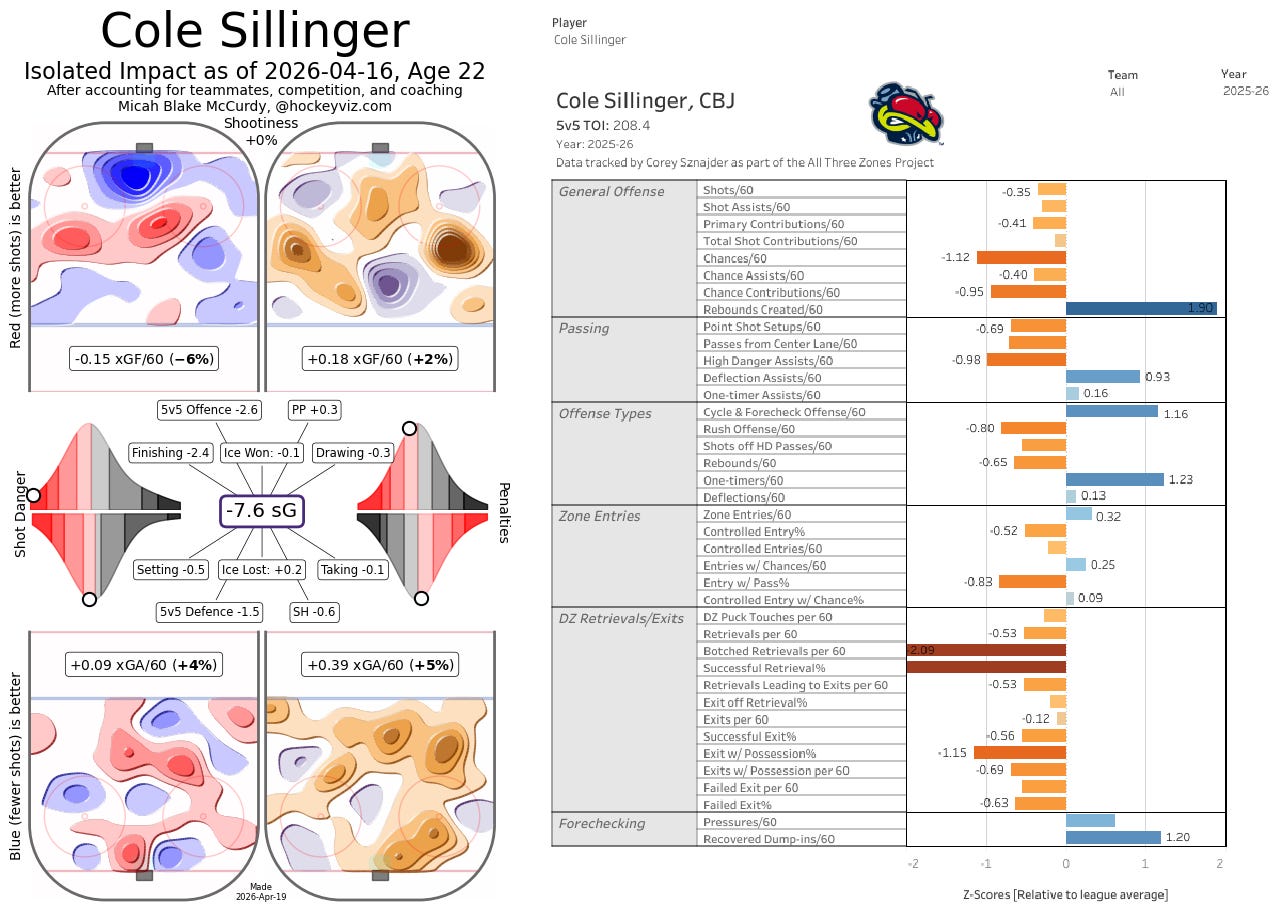
His AllThreeZones contributions are a little bit alarming, though with some things to touch on, and his HockeyViz is places him below fourth line status. The quick and clean takeaway, here, is that it’s most likely he wasn’t a particularly significant contributing member save for one critical area.
Sillinger shoots from a distance far more than the interior, mostly from the cycle and forecheck and has few other mentionable offensive skills. He is an average entry creator and average again at creating chances from them. He is incredibly poor at getting the puck out of the defensive zone. He is an incredibly well balanced and impactful forechecker and this is perhaps what helped him maintain his role.
HockeyViz corroborates some of the data, especially by way of offensive slot impacts, but they’re not really designed to do the same thing. The caveat here is that this data is still influenced by some of his previous seasons.
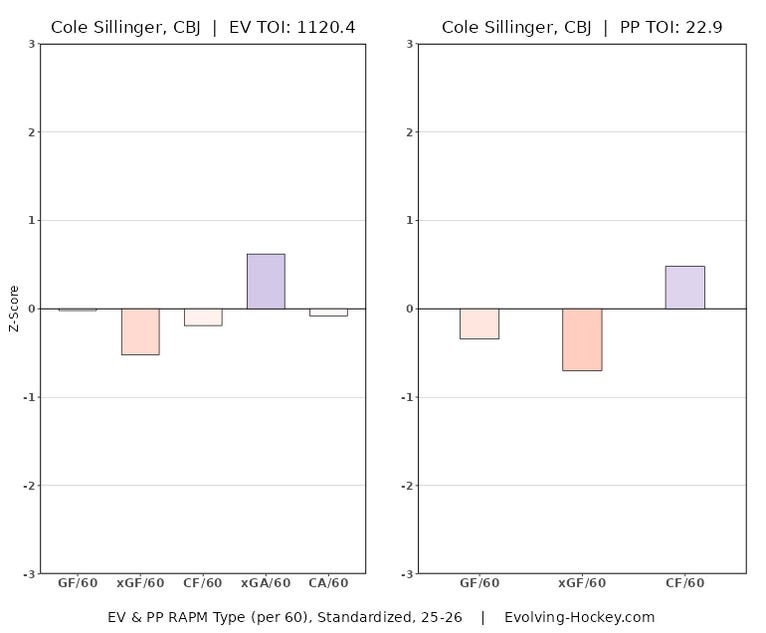
If we switch to EH’s RAPM, which is agnostic of his 2024-2025 season, he comes out a little closer to an average NHLer with some slot prevention capacity. Which one is “most correct”, we’ll have to find out. As we look into some of the tape, it’s pretty clear that Coyle and Olivier play specific styles that each reinforces slot prevention and both are more actively involved in creating near the net.
Should Sillinger perform similar next season, we’ll see a big glow-up via HockeyViz as his older, much worse performance fade away in weight-relevance.
So I suppose the good news is that, from a play-driving perspective and supposing his RAPM at age 22 wasn’t an abberation, we can probably comfortably cast Sillinger as a middle-six quality player through his prime.
That sounds like something a team would certainly want to have, especially considering his attitude, work ethic and the continued emphasis on becoming “Florida” or rather “the idea of the Florida Panthers”. Most heavily winning teams, though, have more than "middle-six quality” players in their middle six roles.
We have some of the requisite information, by way of skills and on-puck contributions, required to form a cohort above in the AllThreeZones but we’ll need to weave in his actual role and some better put together analytics to take the next steps comfortably.
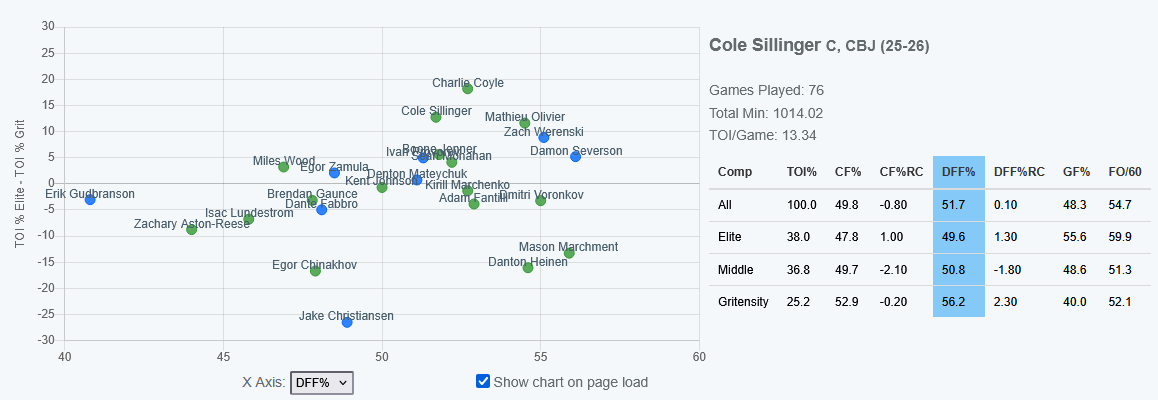
Sillinger drove his value this season as part of a member of the “matchup line” comprised of he, Charlie Coyle and Mathieu Olivier. They got very difficult deployment and often played against the opposition’s best. Inside of that competition, they performed pretty well. We have to acknowledge the Zach Werenski of it all, and certainly the Charlie Coyle of it all, but there is some value in at least being a contributing member of a line that was trusted in these sorts of situations.
This line did not drive possession, though did get some danger, and generally got some big actual goals contributions. We’ll dive more into this later but suffice to say that the coaches liked what Sillinger brought in these minutes.
This isn’t the first time he’s been in this very similar situation. Pascal Vincent loved how Sillinger handled Nathan MacKinnon near the end of that season, which did ignore that Kirill Marchenko did most of the load-bearing work. He again got similar difficult deployment last season but was again carried moreso by the work of Kent Johnson. It remains that Sillinger’s “belongingness” is still quite valued by NHL coaches.
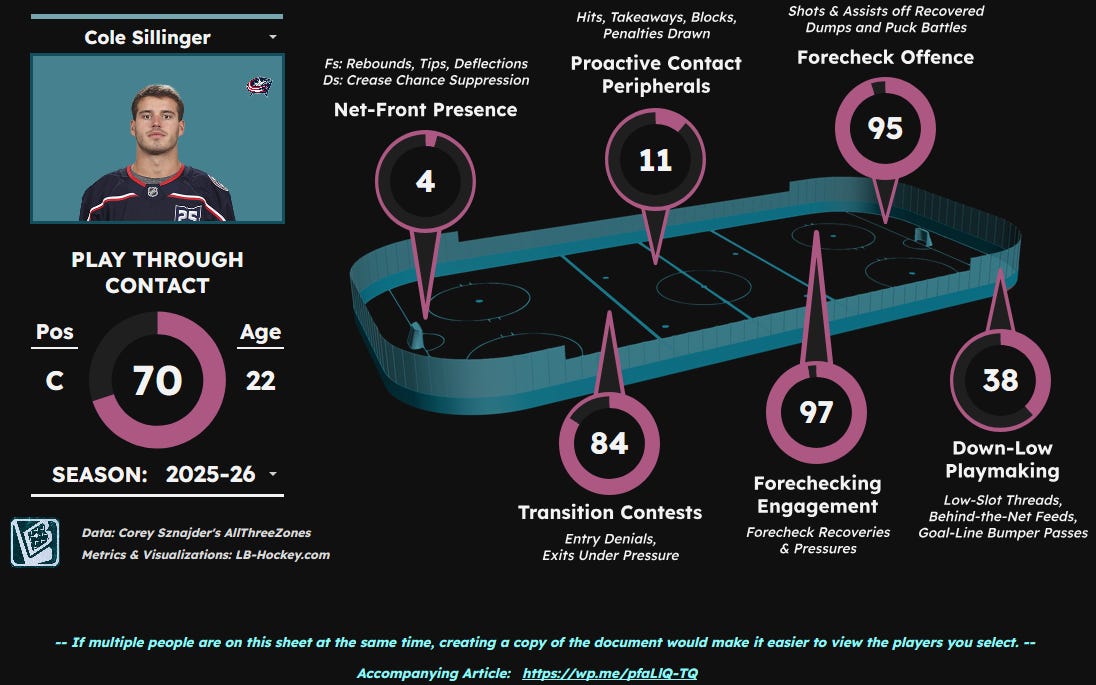
The reason Cole Sillinger belongs, and there’s perhaps more reason to buy his particular contributions this season over the previous, was because of his increased performance in play-through-contact situations. While he was always regarded as a “physically imposing” player he hadn’t really found a way to leverage it for positive outcomes. By moving to the wing of Charlie Coyle, which perhaps helped some of the underlying metrics, Sillinger had the opportunity to really get into the proverbial mix.
Most of his value comes from checking. There are still significant areas of weakness in even this very positive data but this at least paints the picture of the “niche” that he carved out on a very important role-line. Instead of Sillinger’s impact being mostly attitude and the promise of physical imposition, it moved more toward becoming reality this year.
This, at least, helps remove many players who might otherwise be labeled as “middle six” players his age. The problem with moving toward this more “vibes based” cohort, though the vibes come from sifting through data as well, is that there isn’t much of a guarantee that we’re including the full picture of players who did or did not succeed. Like with all of the previous young players, attaching them to the “growth curve” of players we already know have worked out is it’s own form of selection bias.
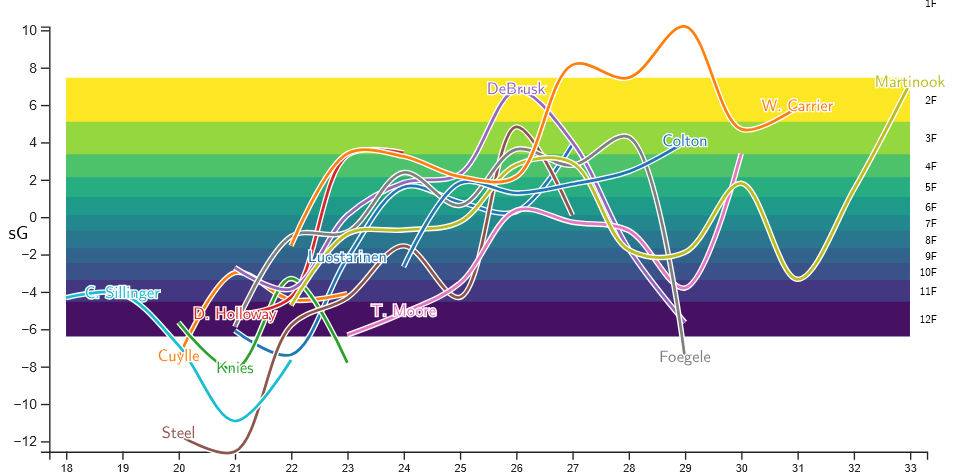
To that end, I have mostly looked for wings who are excellent forecheckers and create their offense mostly by way of shooting but balance is good as well. It helps, whenever possible, that they are cast more as “third wheel” types and serve as vertical threats rather than insulators.
Within the cohort of players who are reputationally aligned, we can at least say that Sillinger’s poor performance via sG was not uncommon at this age. Sillinger still grades out as the worst of the bunch but many of them made significant strides forward in the two seasons following their age 22 season and all improved definitively through age 26.
Similarly, some current young players who are held in high esteem, Matthew Knies and Will Cuylle, offer similar “fourth line” value. The “breakout pick”, Dylan Holloway leapt into an entirely different context when he changed teams from the Oilers to the Blues where Eetu Luostarinen developed steadily as a member of the Florida Panthers. While he’s obviously part of a brilliant defensive line a the moment, his breakout came in a variety of roles.
The difference between Matthew Knies and Dylan Holloway, at least, is that Cole Sillinger has no history of scoring at a high level. In fact, Sillinger has consistently been one of the worst finishers in the NHL every year.
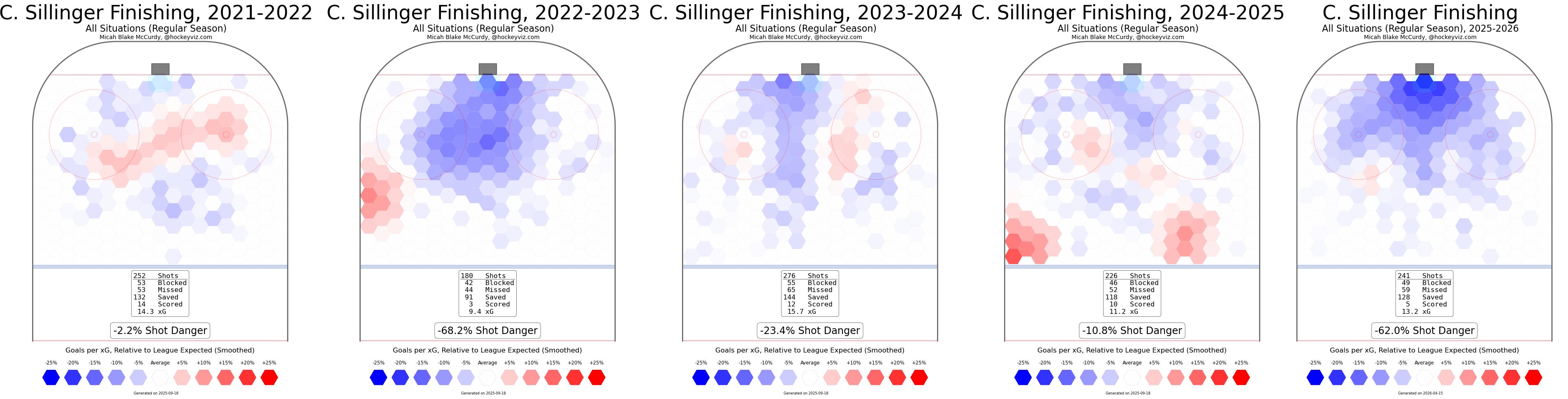
Cole Sillinger has never had a positive finishing season relative to NHL average. While it’s easy enough to write off some of Kent Johnson’s poor scoring as poor-luck based on an inconsistent history, Sillinger’s history doesn’t necessarily guarantee that there’s substantial positive regression in the future. We can see the “quality” of his shot but that has not yet translated to scoring actual goals. Better than this season? Sure. Good enough to make up for the elementary play-driving? Unclear.
The Tape
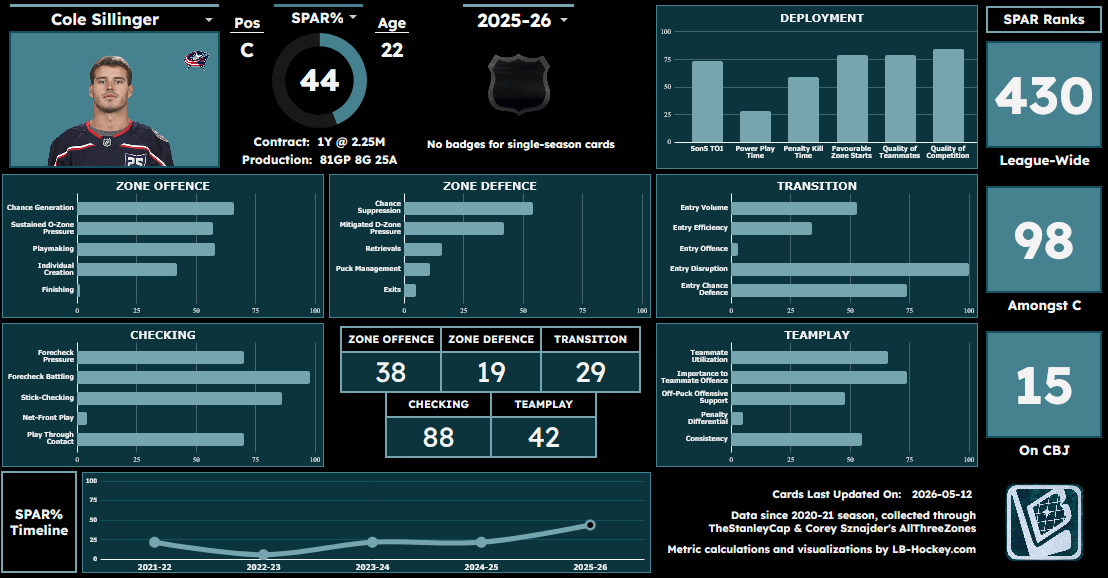
Cole Sillinger’s story as an on-ice creator is more or less easy to tell. In fact, by detailing the matchup line earlier in the season, I think I pretty much got all of it. As usual, the LB-Hockey card captures the rest.
Cole Sillinger was a highly involved and excellent forechecker with decent contributions to offense who literally couldn’t finish. Outside of the checking, he had some big problems with puck management, getting to the net-front and in taking penalties. His defense, such that we can suss it out from this information, wasn’t necessarily “matchup good”. Perhaps the penalties and puck management tell that story enough.
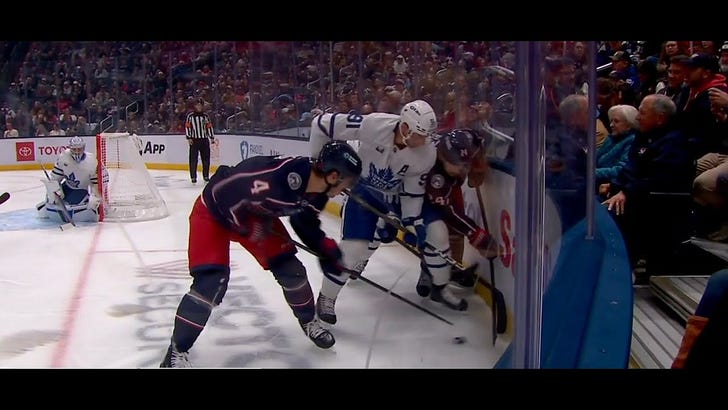
I’ll break out the clips again and offer what happened over the whole season, but it’s really more or less no different than exactly what happened in that breakdown. I’ll try to keep in quick in those repeat sections but there’s more to tell as well.
Checking and Intensity
To sum up Sillinger’s contributions to the matchup line, his specific niche, to a single word you’d have to boil it down to: energy. Maybe, enthusiasm? Desire-to-make-stuff-happen. Across different situations, that energy manifested itself differently. I choose energy because, in relation to Coyle and Olivier, there’s a level of recklessness in Sillinger’s game. Perhaps aggression is the better word but I don’t want to imply that Coyle and Olivier weren’t aggressive either.
I choose energy because it Sillinger was primarily a very active agent in the goings on. He didn’t move to insulate his teammates he was the “spender” of their insulation by way of attacking a puck carrier or a gap or an opportunity. That’s an important role, not that the line can’t function without it, but it helps bring versatility to attacking options.
To demonstrate, I’ll bring three different mixtapes that I think all work together to cast Sillinger as the energy of the line.
The first, and perhaps most important, was Sillinger’s work in the neutral zone. He was proactive in getting back, though not perfect, but mostly excellent by way of creating turnovers and, as a result, generating some counter-attacking offense in the wake of said turnovers.
The NHL has a metric for this and, though their metrics are generally not to be trusted, this one might be instructive: takeaways. At 5v5, among players with 500 minutes, Sillinger was tops on this line with 1.39 takeaways per sixty minutes good for 70th in the league.
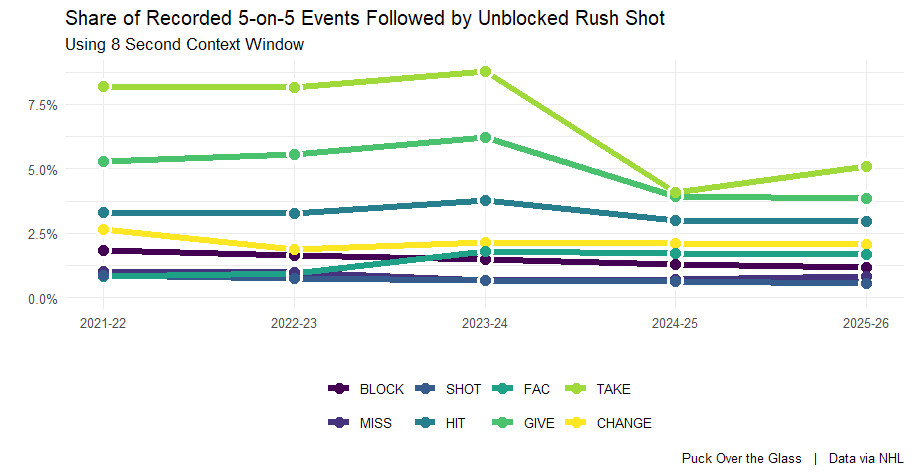
Some recent work via Aaron Knodell suggests that takeaways “frequently” result in “rush shots” . Hopefully soon I can link together some of my hand-tracked offensive situation data to supplement this analysis but safe to say that Sillinger’s play this year likely brought at least some degree of rush attack versatility to this line.
I don’t think we should read too much into this but there are some general repeats at the top of the list that suggest it is indeed a skill. For example, Kirill Marchenko ranked 40th in 2023-24 with 2.53 (NHL tracking changed after this season so all numbers will look different)), 18th with 1.73 takeaways/60 in 2024-25 and 3rd with 2.15 this season.
The list of repeats at the top of the takeaway list includes a smattering of interesting players: Evgeni Malkin, Mark Stone, Filip Forsberg, Alex Tuch, Josh Doan, Mat Barzal, Mitch Marner, Nick Schmaltz, Auston Matthews. Among defensemen, who gained in takeaway volume post-change relative to forwards, Jaccob Slavin, Cale Makar, Lane Hutson, K’Andre Miller, Adam Fox.
Given these generally low per-sixty rate numbers, we can still say takeaways are not a particularly common event. While those above are good players (for some reason particularly right handed wings) they certainly aren’t the players that line Selke nominations either. So, let’s leave this as a potential stone in the mosaic of on-ice contributions that comprise defense and take note that “true defending” might come from somewhere else.
Mostly, the line as a whole played the forechecking system very well and created quite a lot of danger by way of doing so. These forechecks, whether they ultimately result in corresponding offense or not, are one of the earliest points of intervention when it comes to preventing dangerous offense against.
He, and the line in general, was particularly effective when it came to creating offense in the downhill opportunities just after a wall-exit forecheck takeaway. We should recognize Sillinger’s role in all of this. He is active at getting in on the forecheck, combative on the walls and finds good timing to disrupt exit passes when the first wave doesn’t create something directly.
When we look at the AllThreeZones or LB-Hockey Data this is the core of value for Sillinger and, I’m sure, a big reason why coaches and the front office alike are so enamored with the young player. It’s easy to see this game working when defenses are dialed up come playoff time and especially if it works at slowing down opposition rush attacks.
This last mix is a combination of some of the less effective clips involving his physicality and forechecking. As it wears on, it gets to the negatives too. The departure I’d like to make from the “Sillinger is fantastic and playoff ready and a great defensive wing” is contained within the above mix, too.
While his forechecking routes look great and he’s highly disruptive, I think he’s very much gone to the Boone Jenner school of forechecking and defending, which is to say that there’s not always a lot of nuance and there is a lot of stick swinging at hand-height.
This sometimes reckless combativeness manifests itself in a ton of penalties and isn’t really indicative of how top players come by their defense. Look no further than the work of Charlie Coyle for a better example of what defense actually looks like. I’ll say more later about conceptual takeaways but let’s just say that plenty of Sillinger’s aggressiveness was enabled and not necessarily effective in a vacuum.
Offense
In-Zone Off-Wall and Recoveries
Sillinger’s primary contribution to the in-zone offense revolved around his capacity to get to the walls and battle hard. From there, and no doubt due to his strength and wall-pickup ability, he was able to win the puck and exit the battles with enough speed to do something with the puck.
That most often manifested itself in the corner-exit pass to the slot but plenty of direct handling power-moves at the same time. We should not underestimate the utility of this particular skill as more recoveries mean plenty more time spent in zone and plenty of opportunities to eventually create structure breaking moments later in the sequence.
In the above “matchup line” breakdown, I think I generally overstated Sillinger’s contributions to the offense. While I still agree that he added something that was important, especially energy, a second look at those clips and more games since then suggests that Olivier more than held his own from an off-wall perspective and Coyle’s importance goes without saying. The two more veteran players had a measurable impact on actually getting pucks into the slot.
Similarly, he doesn’t quite have the skill stack, or body-contact → takeaway → playmaking integration that you see of the true top takeaway creators. Kirill Marchenko, Dmitri Voronkov and Mason Marchment are better examples of what that looks like but, from this playoff run, Zach Benson and Josh Doan as well whereas Auston Matthews is perhaps the best example of skill-stacking in the league. They don’t just take the puck, they take it and instantly exploit the openings it created. In order to become a true defensive force or even a high quality top six complementary player, rather than a pace-oriented checker, he’ll have to start stacking some of these skills.
On that front, there hasn’t been overly much progression even as impact has grown. I think we’ll see as much in some of the transition tape.
Shooting
Demonstrating the sheer volume of quality shooting chances serves the same purpose as it did for Kent Johnson. There are simply so many good chances. Like with Kent Johnson, a little too many of these end with blocked shots. Despite his mechanically excellent release and high velocity, the pre-shooting handling has a bit of a hitch. He tends to “dust off” the puck with some quick handles which ultimately limits his capacity to beat the goaltenders.
Ultimately, it looks a bit like a problem with shooting-location selection or a continued priority of simply shooting hard rather than modulating each of those aspects relative to this specific situation. I can’t really say why exactly he has some consistently near league-worst finishing but perhaps he is instructive of the vast gulf between finishing and shooting.
Transition
Neutral Zone Carrying and Transition Passing
While Cole Sillinger did bring some rush offense he still didn’t grade out particularly well when it came to comparing him to the rest of the league, though it’s easy enough to see that his line prioritized different modes of creation. What I’d like to point out here are some of the same habits or skill deficiencies that have plagued him for quite a while.
His skating remains mostly the same. His heels kick, his strides are short. I noticed his skating less as a limitation, despite the sameness, and that probably says all we need. I think he anticipates sequences a little better but the clarity provided by Coyle, Olivier and the general identity of the line probably made that a little easier. His acceleration has some issues but staying in motion appeared to ameliorate the greater negative impact.
I think the lack of skill stacking expresses itself well in some of these sequences. His handling, in particular, comes across as a little bit… stiff? Really, he still has a tendency to stop moving his feet whenever he gets into pressure situations or is otherwise faced with more complex handling situations. Perhaps the recent exposure and deep diving with Adam Fantili, Kent Johnson, and Kirill Marchenko by way of all of them, has made all other puckhandlers look inferior by comparison.
In any case, notice especially some of his delay sequences and how.. discrete(?) each segment of the move is. This suggests further need for “blending” but might also suggest he needs to anticipate and integrate these moves into his anticipation better as well. We don’t need to spend too much time here save to say it doesn’t appear that we have a rush dynamo waiting to be discovered.
Transition Turnovers
The downside of some of Sillinger’s boldness with lack of anticipation is the degree to which it turns into big turnovers. The data above suggests a puck management problem and it certainly appears there is one. The path forward here is easy enough and could be taken quickly next season as he leans into a puck hunter.
Post-Entry Routes
The more confounding or frustrating aspect of Cole Sillinger is that he has some genuinely good post-entry ideas that he can, on the occasion, turn into some very interesting rush looks. He’ll hit the entry, especially in even-numbered situations, and surf across the zone east-west to open passing lanes and more creative connections with his teammate. Compare this with Kent Johnson who, mostly, prefers to stick to his lane after entry and let the play and space develop. I am sure Johnson has ideas on why he does so(he plays on the perimeter to open the slot, which necessarily precludes him skating into the middle lane, but I think he’s too rigid on that front, and the combinations with Garland perhaps instructive, but Sillinger’s approach has plenty of value as well.
The Matchup Line Niche
The difficulty with Cole Sillinger is placing his current value alongside some sort of trajectory. Given the extremely volatile nature of the Blue Jackets over his career, we shouldn’t exactly be surprised that it’s hard to understand what exactly he is.
This year, though, was his first year shifted to the wing full-time. Inside that transition was an elevation in terms of competition and 5v5 role but at the same time an insulation next to players who feel a little bit designed to hide some of his weaknesses.
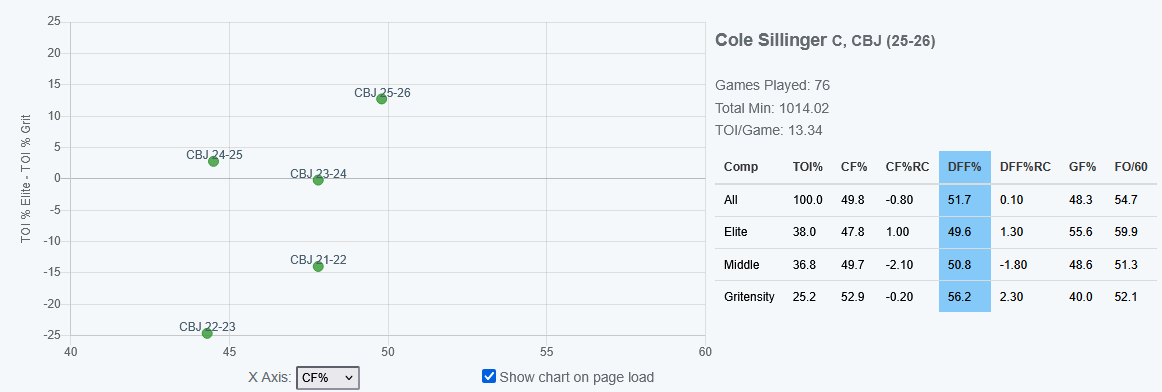
While it certainly feels like Sillinger isn’t making progress from any real angle we can measure, perhaps the progress is hidden by the increased difficulty of his minutes. Not only was this season the most difficult deployment of his career, it was also by far the best performance relative to the team.
Perhaps, when looking at most players at age 22, they simply weren’t given the opportunity to “fail” as much as Sillinger arguably has. Normally, when a player is bad they simply don’t play. They are “hidden” as much as they are likely sheltered. Many who performed quite well early in their careers may have done so under coach-designed conditions that we can’t adequately capture. I wouldn’t necessarily say it’s likely, many difficultly deployed players also had sterling underlying numbers that went unrecognized by coaches, but we can at least acknowledge some of the potential blindspots as well.
The more difficult aspect of the overall player evaluation comes from the ultimate deployment of him by the coaching staff, especially relative to other players, but also in terms of his “core” status as told by the front office. We’ll see shortly how valued his contributions are by way of a contract but evaluation in the meantime could be critical to offseason planning.
Late in the season, Rick Bowness grew tired of the inconsistency of Mason Marchment alongside his rigidly insisted top line of Adam Fantilli and Kirill Marchenko. Simply too many turnovers despite some very heavy minute winning. In order to “promote balance”, Bowness shifted Cole Sillinger (and later Isac Lundestrom) alongside Fantilli and Marchenko.
This isn’t a Cole Sillinger issue but I think it helps illustrate what exactly Sillinger brought to the matchup line in the first place. He wasn’t an insulator who covered for his linemates and increased their safety, he was a spender whose aggression helped bring some juice into a line that might have been a little slow otherwise.
In order to illustrate the difference in performance, we can look at Cole Sillinger, Charlie Coyle and each without eachother.
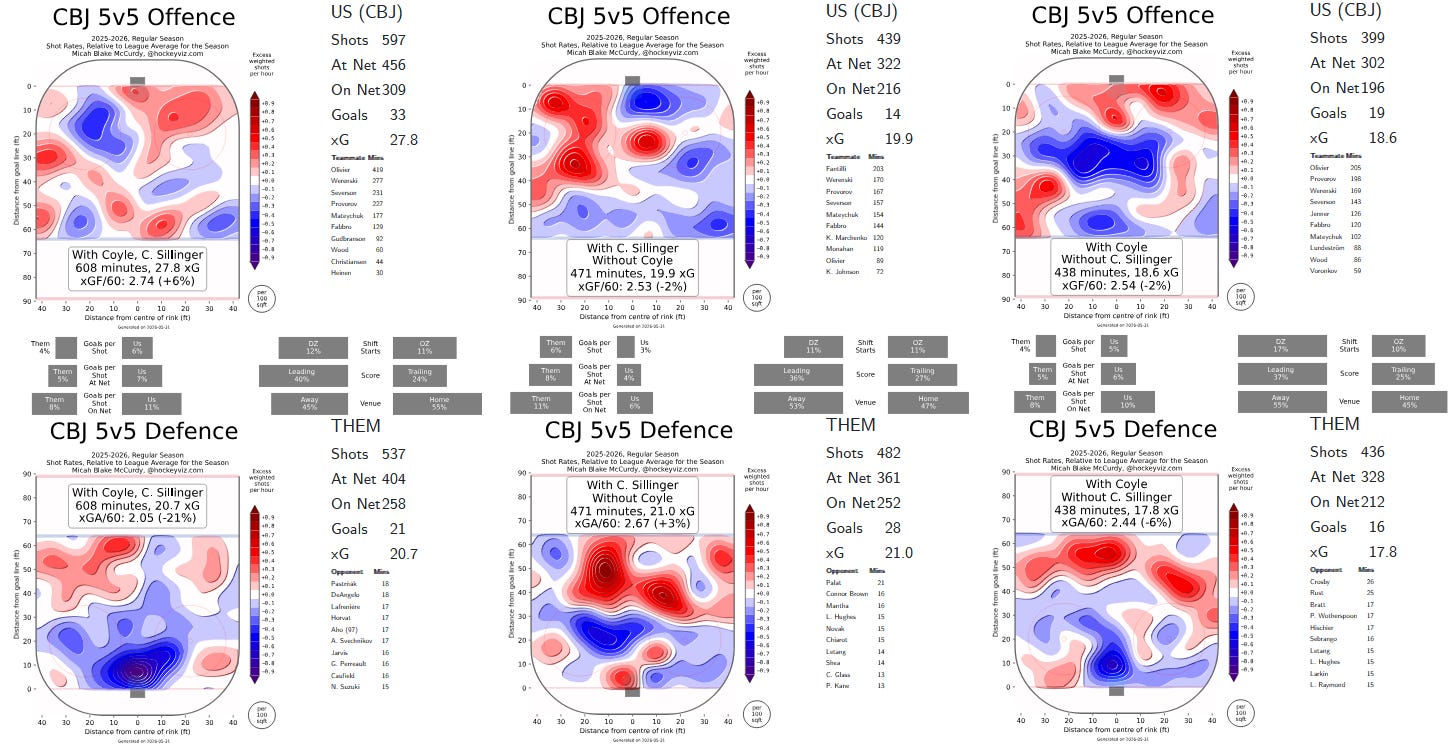
Together, 33 goals for and 21 goals against with expected goals close to matching. Sillinger apart from Coyle is ghoulish, 14 goals for and 28 against. Chances were better but there’s a clear lack of performance in both high danger areas. Coyle apart from Sillinger, a low event but danger focused on-ice performance. 19 goals for, 16 against.
Further along those lines and you get Sillinger and Fantilli with extra Werenski, and competition against secondary competition, whereas Coyle spent more time with Olivier and Provorov against the best of the best. Coyle’s impact was far more robust than Sillinger’s suggesting he had a lot more to do with the on-ice performance than did Sillinger.
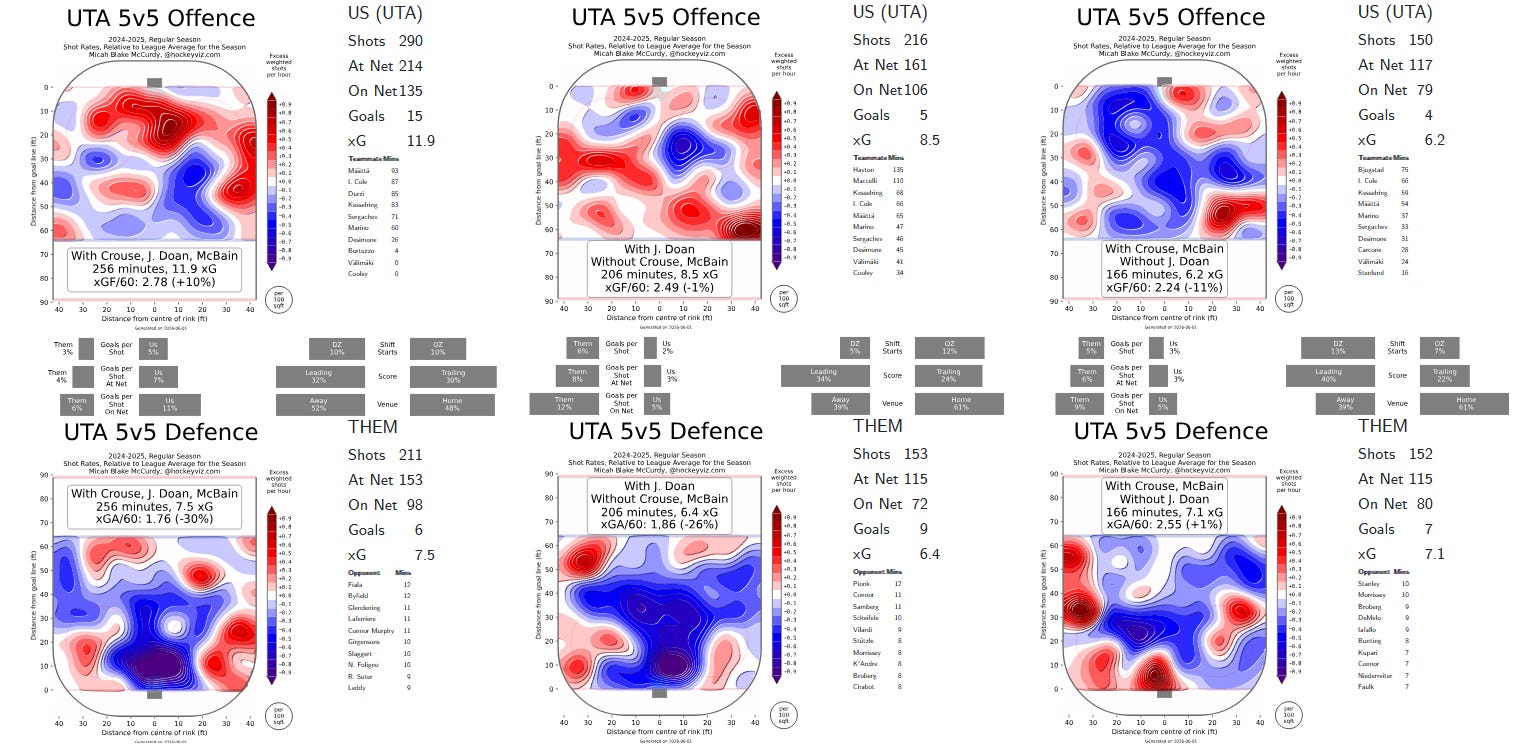
For an example of another case study of a young player who played a similar role to Sillinger, a wing on a matchup line filled with veterans, and got excellent defensive results: Josh Doan. He’s perhaps top of mind for anyone who watched the playoffs particularly because he also got a long contract extension and performed very well this past season.
Crouse-McBain-Doan was a somewhat dominant 5v5 defensive line for Utah last season. Given his rookie-ness, it’s easy to think Josh Doan had little to do with it. When we look at the on-ice impacts of the veterans separated out, we can very much see that it appears Doan does have a consistent impact on slot defense.
I was already prepared for this conclusion partially because I did plenty of film study on Doan as he really caught my eye. When investigating his too-good-to-be-true RAPM impacts, I did notice that he very frequently rotated behind his teammates to take up low-defensive zone positions. There was at least a plausible mechanism for Doan suppressing shots in the home plate area.
If, when Sillinger is on the ice, Adam Fantilli is still routinely defending as the low forward, it’s unlikely that Sillinger would be responsible for any observed “lack of shots” from that area. Obviously, defending in this specific capacity is the most entangled with teammates and decisions in entirely separate areas of the ice but the point remains.
Furthermore, Doan certainly has the body contact sense and skill stacking to quickly convert takeaways into offense. This helps across the ice-sheet. There’s a reason I didn’t really put him in the same cohort as Sillinger. Hopefully, this limited case-study serves as a way to help sus out some of the niche’ing that can occur for individuals who play inside high performing lines.
Sillinger, on tape, does not have rotation coverage insulation on his tape. Charlie Coyle and Mathieu Olivier more readily took up that role. On that front, it was largely predictable that Sillinger wouldn’t work alongside Fantilli and Marchenko as they, similarly, need someone who would rotate behind to plug defensive gaps. Marchenko could have taken that role, and has been successful in the past, but he was an offensive leader for this club and that exchange a poor one.
This last little bit has more implications on general roster building but should, by way of that perspective, help illuminate some of what Cole Sillinger actually is. I think this is an important point to mention specifically because of how similar he is to one of the cohort members, Jake DeBrusk. On that Boston team, the line of DeBrusk-Coyle-Frederic feels quite similar to the current Sillinger-Coyle-Olivier. While the isolated impact at the time suggested Coyle was struggling and Frederic and DeBrusk were breakout talents, time away from eachother has yielded almost entirely opposite conclusions.
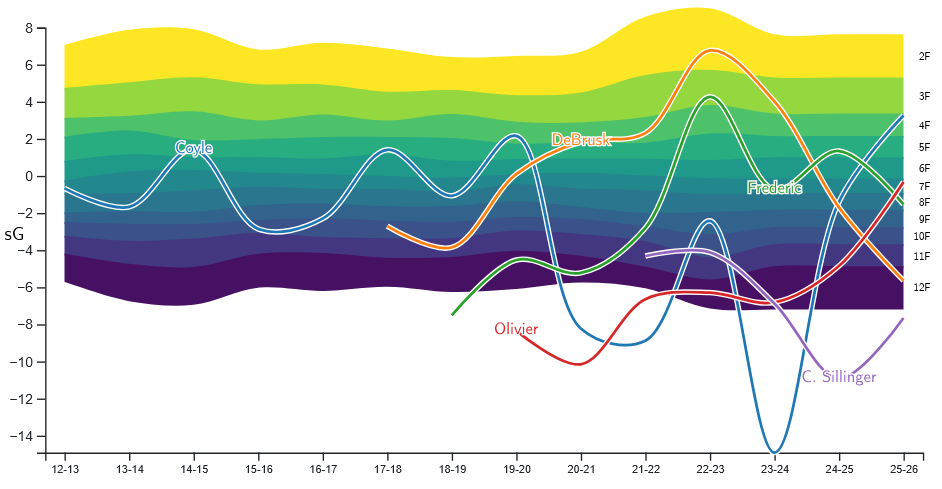
Now, DeBrusk is coming off a strange scoring season. At 5v5 he scored 3 goals with a 2.48 SH% which is one of the few seasons worse than Sillinger’s 5 goals and 4.44 SH%. By way of powerplay finishing, however, DeBrusk finished the season with 23 total goals. Frederic, acquired by the Oilers, also shot 5.19% at 5v5 and feels well on his way to a buyout.
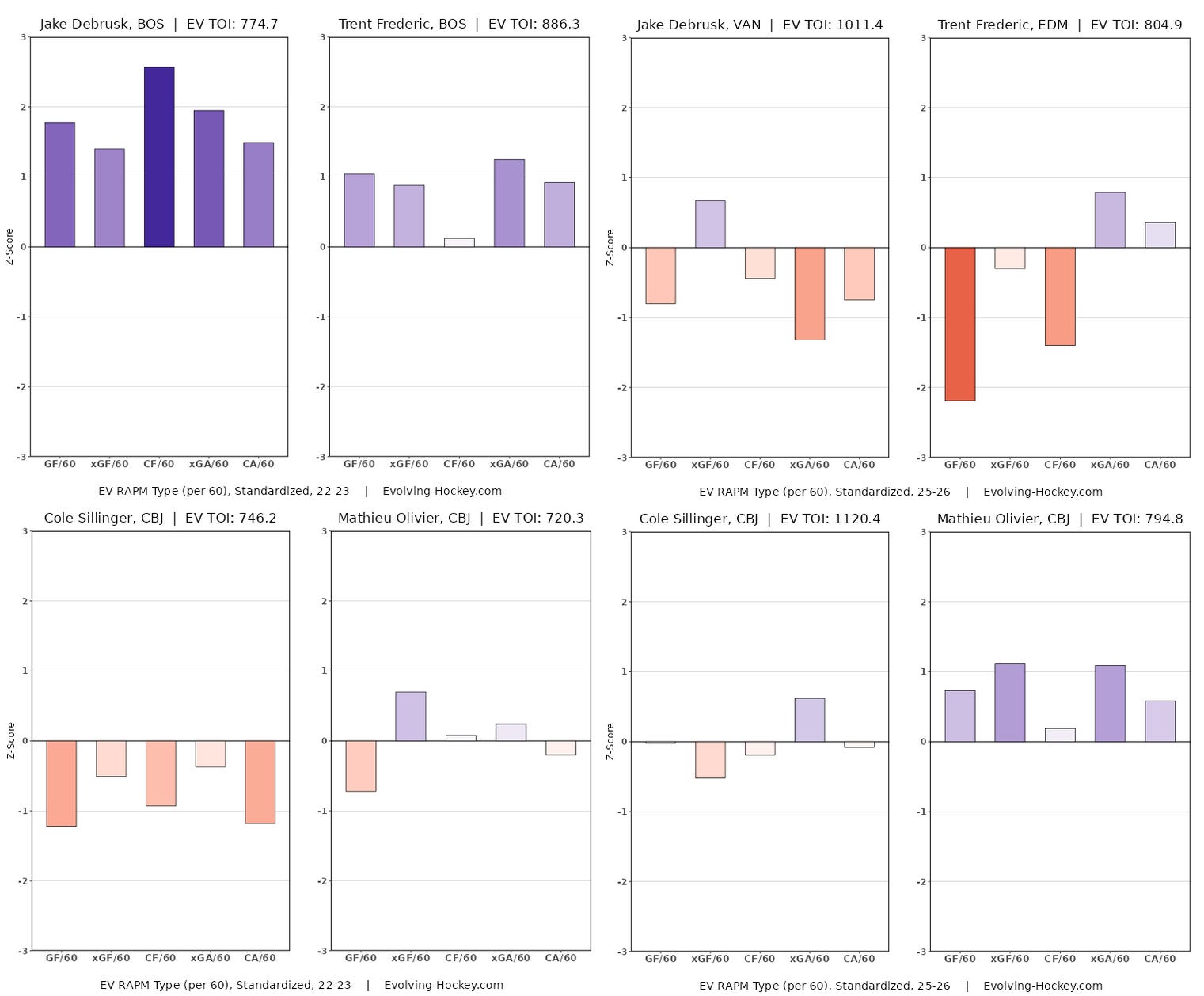
This is a separate issue, I suppose, but it’s genuinely alarming how similar Olivier and Frederic’s RAPM cards look when they played next to Coyle.
Future Considerations
That all but wraps up the series with this final piece on Sillinger. If you’d like to compare how specifically he compares to a similar exercise that I completed two offseasons ago, feel free to read.

Cole Sillinger is held in high esteem by all hockey men in the Blue Jackets’ front office. While their reasons are good, attitude and work ethic should still be valued in a team environment, his current ability doesn’t necessarily merit significant protected status.
His defensive fragility was somewhat acknowledged by way of his limited penalty killing time (the Blue Jackets’ playoff hopes may have died on his coaches deployment decisions, so maybe not the best appeal), though I must admit the Blue Jackets need a player who can kill entries in some capacity on the unit.
In any case, there are clear areas that Sillinger must develop in order to find improvement along whichever role axis is preferred. The pacey-forecheck drivers like Eetu Luostarinen and Warren Foegele or the high-value complementary power forwards like Matthew Knies and Dylan Holloway.
The biggest, most critical area for improvement, for both roles, is in both attacking and defending the slot area. While there’s plenty of promise inside his in-zone off-wall game, he still needs to develop some contact-for-offensive-exploitation skills. His game feels centered around creating more open space via quick wall play and physicality than it does using contact to manipulate bodies and succeed through closed space. In my mind, that’s the distinction between some of the most consistent and best complementary players (and the entirety of the Florida Panthers) and someone who is simply part of a forechecking unit (or what it seems the general media believes caused Florida’s cup).
As far as defending goes, and especially if he wants to develop along the matchup-forecheck axis, he simply needs to fix the same awareness issue. Perhaps more time alongside Coyle, or with Rick Bowness as a coach, means the slot-protection over direct-stick-attacking methods win out. Otherwise, we might have a similar Boone Jenner defensive situation. A very trusted player but one whose defensive stopping power is limited to activity at the puck. If he wants to be the transition/vertical forecheck leader of a matchup line going forward, he’ll absolutely need to find better defensive insulation and certainly a penalty-killing role.
Frankly, I see him as somewhat similar to a forecheck flavored Alexandre Texier at the same age. Handling skill, powerful shot but lacking the softer space passing and rolling-off-bodies, or facing-the-boards passing abilities, that true top off-wall creators possess. Texier took a step forward in that regard with some quick chemistry with Adam Fantilli, especially in terms of his reconfiguration of handling and playmaking ability from open ice to the small space scenarios, but never quite leaned on it consistently and his defensive directness/lack of awareness was eventually exposed.
It’s unclear whether or not Sillinger can develop his finishing. It hasn’t improved yet but it’s also been so poor through his career it’s fundamentally difficult to believe. If finishing rebounds, Sillinger could add an entire offensive dimension to a matchup line.
All told, Sillinger developed a strong role this season and that’s not without merit, especially considering both Coyle and Olivier are signed for the near future. Sillinger’s forechecking routes, tenacity and in-zone puck hounding all provide a template for a role that most teams have a significant desire for come April, May and June. Whether he has the actual defensive triage acumen, or the ability to win confrontations and create through defenses, might just remain the cap on his ability to positively contribute.
The only question is whether the team might be improved with veteran players in his role on a team that seems to be on the second year of playoffs or bust.
It's fascinating how a prospect primarily characterised as a shooter can become such a dreadful finisher. I remember on one of his goals, he had a wide open net and still hit the goalie. Respectfully, I'm seriously starting to wonder if he has some sort of lingering post-concussion issues or something.
Personally, I hope other teams value him as highly as Columbus so that he might be included in a trade. Maybe for Larkin?
A bummer you won't do one of these on Voronkov. He, Johnson and Monahan are the big questionmarks heading into next season.
Great stuff as always. Sillinger's game bothers me so much I actively take it personal. All that skill and it's trapped in the vision of an NPC.