
Winning Time is Now
The Waddell Window is Open

Don Waddell recently got the first bit of his overwhelming off-season contract negotiating business done by signing Charlie Coyle to a 6 year, $6 million AAV contract early Tuesday. The contract comes on the heels of news via Aaron Portzline on Monday that negotiating with free agents hadn’t even started.
Charlie Coyle
The quotes coming in the wake of the signing only further support the ease of negotiations, perhaps by way of excellent groundwork laid during the Olympic break, and desire for both parties to get it done. Coyle, reportedly didn’t even take his gear out of Nationwide and had this to say about his signing.
We can win. I see that potential and I didn’t want to leave that.
Those are very exciting words to hear from a player who was genuinely very good and a person who is about as wholesome as they come. Charlie Coyle represents some actual talent and skills that this roster simply hasn’t had for a long time and, on that front, his inclusion in this locker room for the years to come is very exciting.
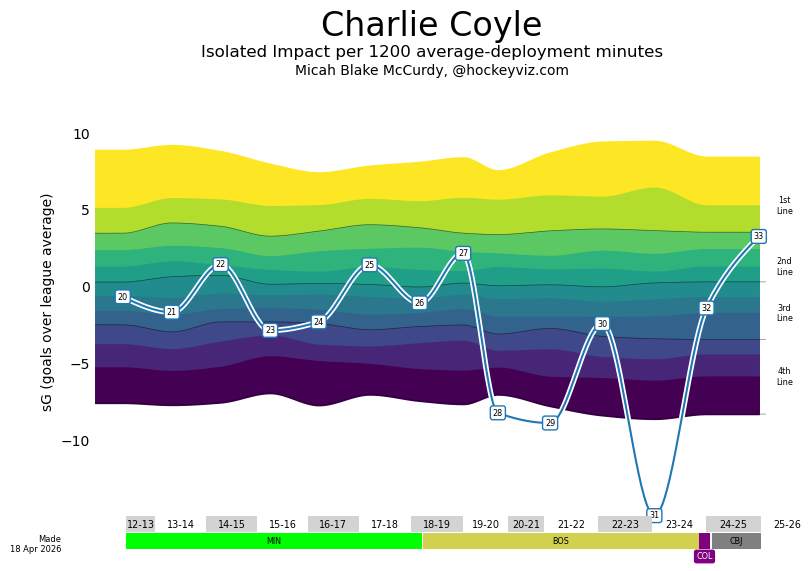
Evaluations of the player and the resulting contract are murky. This was the best season of Coyle’s career coming on the back of a stretch of mostly the worst according to sG. Signing a UFA to a big contract after a career year is a classic GM trap but we’ll save that for later, for now we’ll focus on the player.
Charlie Coyle was genuinely good and I think there are good reasons to suggest that his demise was exaggerated by some collinearity within the above model.
Essentially, he shared so much time with certain players on Boston who looked very good and so it must have been true that he was very bad in order to explain their associated results. It’s an impossible to stop tendency for these sorts of things, and who is to say it’s purely incorrect, but while it is a flaw that doesn’t mean outright dismissal is appropriate either.
Models don’t think, we do, and we can always apply more context via our wonderful human brains than it makes sense to try to hardcode into whatever else we create. In order to help illustrate that context, I’ll plot Coyle’s most common teammates from his time in Boston onto the same viz.
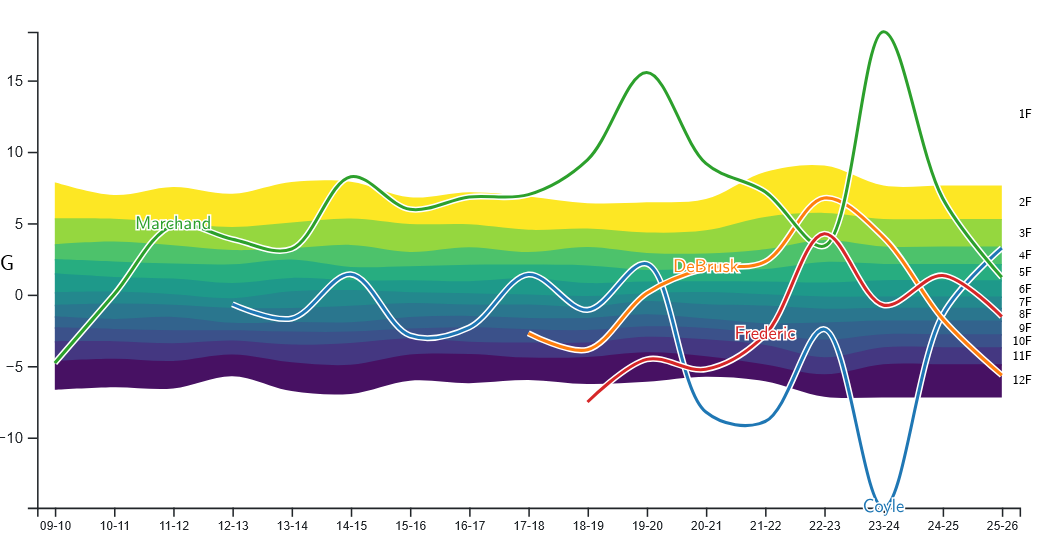
The key players to notice are, obviously, Jake Debrusk and Trent Frederic. A lot of time together, a lot of “belief” that Coyle was much worse and a complete reversal once they all found new contexts. Note the especially mirrored dynamic between Marchand and Coyle.
Side note, Debrusk-Coyle-Frederic certainly feels a lot like Sillinger-Coyle-Olivier.
Coyle creates value by being smart and proactive and by using his body well in cases of puck protection. All of these aren’t likely to degrade overly much as he ages, I would say especially so in the more modern age of athletic-care, but time will come for him as it inevitably comes for us all. Waddell, who signed Jordan Staal to a long and cheap deal in Carolina, certainly has a front row seat for the aging of just such a player.
I think there’s still more to say about the career year relative to “underperformance”. While the public has done excellent math to ascertain the impact of roles/teammates/deployment/coaching or what have you on player impact, there seems to be a section of outliers that aren’t always adequately acknowledged and Coyle has been performing inside of that group for some time.
Charlie Coyle has always taken very difficult matchups. He normally gets very poor lineup support in the way of teammates. His most common defenseman-teammate in those hard minutes in Boston was Brandon Carlo, though second was Charlie McAvoy, which suggests an overall defensive bend to every aspect of his minutes.
This past season, his most common defense-teammate was Zach Werenski. Both players had synergistic effects on eachother and within that synergy lies a key concept that might have more influence than we have previously thought: Puck-moving defensemen play a key role in creating offense for their forwards.
When Charlie Coyle played very difficult minutes against top competition with secondary teammates we shouldn’t be surprised that he wasn’t producing much or generating significant positive on-ice results. He was, in other words, being “drowned” or being deployed as a “sin-eater” so that other players can thrive in easier offensive contexts.
There’s a connection between Belfry’s Bergeron Dilemma, whereby he is one of the most excellent players in the world but by way of his defensive burden and consistent defensive choices, it was difficult for him to find scoring positions. Essentially, he was always behind the “center of gravity” of the attack and therefore required some other things to go right should he ultimately get the final touch in some of the sequences. This is merely conceptual, though, there are plenty of in-zone sequences where it doesn’t quite work like that.
Perhaps I should do more rigorous work on this concept but I think we can see some “breakout” seasons coming from players with somewhat poor reputations simply because they are freed from this sin-eating context. I probably spend too much time immersed in the data of various websites but in this case it helps to connect some otherwise disparate dots. PuckIQ is the only site that bins competition levels, though there are reasons no one else does it, but here I’ll show the proportion of time on ice against Elite Competition in both 2023-24 (left) and 2025-26 (right).
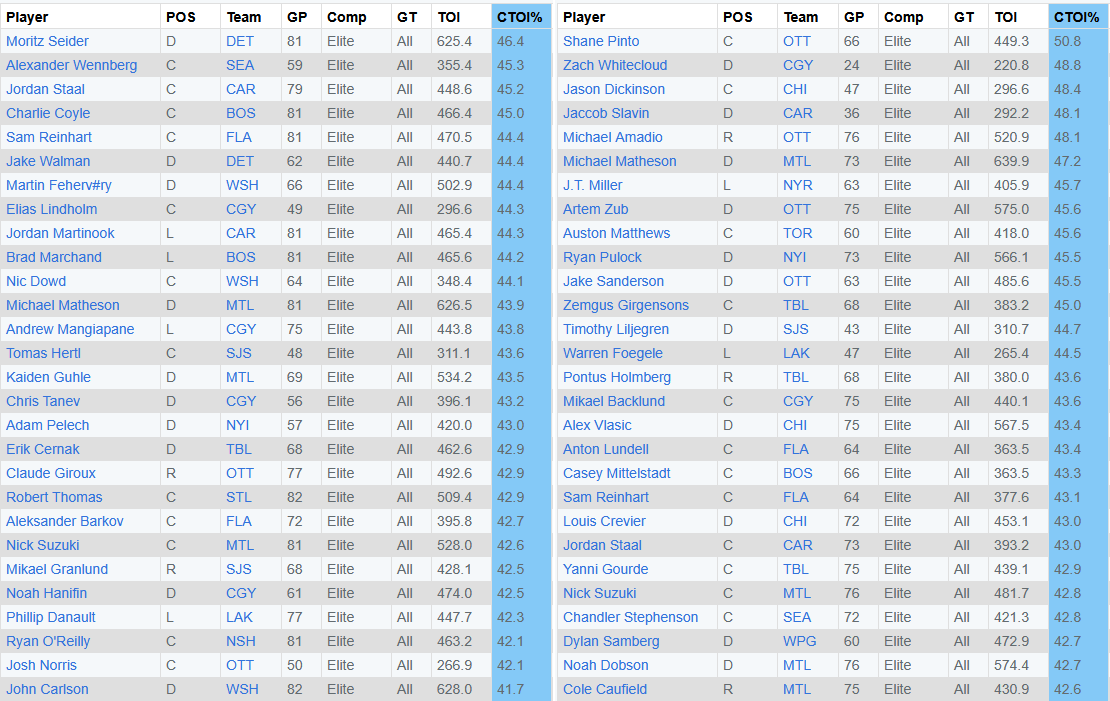
In 2023-24 Charlie Coyle got the fifth most time against elite competition, as a ration of all other ice-time, in the NHL. You can note some similarly defensively reputable players like the aforementioned Jordan Staal, Nick Suzuki and Sam Reinhart. Charlie Coyle doesn’t make it on the tippy-top selection but he comes in around 41 CTOI% there as certainly the highest on the Blue Jackets.
Mortiz Seider, now on an improved Detroit team and freed of his wicked deployment, looks like the 1D that Detroit deployed him as but the “analytics” suggested was actually a somewhat mediocre defenseman. Notice he’s far and away the top in 2023-24. While he was absolutely not sheltered, he logs a more 1D-normal share of ice time against elites at around 36.1 CTOI%. This ranks him 51st among all defensemen.
For reference, plenty of other 1D come in around that amount though Montreal (Matheson/Dobson) and Chicago (Vlasic/Crevier) really like to drown their top pairs at the moment. Werenski, Makar, Bouchard, Seider, LaCombe and Morreissey are all in the same neighboorhood at around 37 CTOI%.
Similarly, Auston Matthews (and even a tinge of Mitch Marner) have been drowned with significant defensive burden (Matthews’ 45.6 CTOI% ranks him 4th among forwards) without any particularly interesting puck moving defensemen to help share the involvement burden.
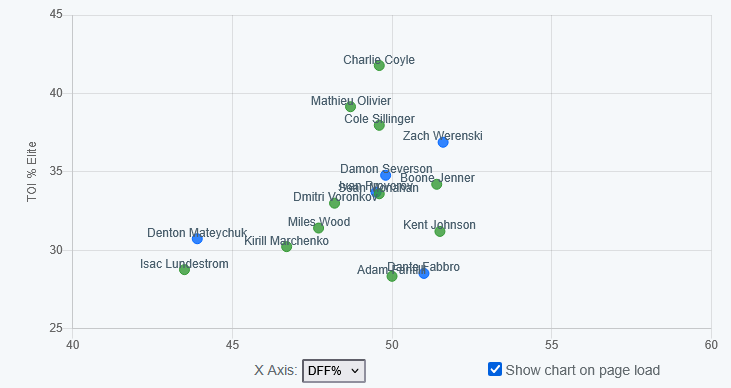
The chart is trimmed to players who played above 150 minutes against Elite competition, so most of them have above 30%. Below 30 CTOI% against elites is where you get into “sheltered” territory though there are plenty of other shelter points outside of simply competition.
I don’t want to go to deep here, just enough to say that Coyle has been a dependable player against top competition and Werenski has consistently been trusted in this regard as well though his reputation as a defender lagged well behind. Though Coyle might have scored a lot because of his partnership with Werenski, it’s likely that he’ll continue to provide value as a matchup center even if he doesn’t stay at this top-of-career point production level. That means the contract might be inefficient in terms of dollars but that’s perhaps not going to be the ultimate issue either way.
The Contract Term
Up to this point the Coyle signing probably comes off as relatively positive. I think he’ll age well, his skillset and mindset are valuable to a team with young players who need to incorporate bits of both.
The elephant in the room is the 6 year deal. “Aging well” is fine and good, but the age at signing and term are fairly unprecedented. Curious, especially, for the sixth year. It suggests, especially considering his age, that the same dollar amount for fewer years wasn’t even on the table and that his cap hit has suppressed via adding an extra year.
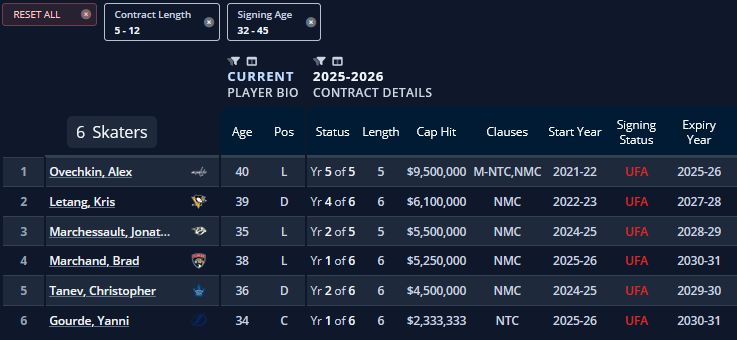
This is the complete list of players who played in 2025-26 on more than 5 year long contract that was signed while they were in their age 32 season or older. There aren’t many at all and most of them are near franchise legends or significantly high performers. Chris Tanev’s contract as a reputable heavy-matchups defensive performer with special market boost right-handedness probably feels like the best comparison though his injury history was frightened and Coyle’s is not.
The other side of the coin, though, is the rancid UFA marketplace and general dearth of significant trades. Waddell made a choice to prioritize the skillset and acumen of Charlie Coyle over pure contract efficiency. This is a tradeoff Waddell has been somewhat repeatedly been willing to make over his short tenure as the Blue Jackets’ GM but not one completely devoid of merit.
What I think we can say with confidence is that Charlie Coyle will not be close to the same player he is now than he is by the end of his contract. NHL aging can be quite outrageous and the fall from the cliff dizzying. Patrice Bergeron retired three years ago and just turned 40 this year.
Waddell, essentially, has traded one type of risk for another. Though Coyle has been very healthy and durable up to this point in his career, there’s no telling what his recovery will be like as he ages. There’s limited point in planning specifically around the worst-case scenario of major injuries but this might just be one of those things that happens on an aging team.
Generally, being comfortable with this type of aging-term risk could mean Waddell believes one or more of the following things:
The Cap Hit Won’t Matter
Coyle Will Maintain His Performance
There are reasons to doubt that Waddell believes option two there, and even should he maintain his performance well, it stands to reason that he will not be at the top of his game in that time either.
Reason one has a few options for belief the most important one being the last.
First, the cap might continue to rise such that this contract is insignificant and the cap space above it so plentiful that it’s a drop in the bucket should there be no value from the player.
Second, given the way the player market is going, it might be trivial to move on from Coyle via buyout, retirement or even trade.
Third, and this is most common with some of the above contracts, years four through six won’t be important because the best chances for winning come in years one through three.
This third point, I believe, is Waddell’s official declaration with this signing.
The Fundamental Friction of the Roster
Since Don Waddell joined, the Columbus Blue Jackets have been pulled in two directions.
There were the elite veteran players in Zach Werenski and Johnny Gaudreau that more or less demanded, via skill, a team ready to compete in the playoffs that were supplemented by players like Boone Jenner, Damon Severson and Ivan Provorov. Sean Monahan was signed just after Waddell’s arrival and his performance in 2024-25 all but cemented them as a team that was indeed ready.
Then there was the “rebuild wave” full of young players comprised of players picked after the Seth Jones trade, Cole Sillinger, Kent Johnson, David Jiricek, Denton Mateychuk and Adam Fantilli. This wave certainly wasn’t “ready” to carry the team into the playoffs when he joined and despite single seasons of excellent performance from Adam Fantilli and Kent Johnson, doesn’t appear particularly ready now either. At least certainly not in the way that Leo Carlsson, Ivan Demidov or Macklin Celebrini appear to be.
Then, there was a sort of middle-wave of secondary draft picks who had an outsized impact on the roster in the three Russians Kirill Marchenko, Dmitri Voronkov and Yegor Chinakhov. Perhaps, Patrik Laine’s age put him in this group but he was a flame out and no fault of Waddell’s. They are less relevant for the greater tension but certainly contribute(d) to the now fullness.
Jarmo Kekelainen gave Waddell a couple of gifts in terms of total roster/cap construction: a pivot point.
Werenski’s contract expires in 2028 (which will be his age 30 season) but that last season free of trade restrictions. Similarly, Gaudreau, Monahan and Severson’s movement restriction all expired at the same time. Waddell having signed Monahan, seemed to acknowledge as much.
This, effectively, meant there was preserved optionality should the team be built around Adam Fantilli. Severson, Provorov and Gaudreau all arrived under the context that the Blue Jackets would have Fantilli (or Carlsson) on the roster. There was, thereby, a way for the club to ascend out of the muck, perhaps win a round or two, and then still have the capacity to “retool” and reinforce a window during the primes of their youth.
Obviously, there’s been turmoil, tragedy and changing plans and plenty of other things between those specific moments and where we find ourselves now. Waddell had to, at least conceptually, deal with the friction that Zach Werenski is a superstar deserving of playoffs and winning now (and Kirill Marchenko too) while also managing the fact that the next wave either isn’t working out (David Jiricek) or simply isn’t ready to carry a team into the playoffs just yet (Fantilli, KJ, Sillinger, Mateychuk).
With this move, the acquisition of Conor Garland, and plenty of reports that he’s willing to deal the 2026 1st in order to move the team forward, it’s clear that Waddell feels he has addressed this friction.
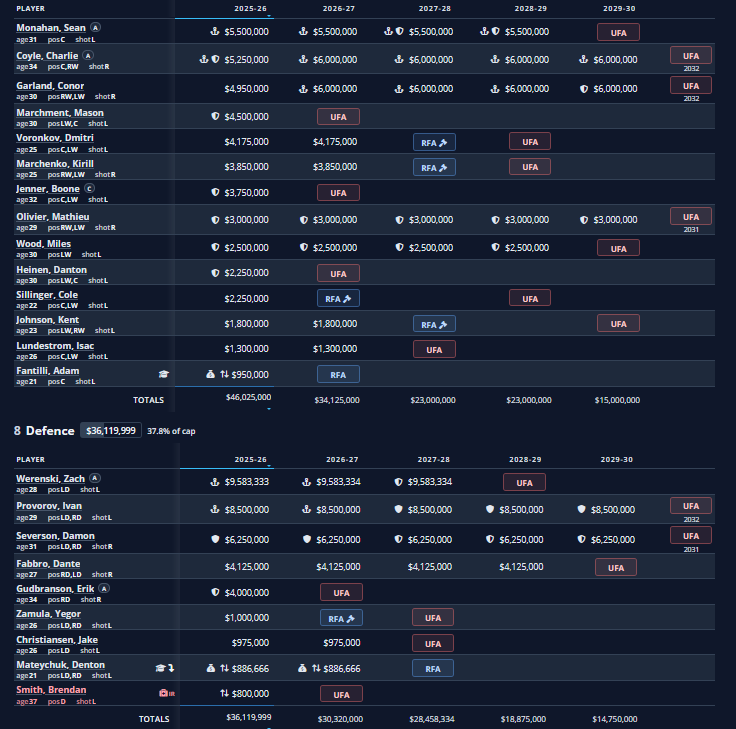
As of now, the longest signed Blue Jackets are Ivan Provorov, Conor Garland, Charlie Coyle and Damon Severson. The three Waddell additions, or at least contracts, are all movement protected well into the future and extend past Zach Werenski’s contract expiration. This is a clear departure from a potential pivot point and serves to smooth out the bridge between the two groups. In fact it mostly shatters the bridge by way of building for the now.
By the end of their contracts, this movement restricted group will likely be far inferior players than they are now. In essense, this nucleus of players will have their most to contribute to the roster over the short term and the team is more or less locked in with them. Unless you believe that there is a wave of players who will push them to peripheral roles, that means the bulk of the winning potential of the team will happen over the next few seasons.
These moves make plenty of sense under the context that you think the Blue Jackets’ best chance to win is by reinforcing the Werenski Window and worrying about efficiency and complementary players for the younger nucleus later. Typically, these “forget the medium-term future for current contract efficiency” type contracts are reserved for teams who are currently winning in the playoffs and only hope to extend their window (see current Florida Panthers) but the Blue Jackets can only play the cards they are dealt.
The plan, otherwise, would have been to build roster/future capital and only start spending as Fantilli improves as a player (and Johnson and Sillinger etc). Now, he’ll be heavily constrained during his prime by very old players who aren’t quite as good as they used to be. That’s not usually the method you would think of when you consider reinforcing a (supposed) Franchise Center cup winning window but there are always different ways to accomplish the same objective.
Perhaps Waddell sees the struggles of Sillinger, Johnson and Lindstrom, and Fantilli’s relatively tepid ascent when compared with Leo Carlsson or Macklin Celebrini, and is wagering that building around that window with only a single top five pick hit is not one likely to win a cup or will require much more significant reworking. We’ll get more information on his overall plans shortly as we discover the contracts (or not) of Mason Marchment, Cole Sillinger, Boone Jenner, Adam Fantilli and Jet Greaves.
Waddell suggested, in interview around the trade deadline, that the club had some steps to take before it was a “contender”. By signing Coyle to this contract the statement is clear: the time to win is now.
Implications for Future Roster Construction
For quite a long time I thought Don Waddell might be planning on a sort of “budget” competition window while he re-stocked the pool with players in his preferred image and bought more time for his current roster players to grow.
Perhaps that’s still partially true and the bigger picture will come into shape differently with more moves. Maybe he’s only keeping Coyle, planning on retooling a good section of the roster, and it’s because he believes in the top flight potential of Kent Johnson, Cole Sillinger, Denton Mateychuk, Cayden Lindstrom and Jackson Smith that he’s so comfortable staking down some anchor points in the meantime.
In any case, there is at least the relief of a plan declared and no longer the friction of a “line-straddling” potential future. Whether or not this was the right call isn’t something we’ll discover for a few years outside of extreme best and worst scenarios. Now, it’s all hand on deck trying to squeeze this roster into a shape that maximizes winning over a three or four year window.
If my conjecture here is true, it would have implications on roster planning as soon as the next contract signed. Given their importance, I assume that means the organization still sees Marchenko and Fantilli as “core” pieces. Conventional wisdom, then, sees them signed this offseason at whatever dollar amount for as long as possible.
Considering the cap explosion and significant number of contracts, I do think this opens a window where it is logical for either or both players get a situational “bridge” deal. That isn’t to say a short term contract like the one Marchenko just signed but instead lower dollar contracts that give the Blue Jackets more room under the cap to bring in some heavy winning talent now.
If we suppose Adam Fantilli is signed to an 8 year contract, and his agent is good, he will be overpaid for the beginning of the deal as he grows into his final form. Given what we saw from Fantilli this year, at least as a play-driver, it’s possible he doesn’t “fully ascend” for another year or two. If the Blue Jackets have a four year window to get basically all of their winning done, and a larger reorganization after those four years, then it might make sense to build Fantilli’s contract around that new pivot point (especially to the player and his agent). He’ll get a much bigger deal come that year but he’ll be proven and there will be more moves to be made as the Blue Jackets make a bigger shift into his era.
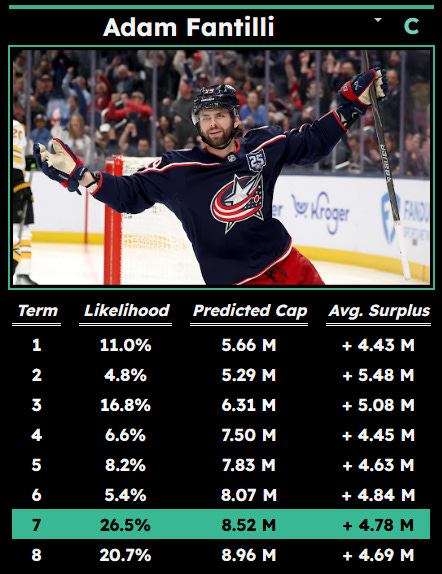
Given Coyle’s contract departure from predicted values (term mostly), let’s assume that Fantilli’s 8 year number would be larger than the above projected, somewhere around $10 or $11 million. Let’s say that it’s accurate on the smaller projection and he signs 3 years for $6.31 million. The difference between those contracts in the first three years is the Blue Jacket have $5 million extra to go an add a player of the caliber that pushes them closer to winning a cup.
I wouldn’t count on it, but eyeing Jason Robertson’s supposed desire to beat Rantanen’s number, or seeing Matthews’ $13 million being potentially on the move or even a Dylan Larkin, Jordan Kyrou, Adam Fox or perhaps some surprising Winnipeg player(s) means this summer does have potential for big fish acquisitions (as they all do until nothing happens). Frankly, given the “hates losing” directive from Rick Bowness, I would be surprised if JT Miller wasn’t another target to join the over thirty cohort.
Something to keep in mind: the Blue Jackets do not have their own 2027 2nd round pick, which means offer sheets must be in the $11.7million + (4 1st round picks) or the lower tiers that do not involve second round picks.
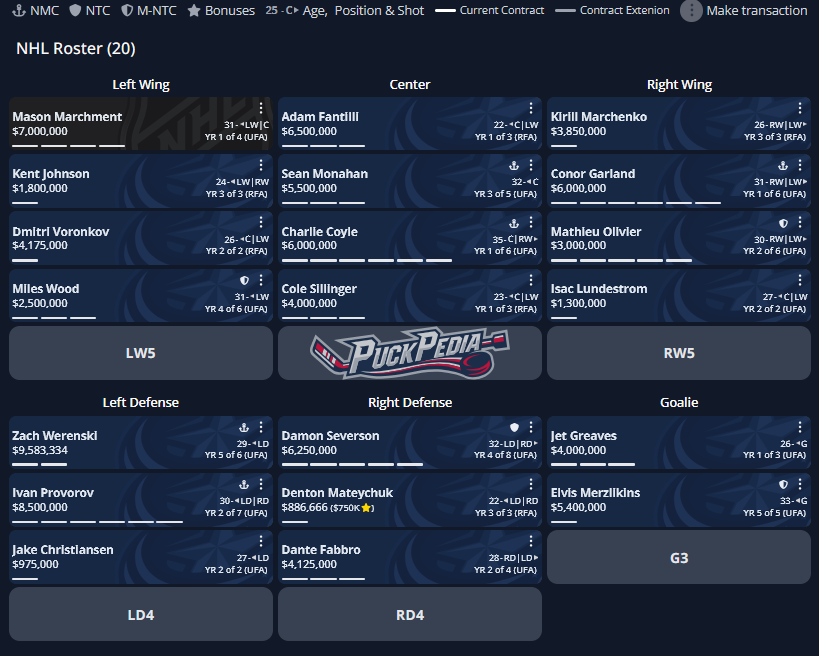
A team with these dollar amounts signed, having gone short on Sillinger, Fantilli and Greaves and (hopefully) ambitious on Marchment, has $12+ million underneath the cap. Resulting moves of Johnson, Voronkov, Fabbro or Merzlikins open up potential for more cap space to chase something big.
Let’s put it this way, this group of contracts allows the Blue Jackets to threaten Dallas with the leverage of an offer sheet above Mikko Rantanen’s salary. That doesn’t mean explicitly tendering it but, like Carolina used to get the ball rolling for K’Andre Miller, it can force Dallas to the negotiating table whereby more preferable terms in both directions could be reached.

I wouldn’t pin your hopes on it, Dallas surely knows how good this player is, and all teams save seven or so have the space to leverage a similar offer sheet.
There are plenty of other considerations in terms of roster management going forward, and perhaps I’ll carve out some time to detail some of these specifics, but it’s at the very least clear that it’s time for the Blue Jackets to cut down to a winning edge and Waddell has committed to a plan of attack.