
What should the Blue Jackets do with Jack Roslovic?
Using data and microstats to make sense of Jack Roslovic's up-and-down time with the Columbus Blue Jackets

Struggles at Center-Ice
Last article, we took a look at players who the Blue Jackets could target this offseason that primarily play in the center of the ice. Getting an established spine at center-ice remains priority #1 for the Blue Jackets as they plot their ascension to a Stanley Cup Contender. I intended to continue to look at the upcoming offseason marketplace but the Blue Jackets current internal solutions kept jumping out of me. Part of the reason for so much consternation in the first place has been Jack Roslovic’s inability to take steps forward towards becoming a bona-fide Top 6 centreman. There has been a lot of speculation that the organization has grown impatient with Jack’s play and that he could be someone the Blue Jackets look to move for improvement-by-subtraction going forward. Let’s examine his performance with the Blue Jackets and see if the solutions to the Jacket’s center woes can come from within the roster.
The Context
Jack Roslovic
Jack came over, along with Patrik Laine, in the trade of Pierre-Luc Dubois to the Winnipeg Jets. He had requested a trade because he believed himself a center and was frustrated by the lack of opporunity. Flash forward a few years and he has been playing in the center almost exclusively for the Blue Jackets. He’s had a couple of up-and-down seasons but over the course of these three seasons we’ve had time to understand who he truly is as a player. Using microstats from the All Three Zones project by Corey Sznajder, as well as data from Evolving-Hockey, and visualizations from HockeyViz by Micah Blake McCurdy, we can determine that he’s a dynamic transition force who struggles to convert these skills into an impact at either end of the ice.
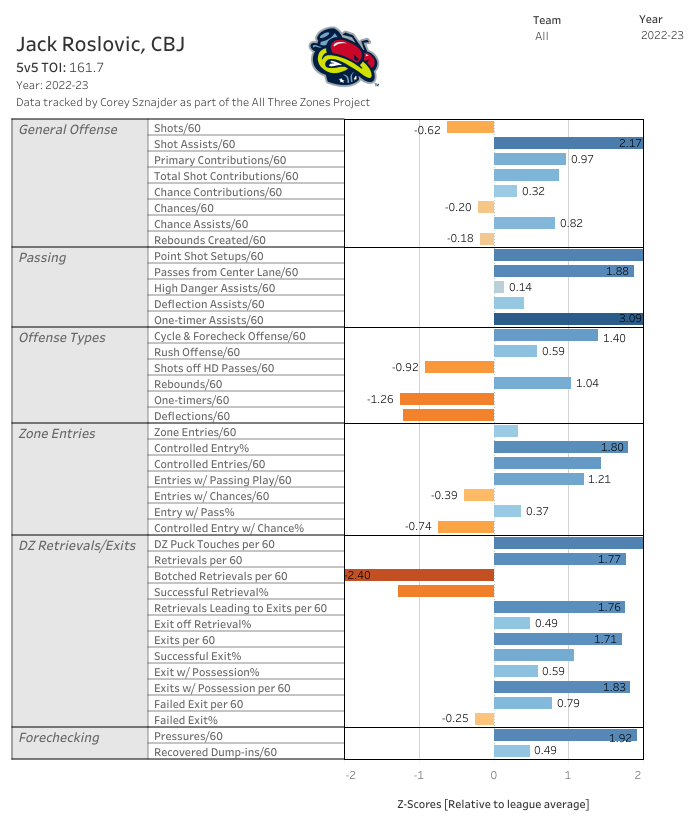
First, his AllThreeZones data, in which he shows out as a dynamic transition force who has a tendency for mistakes and creates more entries and exits than he does danger with them. We see that he generates quite a lot of retrievals/60, exits with possession/60 and controlled entries/60 but is often inefficient, as we can see with his diminished (but still much better than league average) performance on Successful Retrieval%, Exit w/ Possession% and Controlled Entry w/ Chance%.
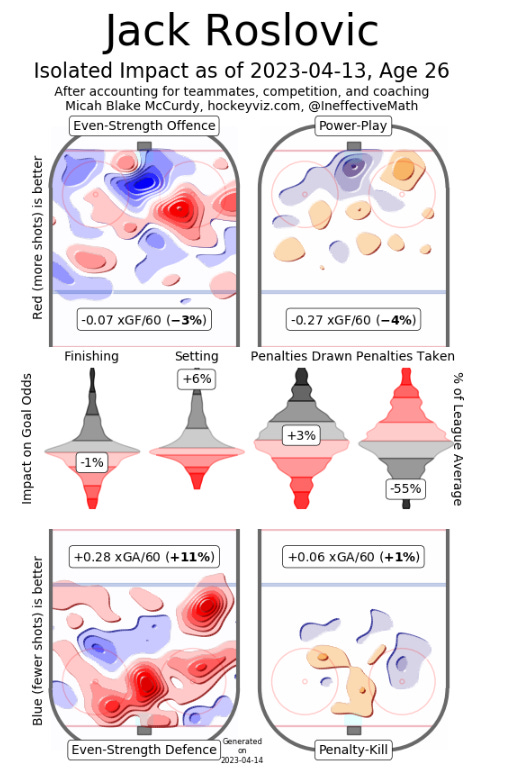
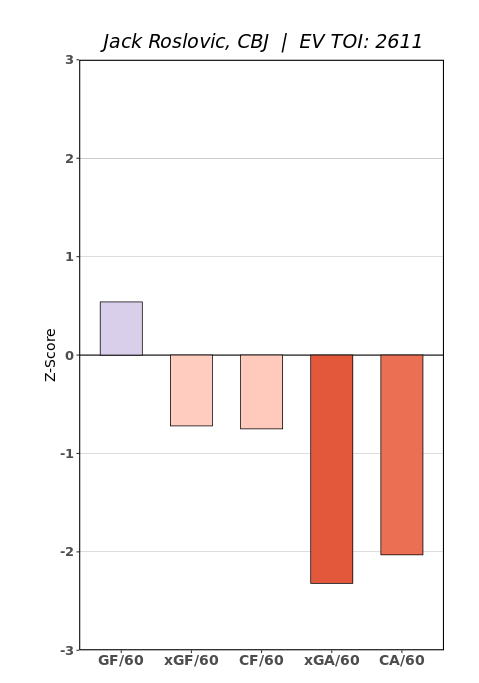
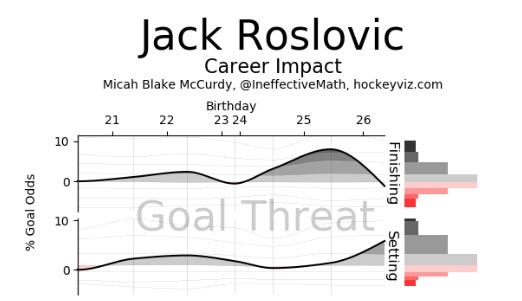
Then, we can use HockeyViz and his RAPM chart (across his career and last 3 years respectively) to confirm his impact on expected goal rates and shot generation/suppression. He is very poor in outshooting his competition and often allows shots from more dangerous areas of the ice. These factors combine to explain the results in his expected and actual goals share to be below average.
His absence in attacking dangerous parts of the ice is a critical factor in limiting his potential. While he may fit some of the criteria required for the “Bus” role, namely his volume success in retrieving and zone exiting, his complementary skills drag his on-ice success down too much for him to be considered a large part of the solution going forward. He just doesn’t shoot from ,or pass to, the middle of the ice. He’s not forming a network between his wingers and his hockey sense doesn’t have him arriving on time; unfortunately for Roslovic, these are some of the key tenets of the “Bus” role. Not all may be lost however, as these weaknesses may not be as damaging if he is afforded the ability to move to the wing.
The Role Swap
His dynamic skating, with dangerous cutbacks forming the underpinning of a good delay game, and perimeter playmaking may be better suited to the Carry role that I have outlined previously. Here, he would be a low forward in a 2-3 offensive zone structure and be allowed to stretch the ice on zone exits. Jack Han (@jhanhky) has outlined some of the benefits of a 2-3 zone structure in regards to the Toronto Maple Leafs use of it and the “Bus” role is primarily built upon this foundation. His experience playing in the center of the ice, and especially penalty-killing, can only serve as “pluses” on his hockey resume. Hockey is a fast game and can’t be fully controlled from the playbook. Oftentimes responsibilities are split purely depending on who is first back into the D-Zone or first into the O-zone. His depth and breadth of experience can allow him to be a versatile player that fills the gaps created by playing the game at a high pace.
An understated part of the Carry role is to be an F1 or F2 forechecker. Since these players will be spearheading the rush they will often find themselves attempting to recover pucks against the back-wall or in worst cases pressuring defenders attempting to do the same. If we examine Jack Roslovic’s performance in the “Forechecking” section of his All Three Zones playercard we can determine that he performs quite well in this role. This isn’t to say that he will automatically succeed as a forechecker. He will very much need to “stick” to his checks and become more disruptive with his stick. He needs to hone his abilities as a puck-thief if he wants to be with the Blue Jackets as they take the next step towards contention.
The final attribute that Jack Roslovic has going for him is his chemistry with Patrik Laine. This past season Jack modified his game from being a dangerous shooter to being a dangerous setter. A “set” is defined as a pass made with the intention of it being shot.
We can also see this trend borne out in the All Three Zones data, as Jack Roslovic’s One-Timer Assists/60 is off the charts. He fits even better with Patrik Laine because he’s a righty passing to Laine’s right one-timer, one of the most dangerous weapons in hockey. The rotation of the puck off of a righty-forehand pass is the same as the rotation coming off of the righty one-timing stick which results in more time in contact with the blade (because of the rotation spinning into the toe of the blade) and results in more control of the shot.
None of this will solve all of Roslovic’s problems. A simple positional swap will not make him better at reacting to situations or problem solving pressure. His hockey sense is unlikely to make major leaps at age 26. The swap could, however, mitigate some of his major weaknesses and give him more time playing against his strengths against top competition.. If CBJ can find a player that can fill the gap between Laine and Roslovic, they could have the foundations of a very strong second line.
Could a Jack Roslovic and Patrik Laine positional swap be everything the Blue Jackets need to form a dynamic pair going forward?
Moving Forward
If the Blue Jackets want to return to the playoffs next year their top six will have to be able to operate against top competition. Improving players in their position will be of utmost importance but solutions from within come at nothing but opportunity cost. Next article, I will investigate some potential offseason targets who could breakout with a position swap, or have a similar flexible profile in comparison to Jack Roslovic, and determine if any of them could be the key to unlocking the Blue Jackets prolific stable of wingers.