
Werenski Olympics Debrief
Werenski Mixtape, Analytics Notes and Other Thoughts

I am sure, at this point, that there isn’t much for me to tell you about Zach Werenski at the Olympics. Frankly, little matters outside of what every American hockey fan already observed. Zach Werenski, through whatever blend of determination, poise and skill you’d like, beat Nathan MacKinnon in a 1v1 battle and passed the puck to Jack Hughes to cement hockey history. Forever, Zach Werenski will have the enduring well of confidence that comes from being the guy who did it.
Olympic Mixtape
First, I’ll apologize for a couple of quality issues here. There is some audio de-sync that exists for a reason that is a mystery to me. Second, there are some closed captions on some of the clips too. I had completely eliminated them from my perception and didn’t realize they were there until a certain point of clipping today.
Third, which isn’t a quality issue, the IIHF and Olympics in general are very deliberate in their copyright striking. I don’t know how long this will last or whether Substack has the capability to filter through this sort of material easily (I was able to get around some IIHF World Championships restrictions a few summers ago). In any case, if you’re sharing this around, be careful how you talk about it please. I’m not sure it matters, but it might.
You’ll find the above mixtape loosely grouped into three categories in a loose time-order within category which should ascend in interest: neutral zone play-killing, puck-moving and resulting rush creation and offensive zone play. Meaning, the fun offense and best clip is saved for last.
These are, generally, the brilliant domains of Zach Werenski. Though I haven’t detailed the forces driving his success just yet, he demonstrated all of them at this best on best tournament. His capacity to stop rushes, win pucks and exploit the moments of transition between was on full display. His off-wing downhill attacking was all there too.
It should not go unmentioned just how many of these goal sequences started with a Werenski retrieval, quick and competent entry pass and sustained play therein. Sometimes, it’s hard to capture these moments as significant because they hardly feel exceptional. Play-driving, especially from the defense position, really just is that way sometimes. Still, I’ve made sure to include some extended sequences that emphasize this point.
Werenski’s Performance
Zach Werenski was brilliant at the Olympics. He wasn’t asked to play as much, or accomplish as much, as he did for the Blue Jackets but he ended the tournament as near the top offensive defensemen. I will not besmirch the names of Quinn Hughes or Cale Makar, who were incredible and also carried a more significant burden than Werenski did. At the same time, it’s not Werenski’s fault he created an outrageous volume of offense in his limited minutes.
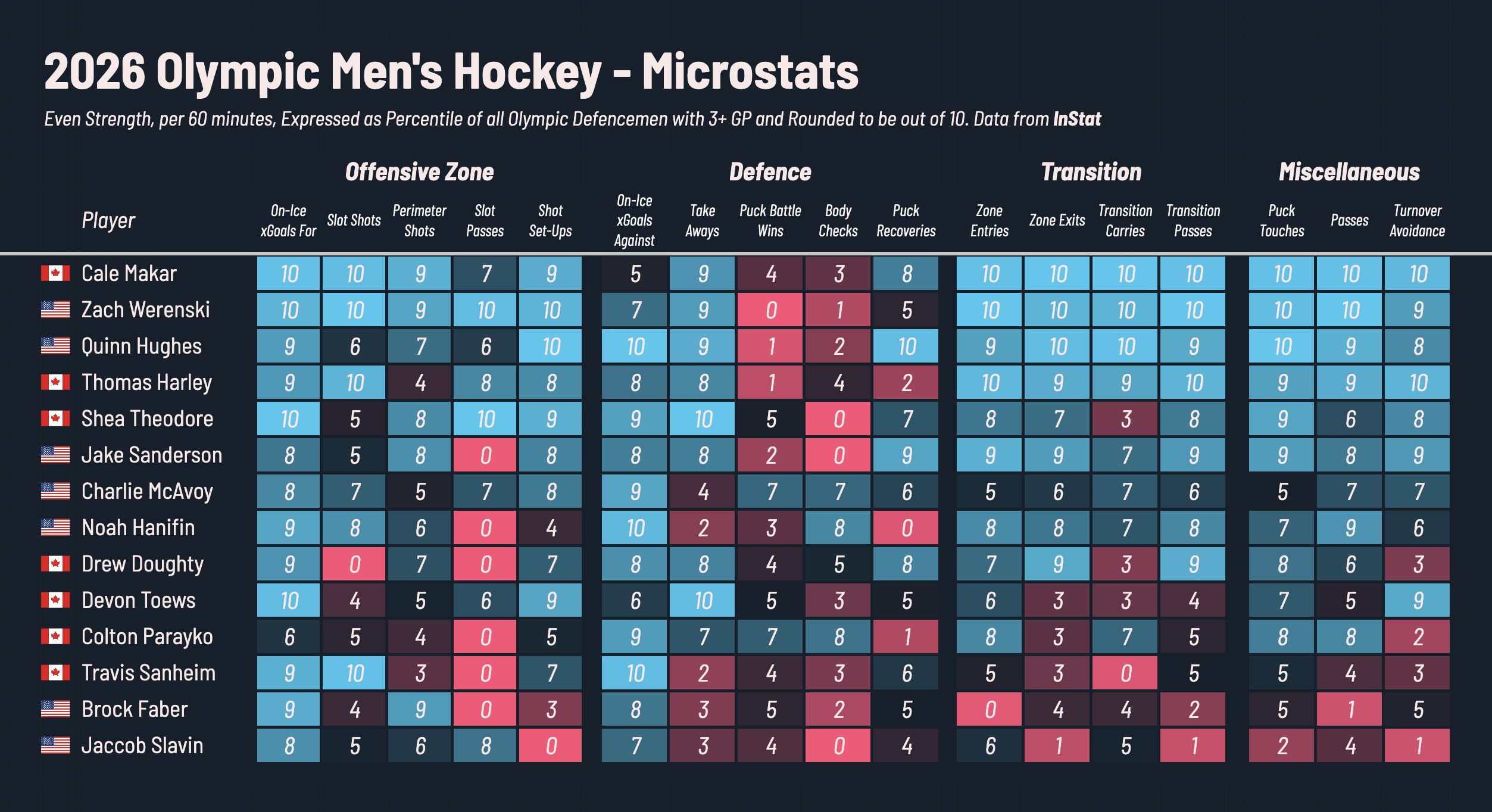
This data only includes games prior to the final, and is rate adjusted, but clearly demonstrates just how much value Werenski provided in his minutes. He finished with 6 points, and the one that counted, second in the tournament only to Quinn Hughes among defensemen (who also had one that counted in the QF against Sweden).
The top four above, Makar, Harley, Werenski and Hughes, have to be the best defensemen to watch in the sport. Their involvement in transition and efficiency in their puck touches is absolutely outrageous. A pleasure to watch them all.
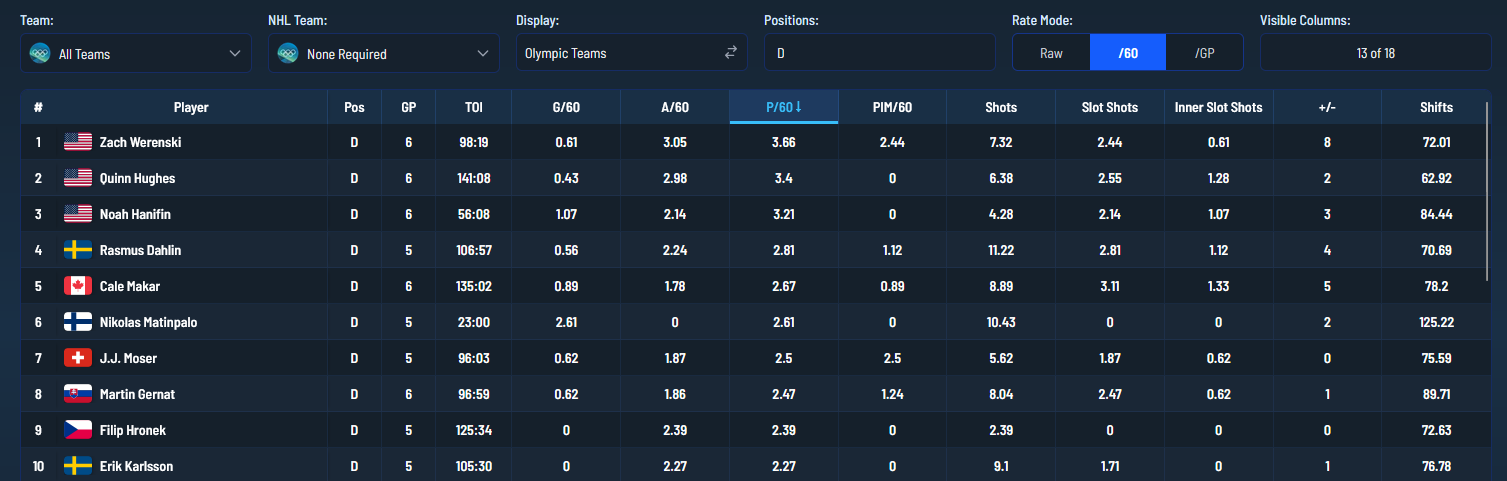
At the end of the day, among defensemen who played significant minutes, it was Zach Werenski who ended the day as the most efficient offensive creator. He lead in both All-Situations Points/60 and All-Situations Scoring Chance Contributions/60.
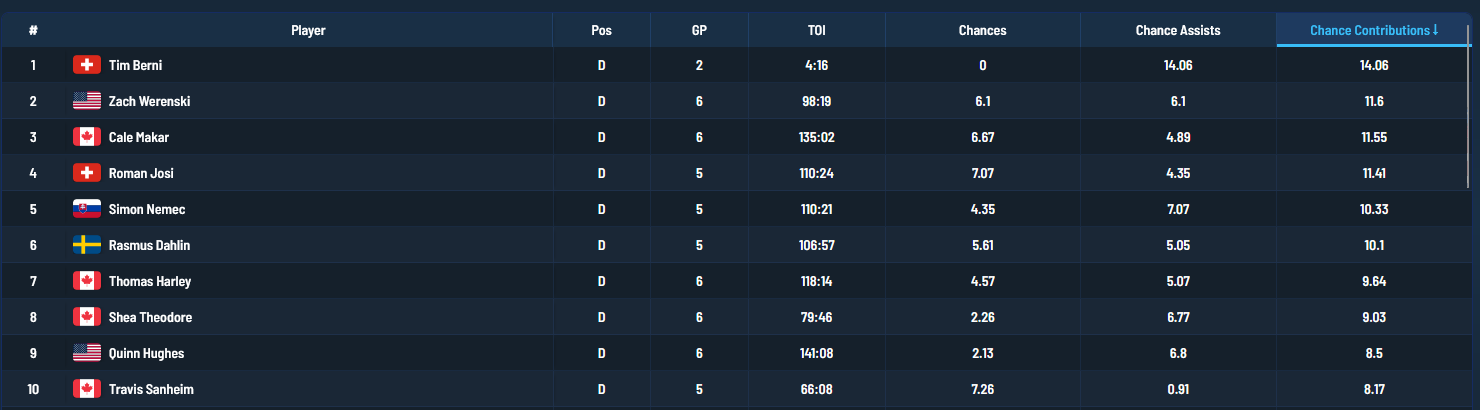
Shoutout former CBJ defenseman Tim Berni.
There are some obvious caveats here. Werenksi played fewer minutes that the Hughes, Dahlin and Makar’s of the world. Got PP2 time on an excellent secondary unit and played few mintues against the best defensive teams of the tournament. A couple of natural data points that mean it was a bit easier for him to “game” the rate scoring system.
Ultimately, Makar and Hughes were named as the best defensemen of the tournament and frankly there should be little arguing. For some perhaps frustrating, if mildly understandable reasons, Mike Sullivan just didn’t trust Werenski as much as the rest of his D and that means he didn’t have the opportunity to impact games as much as either of those players.
To say Werenski was the only defenseman that made mistakes would be wrong, any high level player of the position will, but his rotation minutes in defensive situations were all given to Quinn Hughes or Noah Hanifin. Perhaps, had Sullivan, Tortorella and Co found it in their hearts to trust a dominant force, those leads against Sweden and Canada would have been held.
Other Notes
I’ll keep this quick because it’s late and I could probably just talk about it for hours.
Jack Hughes was brilliant. He’s one of my favorite players to watch for just so many reasons. It was almost bittersweet watching him with Werenski, their chemistry was incendiary and yet they’ll remain division rivals. Still, he might just be the most talented forward in the NHL and yes, that includes McDavid and MacKinnon.
Where those two are brute force offensive creators, Jack Hughes can match their pace at the same time as making it so easy for his teammates to play. There just isn’t a player who integrates the information of his environment into his decisionmaking as well as he does. He perceives and acts in a seamless flow that I find difficult to adequately capture with words.
Autson Matthews, in many ways, is the same. His capacity to integrate multiple objectives into the same move is brilliant. His defensive play was smothering. If he had any finish at all this tournament, he might have just stated his claim for the best player in the world. He’s been a prolific 5v5 dominator for years, perhaps the best scorer at even-strength we’ve ever seen, but that play has fallen off these last two years. Still, it was magnificent watching it as it came.
I have plenty of issues with Mike Sullivan’s coaching and Bill Guerin’s roster decisions, but credit where it’s due: the PK was perfect. How much did JT Miller and Vincent Trocheck honestly influence those results over, say, Connor Hellebuyck, Jaccob Slavin, Jake Sanderson and the rest? Can’t say, but when you get results this good you’ll never convince any human that process matters all that much.
Similarly, I think Sullivan’s systems are getting a little outdated A Gold is a Gold, but I don’t see why he is isolating his skilled players from each other in such a way and I thought the rim-forcing on retrievals washed out some excellent skill. Matthews, Hughes and Eichel could each have used another player who can build off of their brilliance too. On that front, I was surprised by how bad I though Brady Tkachuk was. His decisionmaking was terrible and his turnovers really put his teams in vulnerable situations.
At the same time, you have to wonder if it was a mistake for Canada to load up McDavid, Celebrini and MacKinnon. They created an outrageous volume of chances but none when it counted. I wonder if, as a result, we’ve seen “Peak Pace”. Is there something to be said about this type of puck-dominant speed being more… predictable? It’s obviously impossible to stop, so perhaps I am being overly influenced by results, but it sometimes feels like the defense is more aware of how they’re going to get beat and someone else can come stop it.
I find that some of the best scoring sequences feel like two players have separated in space and time from the rest of the players on the ice, they find these brilliant moments of quiet clarity that make scoring feel inevitable. Celebrini was trying to finish some of those slot passes from McDavid it still all felt very fast. In any case, would they have not been better served letting their puck dominant creators cook separately? Diminishing returns, perhaps.
On that front, you have to feel like Sidney Crosby was a massive missing factor. He’s king of creating those type of dominant scoring chances and I really thought the line of Stone-Crosby-Marner would threaten the half-court game in a way that isn’t really possible to match up with.
Similarly, both Canada and the US tried to create free goals by adding “one more play” on numerous occasions. What was so fun about this game is that they all failed, not because they were wasted but because off-puck defenders were just that good. I can think of a Devon Toews sticklift on an Auston Matthews slot setup and Zach Werenski stick lift on Seth Jarvis just the same. That level of defense is so rare and it’s so fun to watch.