
Setting the Norris Trophy Race Table for Zach Werenski using Analytics

This breakdown will be the first in the coming series detailing Zach Werenski’s game this season. Different from the rest, this one will be quite numbers heavy as a means to position Werenski’s trajectory and performance relative to the rest of the league. In doing so, we might continue to follow certain storylines as they mature through the end of the season.
After this, I’ll start diving into the variety of adjustments and tactics Werenski’s has used to be one of the most dominant defensemen in the league. These will be tape-heavy and split into as many parts as I think make sense. Likely, I’ll go zone by zone demonstrating the extreme depth of skill that drive the Blue Jackets’ superstar to such dramatic success.
I’m writing this specific breakdown prior to the Olympic Final. Werenski has been brilliant so far in the tournament, though frankly that was expected considering the quality of the team the US brought and perhaps overshadowed by Mike Sullivan’s trust in Quinn Hughes. Hopefully, the performance serves as a launching pad of success for both him and the Blue Jackets as they play out the remainder of the 2025-26 season and Werenski adds plenty of hardware to his personal cabinet.
Building the Norris Case
Should this season continue the way it has, I believe Zach Werenski will win the Norris Trophy for: “defense player who demonstrates throughout the season the greatest all-round ability in the position”. He’s competing against a few very good players, the perennial candidates in Quinn Hughes, Cale Makar and Adam Fox as well as the defensive standouts like Miro Heiskanen and Moritz Seider. It’s a great time to be watching the sport if you love active defensemen.
He could have, and perhaps should have, won it last year based on his entirely unique contributions within Dean Evason’s systems. Werenski’s reputation took a dramatic leap forward last season, finally garnering respect from the greater hockey media that likely pays off in voting this season.

Last year, I believe I made the mistake of writing the story on his season too early. I intended to put in some work around the Norris Trophy conversation with a complete update but life got in the way and I found other things to do. Not that I believe anything I wrote last year would have been sufficient to tilt the zeitgeist quite that much but many of the factors are still the same.
In any case, there was plenty more to see from Zach Werenski last season in terms of that specific unique style of rush game domination. This season, he’s scoring more and has the reputational inertia that usually weighs quite heavily on Norris voters’ minds. To back it up, the greater “all-in-one” analytics metrics seem to agree with a significantly improved Zach Werenski.
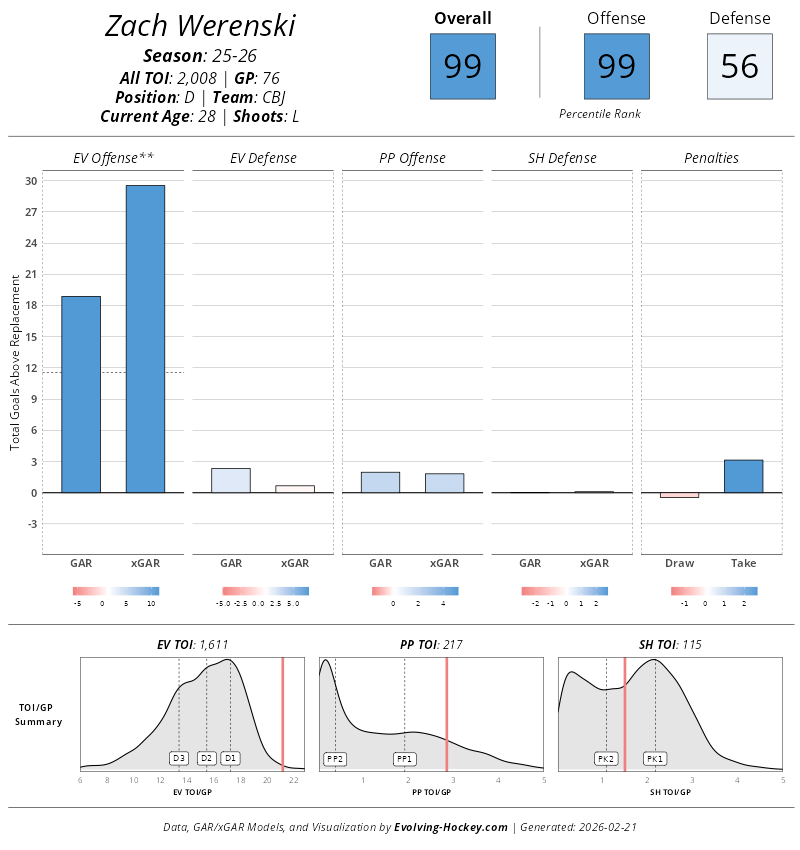
As of this moment Werenski is on-pace to set the “analytics era” record for Evolving-Hockey’s Expected Goals Above Replacement (xGAR) metric. There are, perhaps, some issues placing this performance historically given the recent change in NHL shot-tracking by way of PPT (Player and Puck Tracking) integration from the NHL but for now we’ll work with what we have.
Both models, GAR and xGAR, feature different methods to ascertain a players contribution to wins. xGAR, though the writeup has never been published, has more to do with individual contributions to offense. GAR has more to do with player impact on on-ice shooting percentage.
Combining both usually yields more predictive results. If we combine these metrics, or average them, Zach Werenski’s combined GAR comes out to 20.75 which places him 3rd in the NHL behind Connor McDavid (22.5 cGAR) and Nathan MacKinnon (21.05 cGAR). The closest defensemen are Moritz Seider (19.2 cGAR) and Quinn Hughes (18.05 cGAR).
Relative to the second best player on their team, Zach Werenski leads the NHL at 9.35 differential (Charlie Coyle at 11.4 cGAR), followed by Macklin Celebrini’s 9.3 differential (Collin Graf’s 7.45, though Kiefer Sherwood has joined and is at 8.15) and Connor McDavid at 7.15 differential (Leon Draisaitl at 15.35).
Fortunately, plenty of analytics work has been done to account for teammate and deployment quality and we’ll turn there next. Evolving-Hockey’s Regularized Adjusted Plus-Minus. There are flaws in using such methodology over shorter samples but we won’t shy away from the information that they provide now. By these metrics, Zach Werenski does not grade out quite as well relative to plenty of other defensemen.
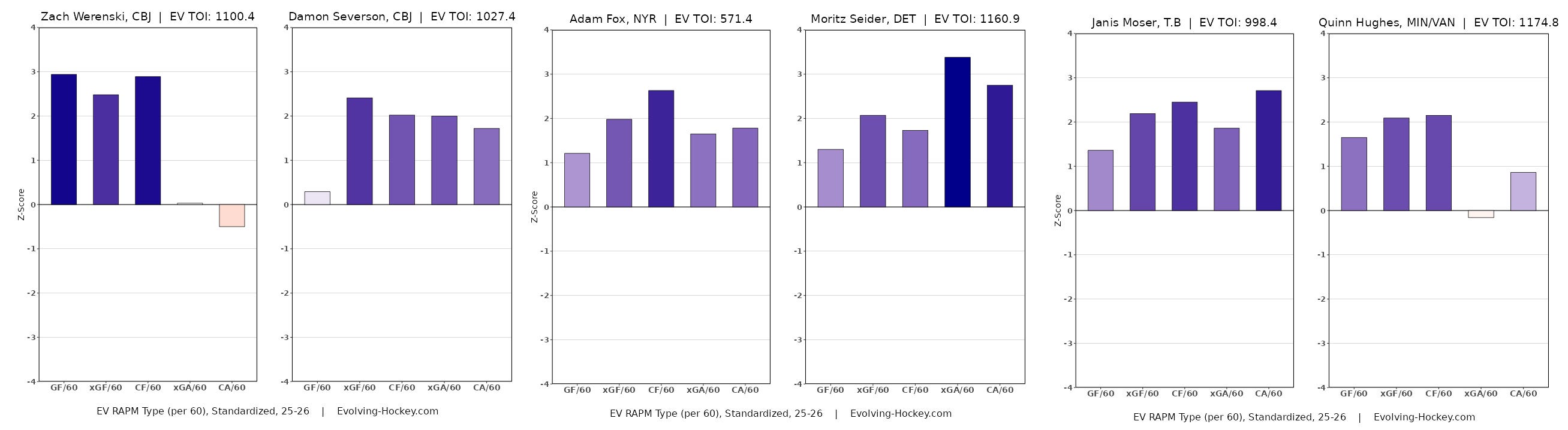
It’s still early, and there’s plenty of time left, but the defensive play-driving metrics of plenty of other defensemen grade them out better on the aggregate at the moment (and Zach Werenski graded out better just last season). As of this current picture, Damon Severson looks better from a possession and danger driving perspective. Plenty of other D-men also didn’t quite fit in this picture: Lane Hutson, Jakob Chychrun, Josh Morrissey and without included the juggernauts that are Cale Makar and Evan Bouchard at the same time.
Zach Werenski, as an exclusively offensive driving force, still remains unparalleled and that is only reinforced when including the last two years as well. In terms of exclusively the offensive portions, combining all the data from the past three seasons, Zach Werenski is the top D-man in each RAPM offensive category: GF /60, xGF/60 and CF/60.
This data, of offensive domination, carries over to the next analytics site: HockeyViz.
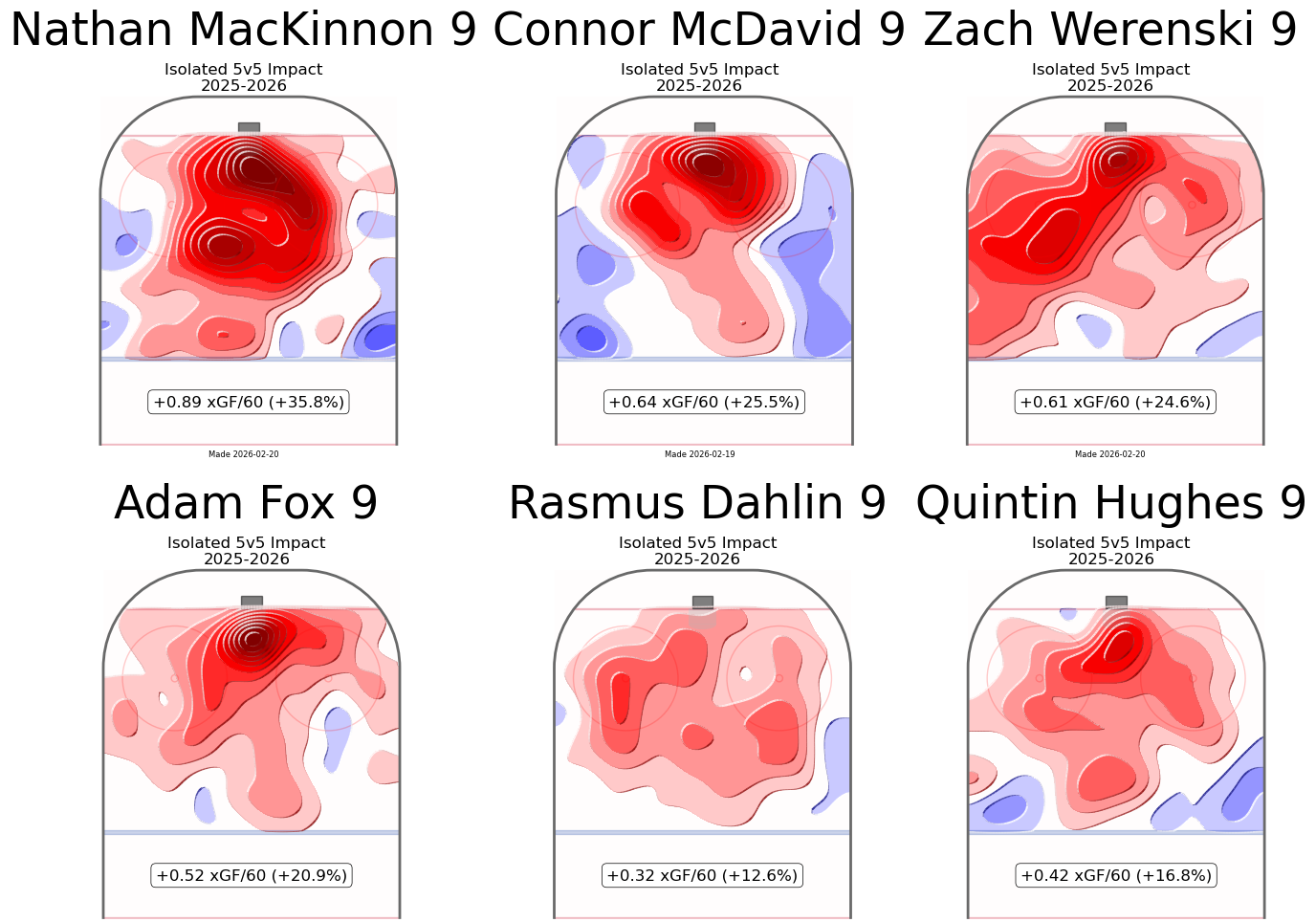
By isolated 5v5 offensive impact, Zach Werenski is not only the best defenseman by a solid chunk but also the third best player in the league behind only Nathan MacKinnon and Connor McDavid. Offensive impact isn’t the only thing and shouldn’t be the sole differentiator for a Hart or Norris Trophy.
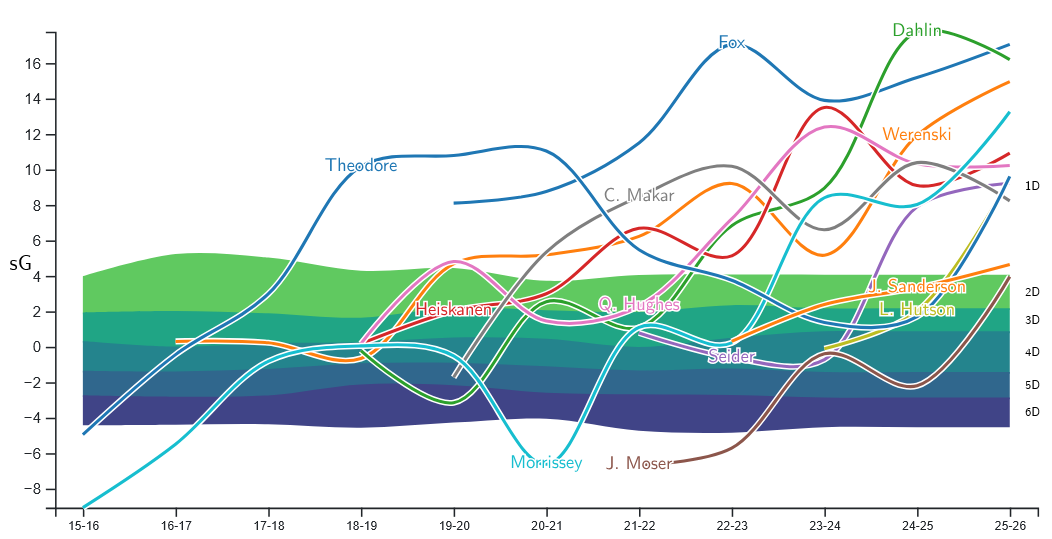
Apologies for the veritable jungle of lines here but there just isn’t a great way to represent the volume of quality defensemen alongside trajectory (which appears to be quite important for Norris consideration) with the tools HockeyViz provides.
Obviously, there’s quite a bit of disagreement here between Norris trophies and Hockey sG (the equivalent “all-in-one” value metric that takes context into consideration) considering Adam Fox doesn’t have a near clean-sweep of the last few years.
In any case, Zach Werenski has been in the group of top three defensemen in the league by this metric both this year and last. He’s on a continued upward trajectory thanks to that brilliant offensive zone dominance. Though Werenski was hardly considered a top defenseman in 2023-2024, and had a down year via sG, we would be remiss not to point to the Pascal Vincent of it all alongside his team leading scoring and goal differential. We’re not here to rationalize but to point out that Werenski has been brilliant for quite some time and his reputation, though it glowed up dramatically last year, perhaps still has some catching up to do.
Ultimately, I set out to write about what exactly has gone differently for Werenski this year relative to last. So far this season, the biggest difference is simply that he’s scoring more. This does have impact on the game-states that he plays in. If we permit ourselves some rationalization, and a quick glance at the reasons for Dean Evason’s firing, we might hedge against some of the play-driving numbers at the same time.
Zach Werenski is at his best when he’s throwing his foot on the gas and driving forward. Last season, that represented itself most in his play when Trailing.
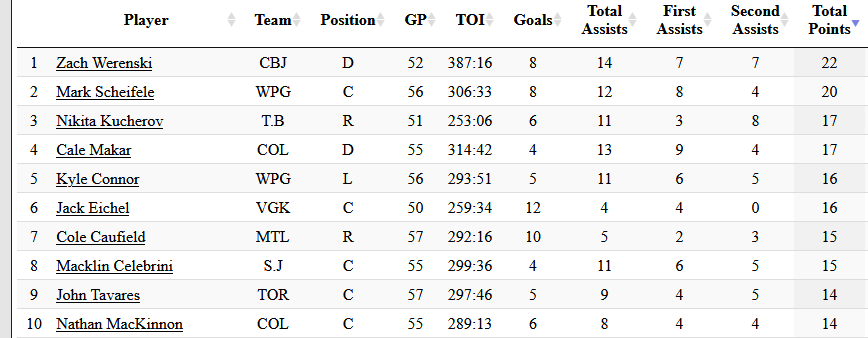
This year, Zach Werenski is scoring so much in tied game states that the Blue Jackets are playing an outrageous amount of minutes with the lead. He legitimately leads the league in 5v5 points in tied gamestates. Not that Werenski has been bad at playing with the lead, at least relative to the game-throwing disaster that has been the Blue Jackets’ third periods, but his unique differentiator has been neutered with the classic NHL defensive shell.
An irresponsible adjustment, all things considered, but something to keep an eye on through the stretch run.
Goal-Scoring
At the Olympic break, Werenski has 20 goals in 52 games behind only Jakob Chychrun who has 21. At even-strength, Werenski is ahead with 17 goals to Chychrun’s 15, at 5v5 the gap is 16 to 12.
That’s really the biggest aspect to talk about regarding Zach Werenski. He has consistently been the best 5v5 scorer (points wise, not just goals) in hockey over the past three years. Technically, Cale Makar has narrowly edged him in 5v5 rate scoring in 2023-24 and 2024-25 but, at least so far this season, Werenski has been far and away the best.
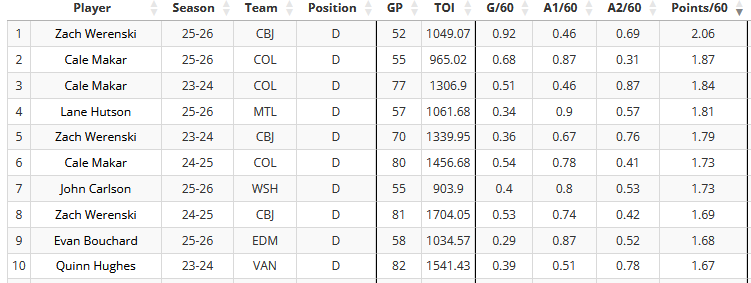
Last season, Werenski was the literal best on-stick shot creator among D men in the league. Werenski’s 0.51 ixG/60, a crude metric to determine the total danger level of his shots per hour of playing time, placed him as 2nd best “all-time” (since this data became possible with modern shot-tracking in 2006) behind 2014-15 Dustin Byfuglien. Still, he only scored 5v5 goals at a 0.53 per 60 pace (a mediocre 33rd best of all time).
This season, Werenski is down to a paltry 0.31 ixG/60 which would be the 6th best in his career. A the same time, his 0.92 actual goals per 60 is far and away the highest 5v5 scoring rate in recorded history. The next closest is Brent Burns’ 0.75 G/60, a number he posted in 2016-17, the same year he won the Norris Trophy.
Most of these are season end numbers which brings me to the next point and one perhaps observed in the 5v5 rate scoring table above: defensemen are more involved than ever and scoring at even numbers is way up from this position as a result. Lane Hutson and John Carlson’s 2025-2026 season being the only ones to break the Werenski-Makar dominance of late.
Critically, the season isn’t over yet. Should games tighten up down the stretch, Werenski’s outlandish scoring numbers may fall. Especially a risk given the low-event defense first mentality preached by Rick Bowness so far.
The Powerplay Problem
The reason we lean so heavily to 5v5 gamestates is because it often serves as the “great neutralizer”. Most games are spent playing the game at 5v5 and it therefore merits the most consideration. When ascertaining questions like “who is the best player in the league” we must consider contextual factors, like above with teammates, that have extreme influence on the opportunity to do great things.
Should we punish Zach Werenski for not looking so good because he can’t simply pass the puck to Nathan MacKinnon or Connor McDavid? It probably depends on your philosophy and many people will lean on the eye-test to offer quick comparisons between relative skillsets. Those are great and experts’ opinions should be considered but we cannot extricate the burden that is lifted by great teammates or the options provided by them that aren’t available alongside worse players.
To bring it around: No one player can completely lift a powerplay to extreme success, and certainly not a defenseman, so it is important to consider contextual factors especially here.
Quinn Hughes and Cale Makar have won Norris Trophies off of the back of the powerplay point scoring and eye-tests overflowing with extreme, obvious skill. They are the two best powerplay quarterbacks at the position and they have routinely shepherded elite units to extreme regular season success.
Zach Werenski doesn’t get votes in the Norris Trophy race because he scores “more honorable” points, or because he’s had a bunch of consecutive bad coaches, so this specific game-state may merit extra attention.
For example: Makar is getting less buzz this year primarily because the Avs’ powerplay is awful. Hughes had a poor start to the season in Vancouver but has now joined a Minnesota powerplay featuring Matt Boldy and Kirill Kaprizov that has been a brilliant unit for a few years and will probably only be supercharged by adding one of the best PP QBs in the sport to it. Lane Hutson, Evan Bouchard, Miro Heiskanen and Mortiz Seider are all part of top 10 units.
At the same time, Werenski’s unit hasn’t quite had the performance that those players have seen over the years. Is it his fault he doesn’t share this specific time excellent power play creators? No, not exactly but that potential cuts both ways.
If the Blue Jackets figure it out, perhaps resurgent performances from Kirill Marchenko, Kent Johnson or even Charlie Coyle in his net-front position, perhaps Werenski runs away with it easy. If the Colorado Avalanche suddenly realize they have some brilliant players, perhaps Cale Makar scores so many points, and passes the eye-test with such flying colors, that everyone has no choice
To Be Continued…
That about wraps it up, I think the table is well and plenty set and we’ve all got enough numbers and charts to hold us off until April. To wrap it up quickly:
Werenski is having a dominant offensive season by any way we can measure. From a play-driving perspective, he might need to find some improvement through the back-end of the year and might be even better should the on-ice actual-goals improve to his underlying numbers (especially with the gaudy 66% xGF% of the Werenski-Severson pairing). At the same time, it won’t be easy for him to continue scoring goals, or even points, at this unprecedented rate. Should he do that, and should the Blue Jackets make the playoffs, it’s hard to see anyone else winning the trophy.
The next few installments of this series are going to focus on the why instead of the what and dig deep into the tape to demonstrate what exactly he’s doing that’s so brilliant. Why is Zach Werenski scoring more goals? Why is Zach Werenski such a unique offensive force?
I’ll spoil the big picture for you here so you have an idea of what to expect. Werenski has added a new layer to his game primarily around creating robust downhill attacking situations on his off-wing. He doesn’t just lean on patterns and play the probability, he exploits the environment with a diversity of attacking methods bespoke to the situation before-him.
There are simply so many details that are hard to notice if you’re not slowing the game down and watching closely. Even better, we’ll get into the tactical variability that Werenski uses to completely weaponize pace. He’s perhaps the preeminent player at exploiting the defense → offense transition.
You can’t find these patterns just by watching on a game-to-game basis, it requires consistent observation across games and situations as well.
In order to keep these breakdowns as digestible as possible, I’ll likely be splitting up the coming breakdowns into a few sections. As I write them, I’m sure I’ll find the best ways to compartmentalize each section without losing the whole. So far, headlines include: Downhill Attacking in the Offensive Zone, Exit Kill,and Defensive Zone Transition, each exploring the themes of Off-Wing Weaponization and Tactical Variability. Stay tuned.