
Quick Preview of Draft Options Post-Lottery

The Blue Jackets did not win the draft lottery, they are not blessed or fortunate like some other franchises. Their process must be better if they’re to outcompete the likes of Utah, the New York Islanders, New Jersey Devils or even the Anaheim Ducks and San Jose Sharks.
This isn’t the time for complaining, though, it’s a time for planning. Jarmo Kekelainen used always say something cliche “It’s not a good draft but we can make it one” and I think there’s still quite a lot of utility to this statement. There aren’t fantastic ways to quickly evaluate draft classes in the years post-draft, every metric seems to have some tradeoffs.
For the extreme example, let’s assume points are the best metric and lets look at the 2018 draft, chosen because there’s ample time post draft and there’s a certain player who will make a salient point for the Blue Jackets.
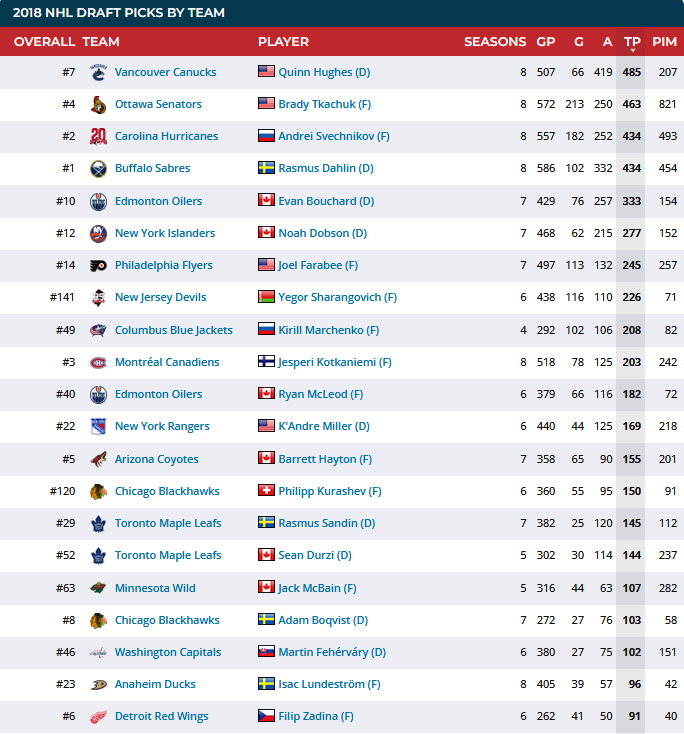
We can go line by line and pick by pick to view surplus value but lets first notice how few significant players there are at all. There’s a good chunk of “stars” (Hughes, Dahlin, Bouchard, Tkachuk, Svechnikov, Dobson, Marchenko) and a good chunk of very servicable players otherwise. K’Andre Miller and Ryan McLeod have developed into good shutdown options (Mattias Samuelsson who didn’t make the points cut), Farabee and Sharangovich have more or less flamed out.
There are 19 players who reached 100 points. We make a big deal about draft pick value, and rightly so considering the few tangible currencies NHL GMs tend to use, but there just aren’t that many difference makers in any given draft.
I think NHL GMs are generally getting better at the draft, so perhaps the top 20 players of this draft generally trend closer to the first round but it is certainly possible to “make it a good draft”. Take 2019 for example, where there are currently 22 players who have reached 100 points (and more very close), where the 21st highest scoring player is Dmitri Voronkov.
Pick or Trade?
In Aaron Portzline’s Monday Gathering on 4/27, Waddell said the following about the Blue Jackets’ first overall pick:
It’s early, but you have to ask, right? Waddell isn’t in patience mode or rebuild mode; he’s in win-now mode. We asked him Sunday — exactly two months from draft weekend — if that first-round pick would be available via trade.”Yes. I would say yes, if we think it would make our team better,” Waddell said. “Our goal is to continue to try to take the next step forward, so I would say everything is on the table at this point.”
He is open to a trade that makes the team better. Whether or not this is a good plan depends on who exactly is available. I’ve done a lot of work to demonstrate that the team is full so that we’re prepared to evaluate decisionmaking up to this point. There aren’t clear areas where the Blue Jackets can take a risk on a player to drop them into the lineup.
Obviously, depending on UFA status (why haven’t Coyle or Marchment been signed yet?) there may be different options or voids to fill. Assuming they are signed, the only real option for an upgrade is packaging the pick with some roster talent for a top six scoring upgrade.
Frankly, I don’t really see a deal getting done. There are some big fish with the possibilities to make waves, and the Blue Jackets should be in on them, but I see far more teams with more capital and more incentive to win the deal. Both St. Louis and the Washington Capitals have two picks in the teens, if there’s someone to be had it’s easy to see those teams winning.
I don’t really see any players that fit this sort of “middle first round pick” value, though perhaps those sort of players aren’t evident at the moment. Given the above “scoring shallowness” of each given draft, we can say that it’s not bad practice to trade this pick. Simply getting a bona-fide NHLer is likely more value than the 14th best NHLer to come from any given draft. The analysis after these general conclusions gets much more complex relative to roster-crunch, risk in both directions, so we can just say that it depends heavily on who exactly is available in the first place.
The Blue Jackets also have the 43rd pick (St. Louis’s) from the Yegor Chinakhov trade to Pittsburgh. Deal making ammunition but also a good spot to take some risks on players who fall out of the first round.
Availability and Logic at 14
I am going to work under the assumption that the following players are taken by the time the Blue Jackets pick:
Gavin McKenna
Ivar Stenberg
Chase Reid
Caleb Malhotra
Keaton Verhoeff
Carson Carels
Daxon Rudolph
Alberts Smits
Viggo Bjorck
Tynan Lawrence
The last two here are suspect considering size and potential underperformance, but I think GMs will learn their lesson on Bjorck via recent Benson, Blake success. If Bjorck is available, it’s a no-brainer. Tynan Lawrence is interesting, not a lot of pop, but a weird season and a very young birthdate.
Ascertaining what the Blue Jackets desire with this pick is a difficult activity. Generally, we hear a lot about “best player available” but Don Waddell has eschewed some of that to chase athleticism. Perhaps that doesn’t continue given the gap from when this pick is made and their projected roster arrival (which at this point seems like it might be post-Waddell).
If we think about what the Blue Jackets prospect pool has relative to what a “rounded” pool might need, we see a lot of on-puck talent, a lot of athleticism and not a lot of “complementary” players. Depending on how Lindstrom turns out, and Smith at the same time, they might need a lot more actual offensive juice and specifically some building and connective types. Similarly, though each of those players can certainly get stops the Blue Jackets don’t have a lot of “shutdown” juice, defensive intelligence outside of pure stops, coming through the org.
I don’t think that these types must come from the draft considering how difficult it seems to be to project whether a players’ sense, defensive intelligence and faciliation translates perfectly, but it’s something worth considering.
The Information
I won’t be offering too much analysis. The goal here is to use some data and offer some easy video resources should you want to dive deeper in the time between now and the draft.
There is a deluge of content on projections and draft picks but the great majority of draft-related information improves over the next month and change. You’ll probably be familiar with Mitch Browns’ prospect tracking work at this point but suffice to say there will be much bigger samples provided over this time period as well. Elite Prospects has been offering personalized breakdowns of each prospect behind their paywall but I’m sure more specific content will be coming that is more widely available for consumption later.
The American Talent
Wyatt Cullen
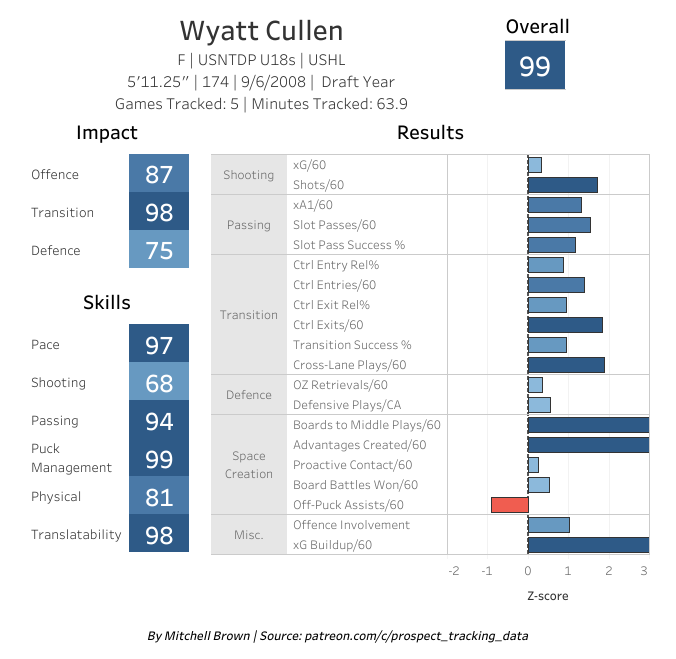
Wyatt Cullen is the best player in this years’ draft eligible USNTDP crop. He has seemingly taken leaps and bounds forward, adjusted to a growth spurt and has an extremely late birthday (this is a very positive theme of a great many of the prospects who are likely to be available at CBJ’s draft position). If you like trajectory and growth and the potential for more of it, this is your guy. It’s gotten to the point that I suspect he might be a top ten pick and, if not, might be gone before the Blue Jackets pick anyway.
The sample size above is too small to get overly worried about but shows a massive talent at playing hockey and in facilitating transition. If you want a player that can keep up with the Blue Jackets’ speed while offering a bunch of playmaking, this is probably the best potentially available option.
For the Blue Jackets’ “need” perspective, he is more of an on-puck creator. Conceptually not what they’re looking for but he offers enough offensive pop that I am absolutely certain he’d provide value to the club especially as a second-wave talent.
Nikita Klepov
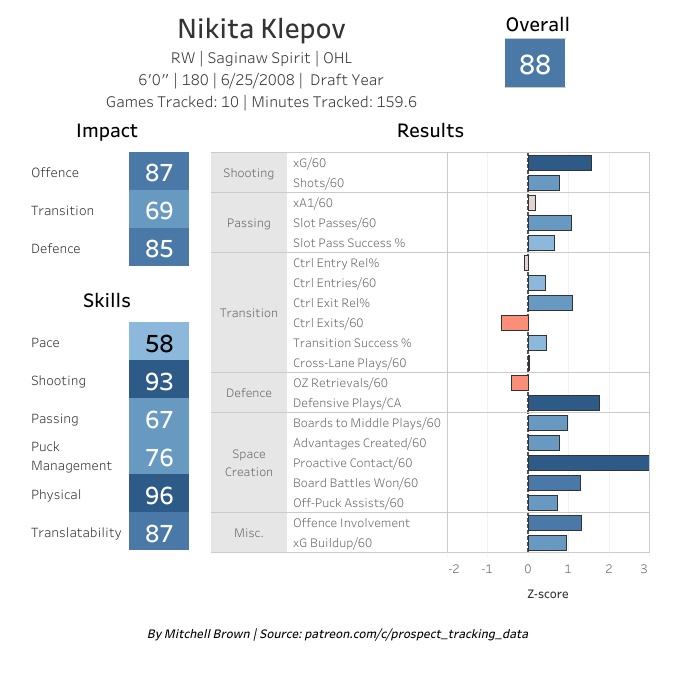
Pick 14 is probably too high for Klepov. His data isn’t overly tantalizing but his position on the Saginaw Spirit and overall scoring profile certainly are.
This is, nearly exactly, the type of connector and spatial playmaker that the Blue Jackets would really like to drop into their NHL lineup as a fully matured player. If you’re eager to fill out the complementary roles, as in fits with Lindstrom, he’s a good option and might even be heading to Michigan State next season.
The question for him is whether his creativity in these playmaking spaces, in his ability to beat players through layers, is a product of Saginaw’s system and whether it will be available at NHL levels. To be determined but it’s not a bad sign that they appear.
The Coyle Succession Plans
Ilia Morozov
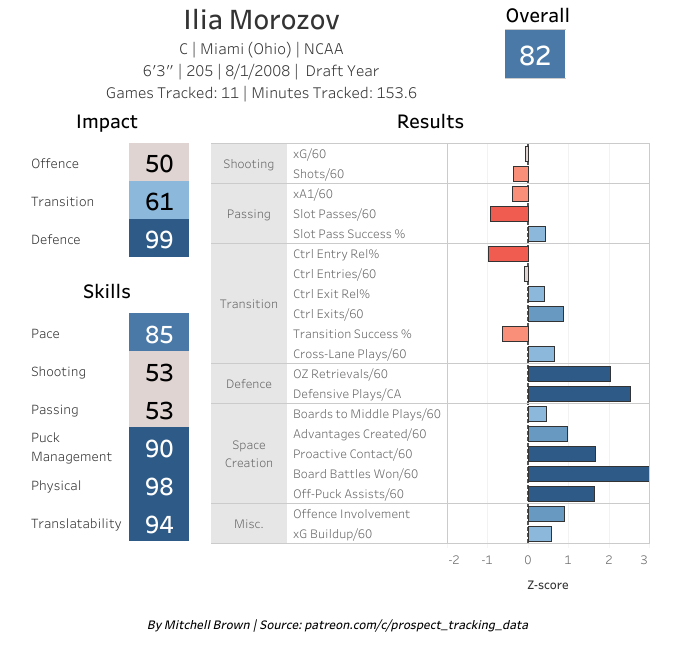
Ilia Morozov’s trajectory is quite interesting and not without risk. He’s very young and stepped right into the NCAA where he was a fantastic defensive player, all the while boosting his scoring from his unremarkable USHL D-1 year. His work in the d zone is legitimate but the scoring and offense don’t always appear.
Was he held back from scoring opportunities by taking difficult defensive assignments on a bad team and prioritizing that domain? Or will he top out as a sort of late Jordan Staal bottom six matchup type player? High quality defensive players are valuable but if Coyle can be had for a 2nd and 3rd as an already mature player, what’s the value in spending this capital just for someone who might be it later.
The benefit of his profile is that he does have connective ability, showed remarkable efficiency in terms of improving conditions of play and can play around the net and along the walls. Even if he doesn’t develop the offense, you can use him as an insulator for more risky offensive wings and he won’t necessarily degrade their capacity to play.
Oliver Suvanto
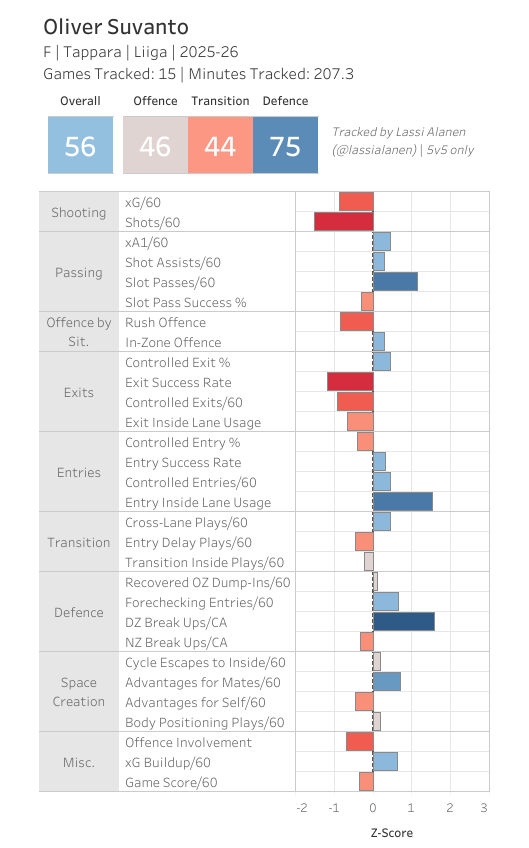
Oliver Suvanto projects to the same sort of profile as Morozov. He’s extremely young, played in a defensive role in a league filled with actual players and gained a ton of the coach’s trust by handling it well. He finished the season playing fourth line wing in Liiga but played big minutes at the U20 level and at the U18 World Championships.
The tracking data for Europe is different, and Liiga still different from the NCAA, so how you use this to compare the players is up to you.
From a data perspective, both players project similarly. You’ll probably find them at similar positions on most “draft boards” partially because most people expect they’ll both do more or less the same thing in the NHL: Defensive 3C.
Getting players like this in the correct order is what probably separates the good amateur scouting orgs and the mediocre ones. I can’t say I’ve watched either really and certainly don’t have a strong opinion at this stage.
The Pacey, Strong Checkers
Oscar Hemming
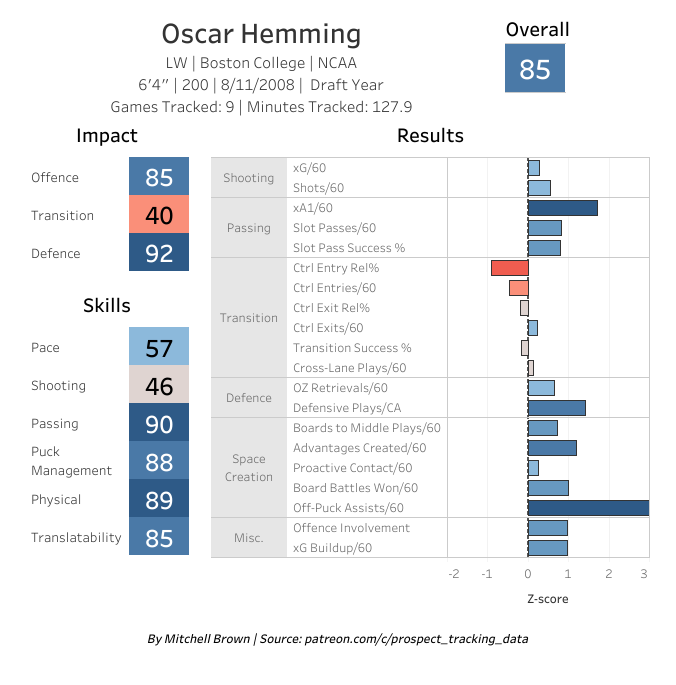
Oscar Hemming is yet another very late birthday who checks a ton of boxes with respect to what the Blue Jackets are lacking. His season has been very interesting considering some contract disputes leading to a lack of playing time. He eventually joined Boston College and put up some very interesting flashes.
If everything turns out well with Hemming, he’s exactly the type of pacey powerforward with playmaking chops that slots into the roster perfectly and fixes all of the issues. He can keep up with Fantilli or Lindstrom, can feed them pucks in the slot, he can even bring open-ice and enough playmaking to a Kent Johnson or Kirill Marchenko.
The limited sample has been all about flashes. As a very young college player, there’s plenty to be excited about. The runway and adaptation is remarkable and the lack of information more possibility in both directions.
Adam Novotny
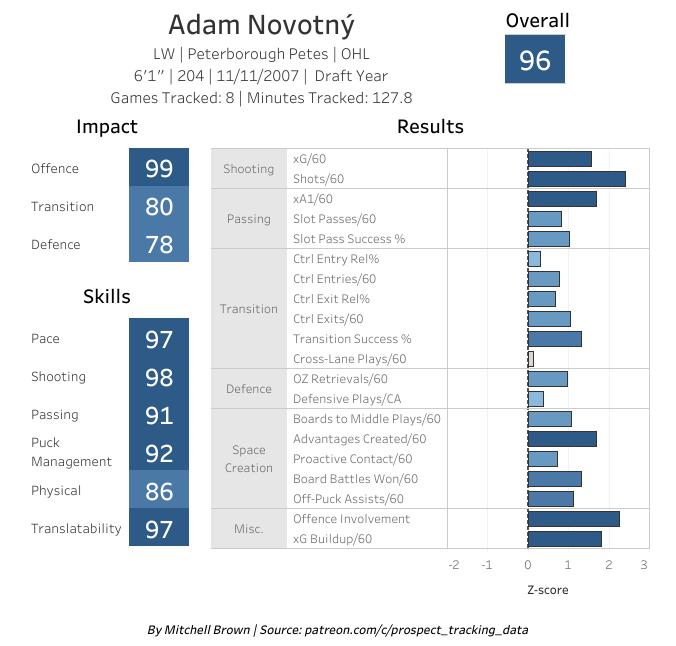
Adam Novotny is something of a departure from a bunch of the previous players. He’s not young and he played in the OHL. As a result, his tracking data is very good.
Conceptually, he also offers a lot that the Blue Jackets might need. He’s strong, fast and has a strong desire to check. He was a big part of his teams’ offense and show plenty of the wall skills you might want of a player with this archetype.
The warts in the tracking data are there. He shoots a lot, isn’t a particularly brilliant playmaker. He might just be more of what the Blue Jackets already have in terms of Cole Sillinger or Cayden Lindstrom. He projects to fit in a playoff style atmosphere, and certain’y won’t wilt when it comes to physicality, but perhaps not enough skill to feel overly excited about adding to the pool.
Given the actual data, there’s a lot that could do right.
Flashy Big CHLers
Ethan Belchetz
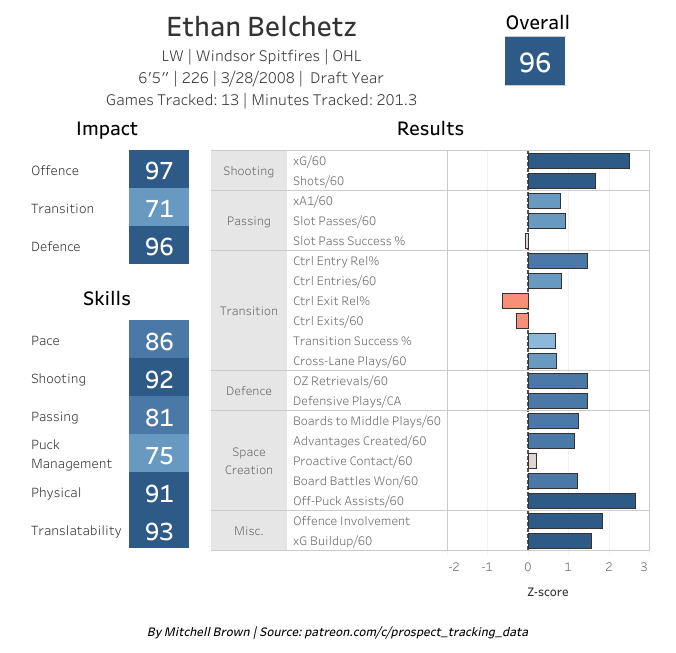
Ethan Belchetz began the season way up high on many draft boards and has steadily slid down them as he stagnates from a progression perspective. He’s in the early 2008 draft window which positions him as having always been one of the older players in his class.
As a player archetype, there’s a lot to like for his fit within the Blue Jackets’ organization. His strengths are around the net and below the goal line on the cycle where he as wall-skills and complementary playmaking.
He’s huge and fills a niche. The secondary value characteristics seem to be mostly negative otherwise, save for his team. The Windsor Spitfires seem to love their big guys and have decent history with them as well. They all get drafted: Alexei Protas, Ilya Protas, Liam Greentree and Jack Nesbitt. It’s too early to evaluate but their reputation with big men might be carried by those two brothers.
Maddox Dagenais
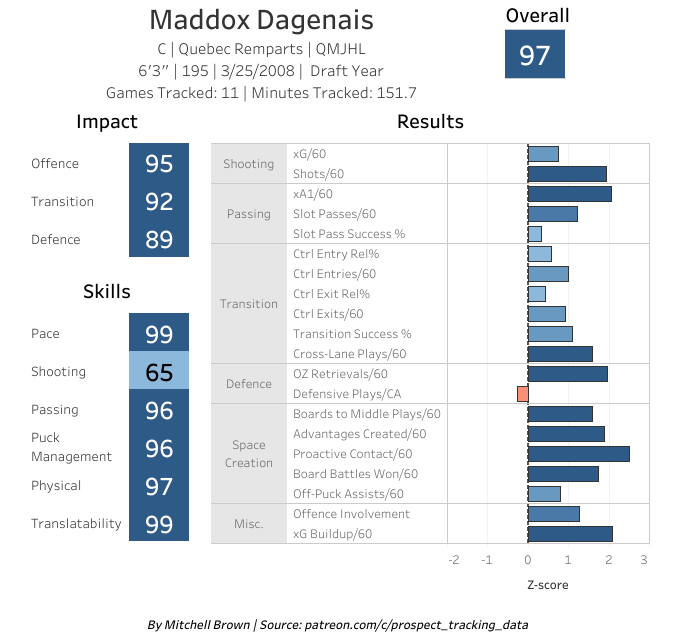
Maddox Dagenais plays in the QMJHL, is a similar age to Belchetz and has similar progression issues. He never really found the score sheet much and it’s hard to understands how that might work relative to the Q as a league.
His tracking data seems to be somewhat exceptional and his profile suggests tools galore. If you think the Blue Jackets pick based on size measurables and tools flashes, and that seems to be the trend as of late, you might expect this to be the pick.
If the tracking data represents him well, it might not even be a bad one. Still, there’s something to be said about the lack of “putting it togther” that might just be too much of what the Blue Jackets have struggled to get the most out of lately.
Canadian Undersized Defensemen
Ryan Lin
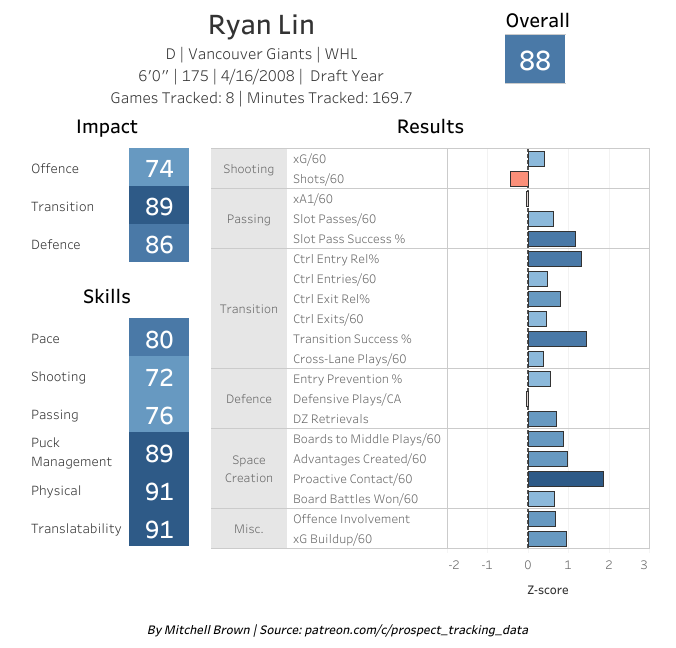
I watched Ryan Lin late last season and early this season in international tournaments with Canada and mostly loved what I saw. Since then, he’s played a ton of minutes (21 minutes at 5v5 per game in the tracked sample above) and without the extraordinary measures that you’d like to bet on a player of his stature.
You might say “6’0” isn’t really undersized” and I’d agree with you. To that point, though, he’s not particularly strong or fast and those work as a profile to become a player that isn’t overly valued by NHL GMs. He’s smart but in the above tracking data that doesn’t appear in any way the screams “guaranteed to succeed”.
I’ve seen some of his proponents describe him as Adam Fox like but Fox’s tracking data in the USNTDP was as obvious as it gets. Perhaps he’s a victim of minutes suppressing his rate values, perhaps he’s a victim of not having whatever is in the defenseman development water in Plymouth, Michigan (where the USNTDP is based).
In any case, as a right handed defenseman he still offers a lot of value as a player who could serve as a complement to what the Blue Jackets have. Werenski, Provorov, Mateychuk and Smith are all lefties and his game is conceptually moldable as a complement to any of them.
To point toward his intelligence and roundedness being more than the sum of his tracked-scoring parts, he’s committed to the University of Denver for next season. Not exactly a D-factory but a very smart college program that wins quite a lot.
Xavier Villeneuve
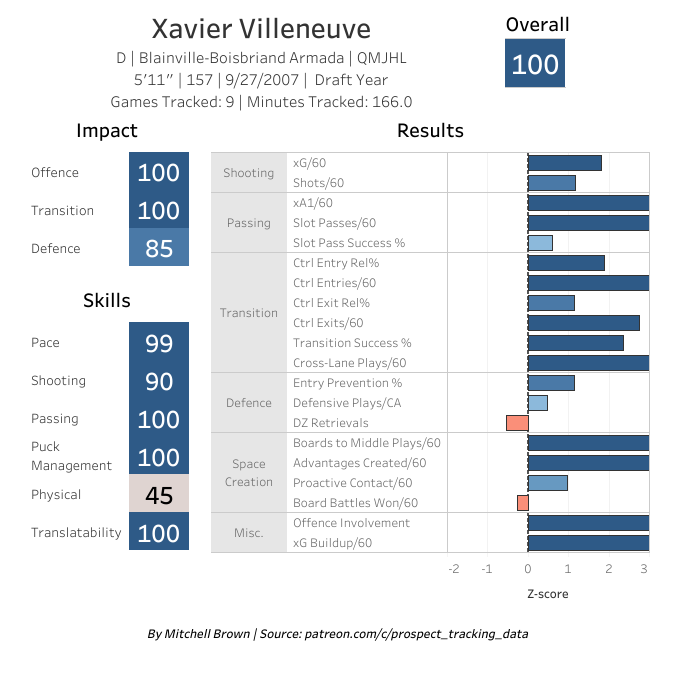
Villeneuve is an actually undersized if not tiny left handed defenseman in the QMJHL. A ton of red flags as far as a Blue Jackets pick goes. Still, I think the above tracking data speaks for itself. Better than that, though, is that he had the same type of data last season as a D-1 player as well. When scouting Justin Carbonneau, Villeneuve popped. The problem so to speak is that his scoring didn’t progress and he’s old for the class.
Given the above dominance, I think he would be an excellent pick for the Blue Jackets. At 14, there aren’t necessarily players who have the potential to impact a club just as much as him. The Blue Jackets might not need him and that might just be all the reason to go in this direction.
If Zach Werenski is with the team for the next 6 years, he’ll likely never find a role. As an offensive defenseman though he probably has a skillset that will create more points than Jackson Smith or Denton Mateychuk especially on the powerplay. Should these players find two-way roles up the lineup, perhaps sheltering him on the third and giving him some offensive minutes gives the Blue Jackets an edge that few other clubs have.
The dangerous anchor, as of this moment, is Lane Hutson. Just because he was a skilled and flawed tiny defenseman who instantly became one of the best in the NHL doesn’t mean that this one is guaranteed to do the same. The difference between the two would come down to the intelligence suffused between all of these metrics tracked. Can he read the game well enough to get stops despite his size? Does the USNTDP have magical water that means their players are much more likely to succeed in the NHL?
The Shutdown Defenseman
Malte Gustafsson
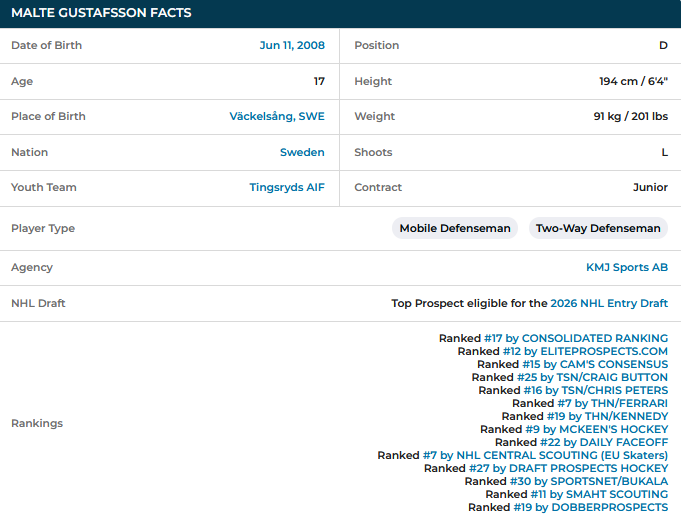
Malte Gustaffson does not have tracking data so instead I’ll offer this preview. He is, regrettably, another left-handed defenseman. He’s 6’4” and young and spent the majority of this season in the SHL. He didn’t really score there but logged regular minutes. When played with his age-group, like at the U18s, he scored just fine.
Generally, he projects very well to be a rush-stopping shutdown defenseman. The Blue Jackets don’t really need this as they’ll mostly be hoping Jackson Smith picks up a ton of this slack. As this specific role, though, I like his technique and approach much better.
The Swedish ice is bigger and, in my opinion, that means any given defender has to rely more on their relationship with the skater to create stops. They have to be more attuned to their systems because the extra space gives the offense more options. NHLers and CHLers for example can use the boards and the volatility of small spaces as a sort of crutch.
He looks almost guaranteed to be that type of rush stopper. In the vein of Simon Edvinsson, K’Andre Miller or even Vladislav Gavrikov. I cannot say whether he has the ultimate offensive upside of Edvinsson or Miller but that’s not exactly a differentiator for those players either. Whether he reaches the heights of Jaccob Slavin, Jonas Brodin, Devon Toews or Gustav Forsling is not something I would feel comfortable predicting.
Given the Blue Jackets’ overwhelming number of left handed defense prospects (Mateychuk, Smith, Ashton, Vass), it probably doesn’t make sense to take him. His refined rush defense though, and projection to a role that helps NHL teams drive wins would be something I’d be excited about.
Closing Thoughts and More Names
I don’t have a fantastic read on this draft as a whole, perhaps I’ll spend more time in the lead-up getting actual eyes on these players, so I can’t offer any full-throated endorsements.
I’m most excited about Cullen and Gustaffson at the moment but perhaps more viewings yields some characteristics in some of these other players as well. Conceptually, though I am reticent to say we should pick specific players in order to replace current NHL talent, both Suvanto and Morozov are young with defensive refinement and I think CBJ should really seek to find some players with defensive intelligence like them. If I had the option, I’d rather have Konsta Helenius at the same time.
As far as trading the pick goes, I think “running it back” and using these picks is the better long term angle. Still, any player that provides value without marginalizing talent is something that the Blue Jackets should obviously pursue. If young players, or roster talent, can be packaged for talent, I would at least hope that Don Waddell can make an addition that makes sense for at least 5 years. We’re still waiting for the first significant addition under the age of 25 on his part.
As the Blue Jackets go down the draft, there are some exciting names that could provide some big offensive hits:
Jaxon Cover - ball-hockey educated and creative open-ice wing for the London Knights
Alexander Command - Swedish two-way forward, could be an excellent insulator bet should Morozov or Suvanto notbe value at the pick
Tommy Bleyl - QMJHL right handed defenseman, might be available in the second round and therefore better value than a Lin or Villeneuve
Simas Ignatavicious - Lithuanian playing the the Swiss League, might have more to offer as a defensive/checking winger than Novotny and might also be available in the second round
Ruck Twins - two Medicine Hat players, both with some very exciting data though they are both undersized, I assume someone tries to get them both and don’t see it being the Blue Jackets but the Med Hat connection could be strong
Adam Valentini - another “undersized” but competitive option for a second round pick. Young, Michigan Wolverine with decent scoring