
Mid-Season Analytics Check-in
HockeyViz Team Stats, Tracking Project Player Stats, Storylines

The Blue Jackets have officially crossed the half-way mark with their strange microcosm of the season game against Pittsburgh. That means it’s time for an update on public analytics and hand-tracked stats as well. We already have a partial understanding of what this team is, thanks to the introductory Thanksgiving Break Breakdown, so I’ll spend less time at each individual point than before.

Team Performance Visualizations
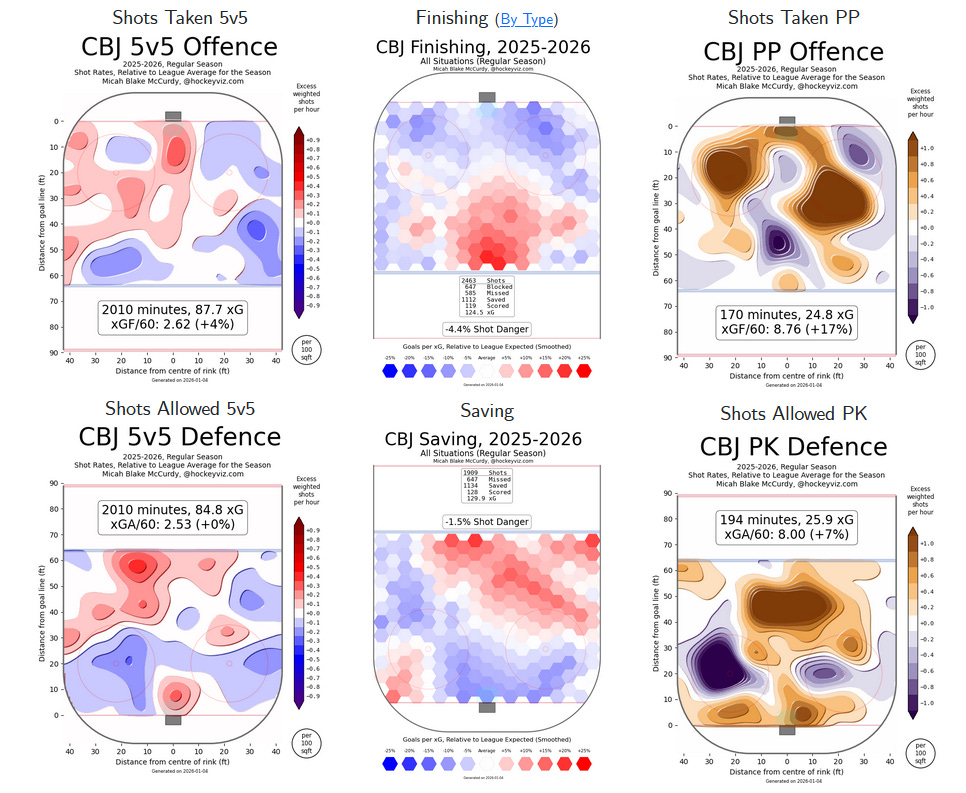
The Blue Jackets are a perfectly mediocre team on most fronts. They are, technically speaking, a good 5v5 chance-share team though that advantage has been blunted by lower event minutes as of late. They haven’t unlocked their finishing just yet, though it has improved, and their goaltending is strong in the dangerous areas and weak from distance. Special teams wise, the powerplay looks better than it performance and, perhaps, vice versa for the penalty kill.
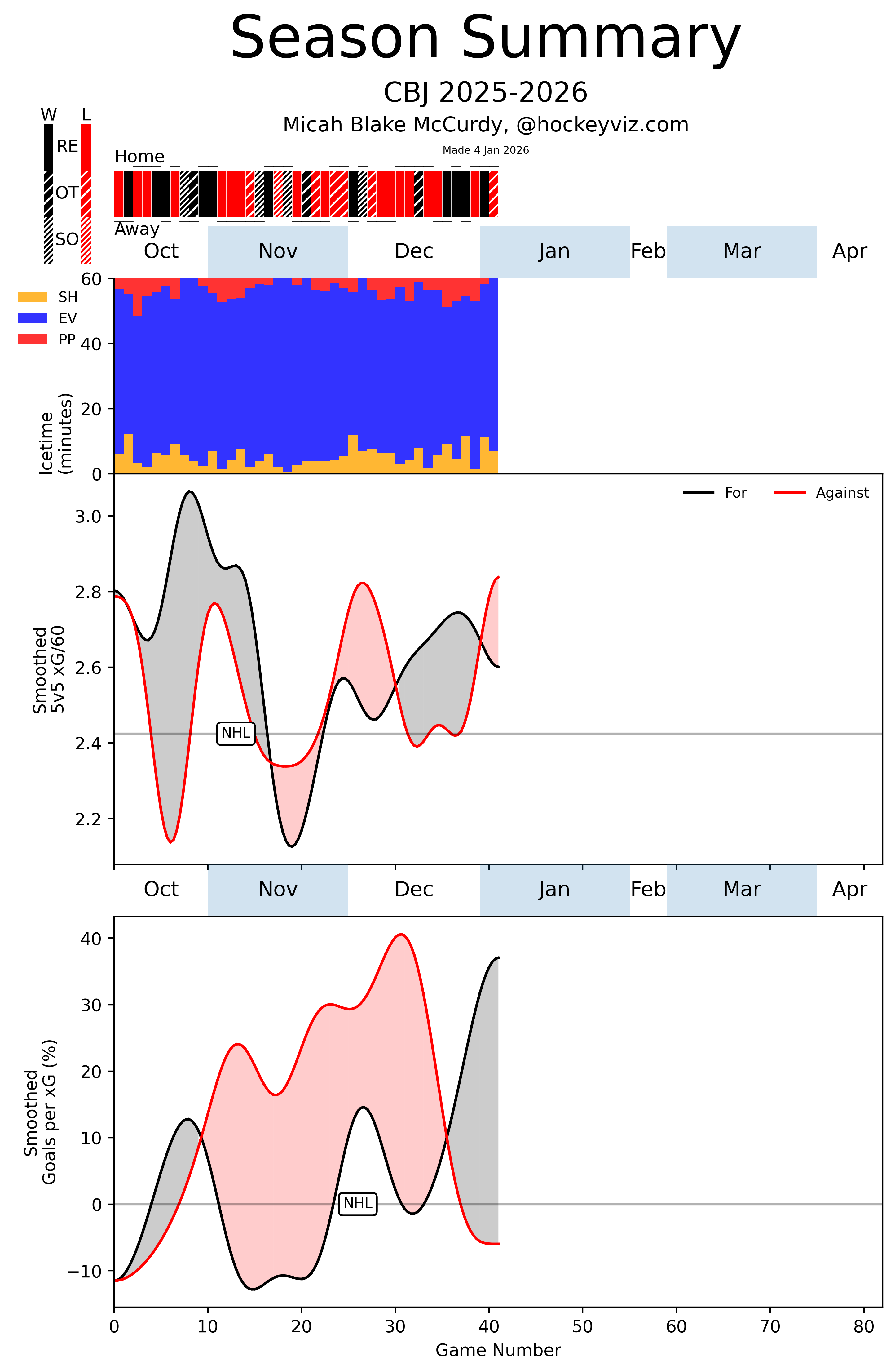
The trends can be observed well on the season summary graph. That long losing streak was in large part due to a simultaneous chance-losing and poor goaltending streak. They’ve mostly put that behind them as of late but there hasn’t been much consistency on any front.
The offense started scorching hot, fell off entirely, and has come back around to a lower peak. The defense has simply oscillated without major improvement or larger trending. The team has preached a renewed defensive focus but it can’t particularly be observed.
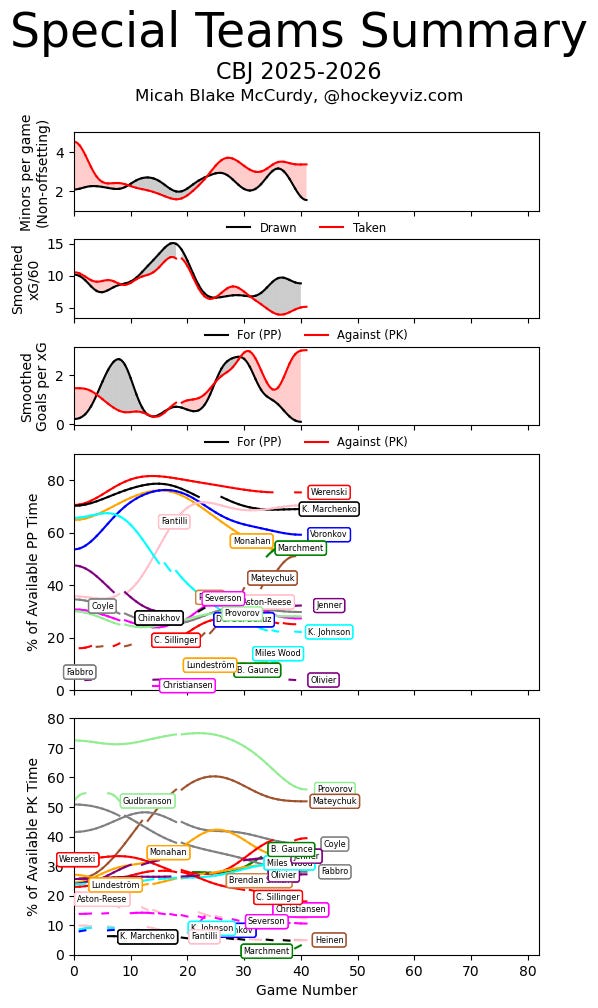
Special teams wise, the Blue Jackets have really pulled it together on the “chance danger” front. Unfortunately, while this is important, it’s not quite as reliable a predictor as it is at 5v5. Offenses control finishing, the capacity to beat the goaltender, more reliably at this game-state than any other. On that front, both the powerplay and penalty kill are trending poorly as of late.
In general, the Blue Jackets remain a team that loses the special teams battle. Their powerplay scores less than their opposition’s does and they get fewer cracks at it the same time. It’s a problem.
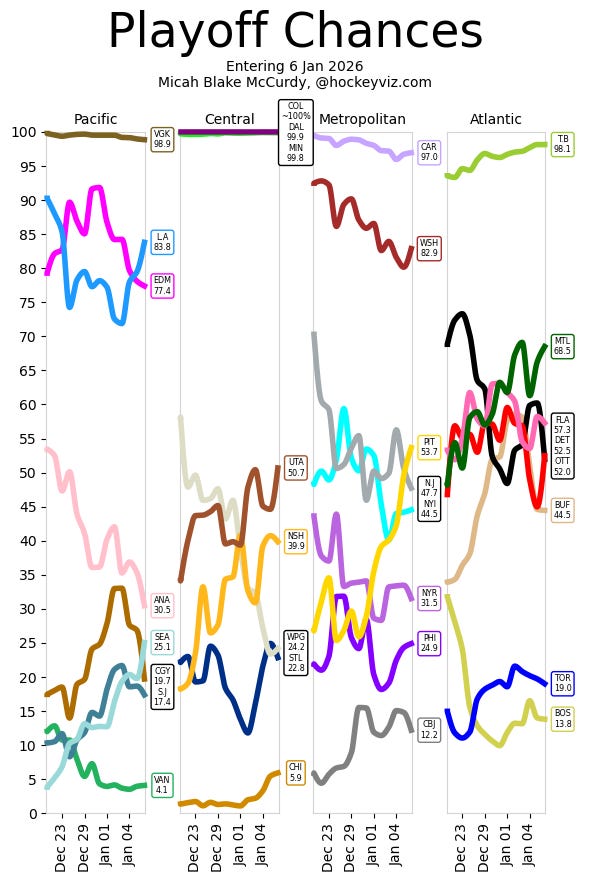
Is the season completely over? No but the Blue Jackets are certainly on the outside looking in. HockeyViz has them at 12.2% odds to make the playoffs from this point which grades as 3rd last in the league.
The Eastern Conference is highly compressed, which does give hope and I’m certain a degree of volatility, but that also means every other team is pretty much equally in it as well. Perhaps the Blue Jackets are a better team than San Jose or Calgary or Seattle but their Conferences and Divisions are worse too.
Here’s a fun year-by-year update from Micah of this seasons playoff probability chaos relative to each other year. Last season, the Blue Jackets were more likely to be in the playoffs at this point of the season. The two prior, though, they were virtually guaranteed to be out. Progress?
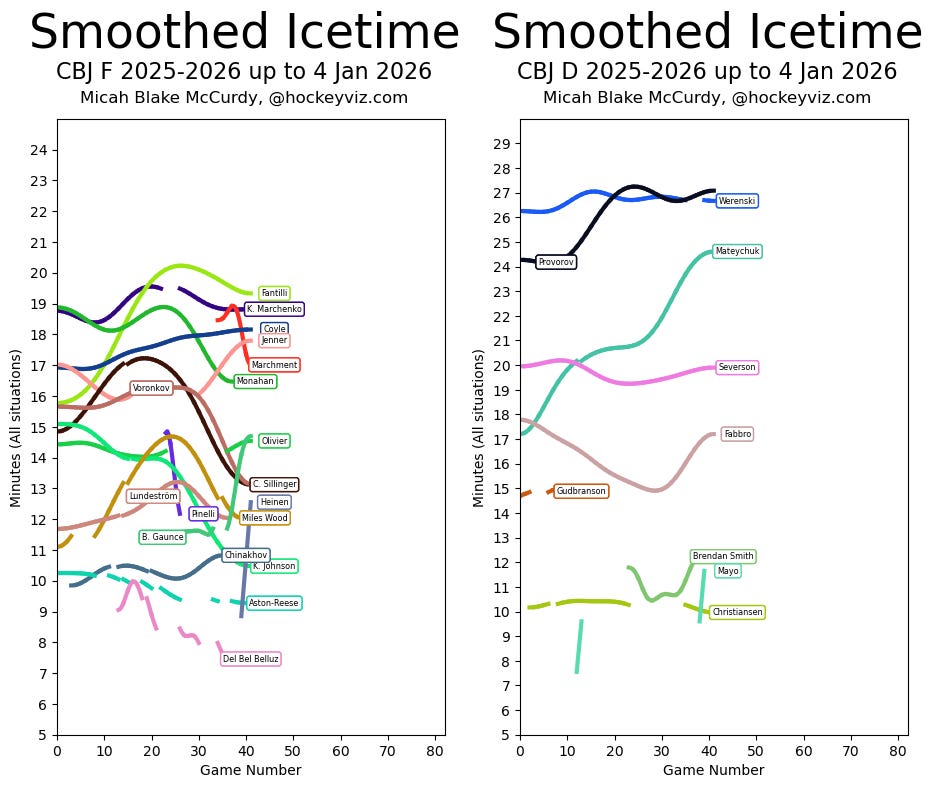
As the season has gone on, and Dean Evason has learned more about what he does and doesn’t like about his team, it’s at least clear what he thinks. Unfortunately for the Blue Jackets, that’s a strange set of things.
The most confusing is his insistence that Ivan Provorov is actually that good. Werenski is a Hart candidate and a probable Norris finalist and it’s debatable whether he should be playing that much at this point of the season. Ivan Provorov, not even very good, certainly shouldn’t be in a competition with him.
Dean Evason has discovered that he loves Denton Mateychuk and Adam Fantilli, though, so that’s at least a good not regarding their future. Not so good for Kent Johnson or Cole Sillinger who have seen their minutes slashed in favor of Charlie Coyle, Boone Jenner and Mathieu Olivier. Hey, at least Olivier has five more years on his contract, right?
Furthermore, Dean Evason absolutely hates all of his third pair defensemen. He’s mostly right about that one, though, and he’s at least somewhat acknowledged that Fabbro has been better as of late. That’s mostly Werenski injury, though.
Waddell signed Egor Zamula today who is a player that grades out very well analytically. He was a feature in my trade deadline defense archetype study as an excellent entry-killer and slot protector but he’s been on waivers too. NHL teams get defensemen wrong all the time, so there’s an angle for a good transaction here. Reports are that he’s heavy-footed which doesn’t really jive with the Evason playstyle, not that we can observe footspeed as a priority on a defense corps featuring Provorov, Fabbo and Gudbranson.
Tracking Project Updates
In case you aren’t in-tune with public analytics discourse on BlueSky or Twitter, there’s been a series of revelations about changes in NHL shot tracking and new discoveries on their impacts on expected goals models almost daily.
In summary: xG models are having a tough time because the NHL is leaning into chip tracking. That makes it more accurate but exposes models trained on data that had more errors. Evolving Hockey’s model, the one that I use because it is conveniently attached to their scraper, is the most impacted.
HockeyViz, the one I most often reference outside of my own work, has been the most well-adjusted.
Keep that in mind as we go into the hand-tracked specifics. The following graphs include all data up to this point in the season, forty-one games cumulative. I have decided not to dive into twenty game stretch comparisons but perhaps I’ll find some time sooner or later.
5v5 On-Ice Expected Goals by Offense Situations
Totals For and Against
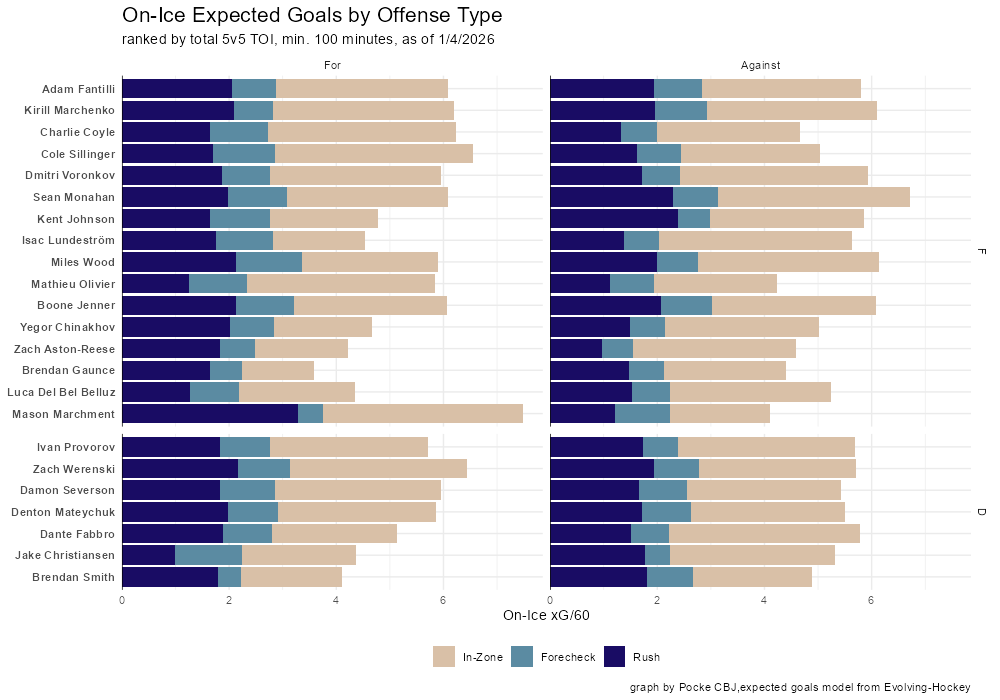
Bit of a messy graph. Players are ordered by total TOI at 5v5 and Marchenko and Werenski’s injuries explain why they aren’t the top players there, though the above graph does support the idea that Provorov and Fantilli have been playing more there lately anyway.
The D all struggle to distinguish themselves in terms of on-ice defense but Werenski is clearly the best offensively. No surprise. Marchment, in a very limited sample size, grades out extremely well. His impact has been felt immediately.
The Blue Jackets’ fourth line looks to really struggle to get any amount of material offense flowing. Perhaps it should be no surprise that Kent Johnson has also struggled tremendously as well.
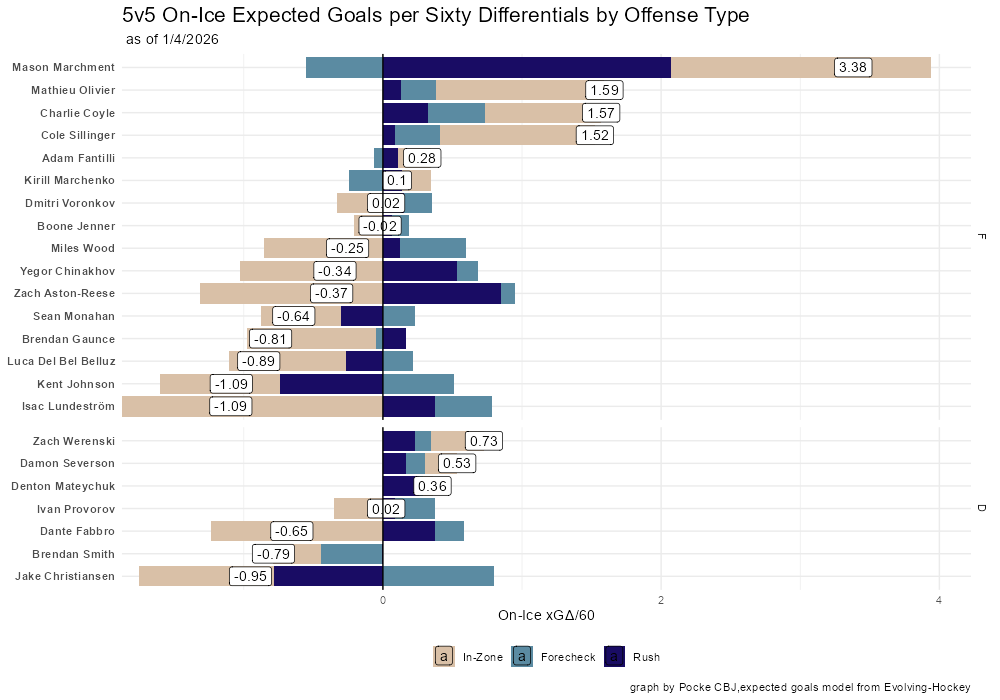
Marchment turbo glow-up noted. Somehow he’s losing with respect to the forecheck battle but his rush contributions are self-evident and we’ll see more later. Kent Johnson is now near the bottom, performing much worse since Thanksgiving.
The Blue Jackets’ vaunted Matchup Line looks great but Jenner and Marchenko have surged up the impact rating as well. Werenski and Severson have also improved their on-ice xG differential in the intervening month+.
Performing significantly worse are: Isac Lundeström and Jake Christiansen. Lundeström has injured himself but it’s hard to see either of those two getting significant minutes as the season wears on. Brendan Gaunce has joined and hasn’t been particularly good either.
Individual Shot Contributions (Shot Attempts)
Shot Contribution Totals
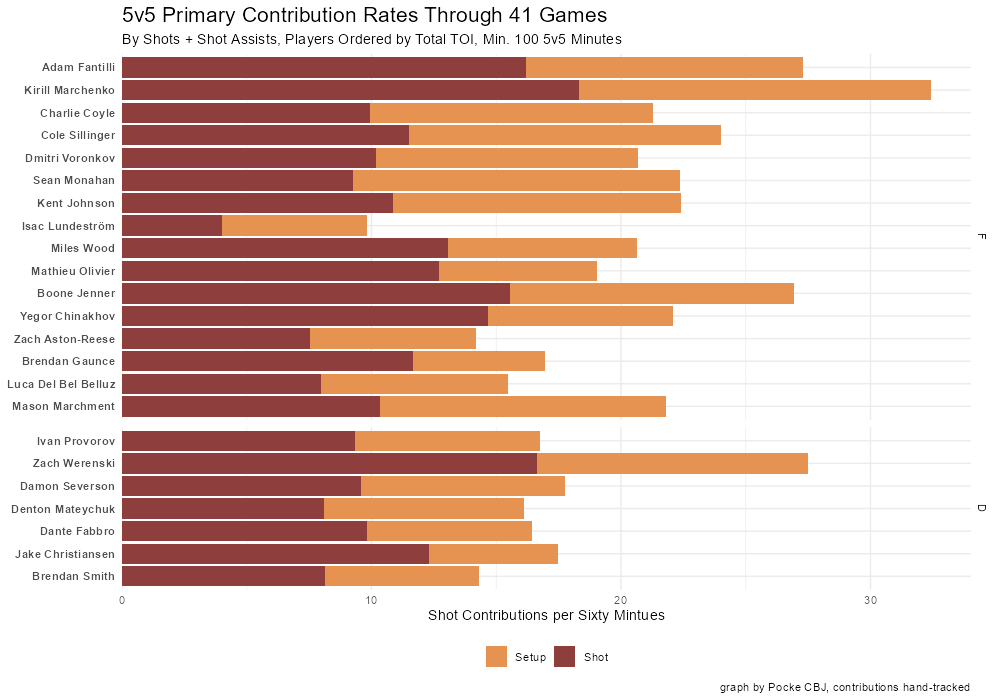
Kirill Marchenko and Zach Werenski remain those dudes when it comes to creating offense. Maybe it isn’t exactly outrageous for Werenski to be leading the way but to be second on the club on a rate basis still feels hard to believe.
Next up are Adam Fantilli and Boone Jenner. Jenner, as we’ll see, is having something of an offensive resurgence. He’s not just driving offense but just events in general. He’s extremely chaotic and certainly supports the theory that you don’t have to actually be good at defense and safe for a coach to love you, you just have to conform to their idea of what good hockey looks like.
Notice, here, that Kent Johnson still grades out well as a shot contributor. He’s on the same level as Sillinger, Monahan, Voronkov, Coyle, Wood, Chinakhov and Marchment. That won’t hold as we move into expected goals based metrics but it’s not like he’s completely forgotten how to play.
Shot Contributions by Shot Type
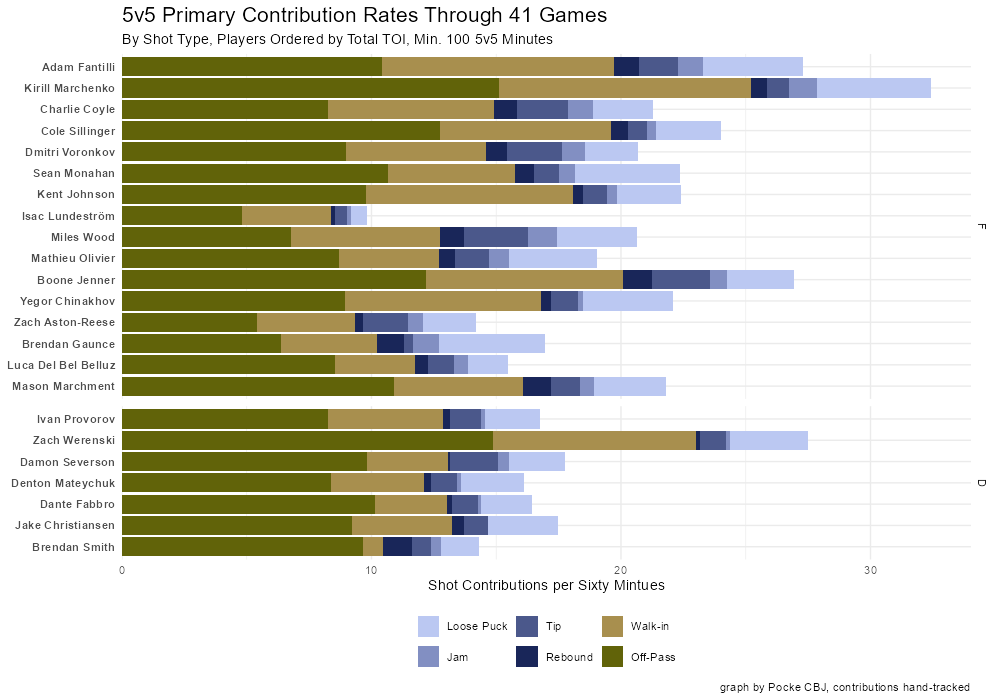
When we move to a controlled offense exclusive lens, Marchenko and Werenski only look better. Fantilli, Sillinger, Jenner and Johnson then look like the next wave.
Across shot contribution metrics, and on-ice as well, it’s a bit startling to me how little the rest of the D stand out. I suppose that makes some sense, these are offensive metrics after all, but they’re all really even.
Shot Contributions by Outcome
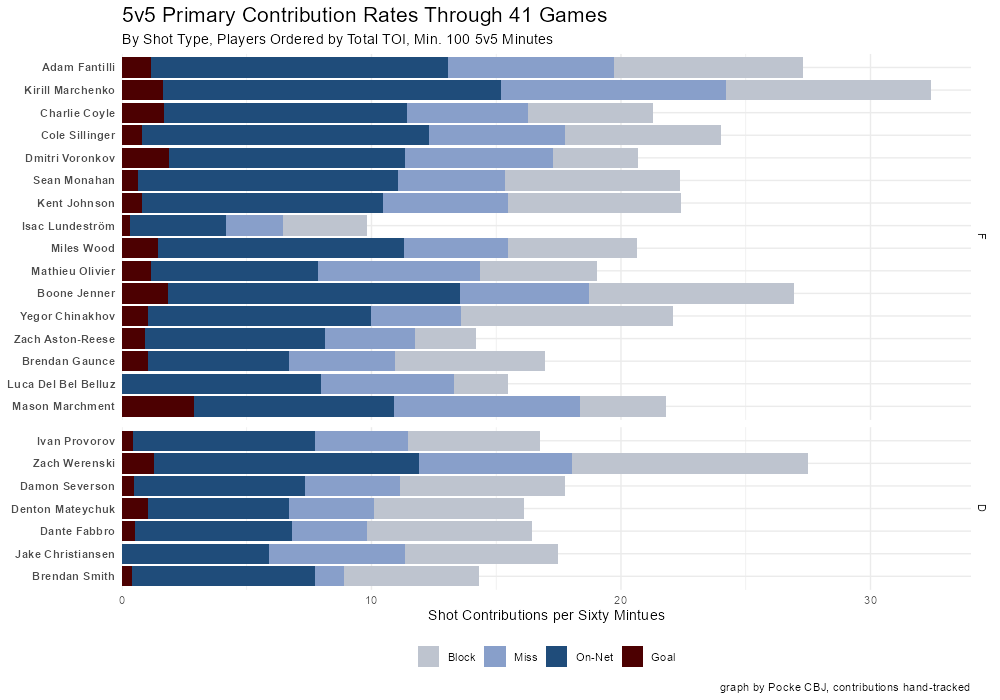
If we factor out blocked shots, Werenski looks a bit more normal. Still head and shoulders above the rest of the defenseman, but on the level of Fantilli, Jenner and Marchment.
Specifically, Kent Johnson and Sean Monaahn really struggle to get pucks on net as well. Olivier, Voronkov, Coyle and Marchment tend to be very efficient there. Perhaps something to do with their net-front games.
Marchment’s torrid scoring pace also well visualized by that big red bar.
Contribution Shot Types Across Offensive Situations
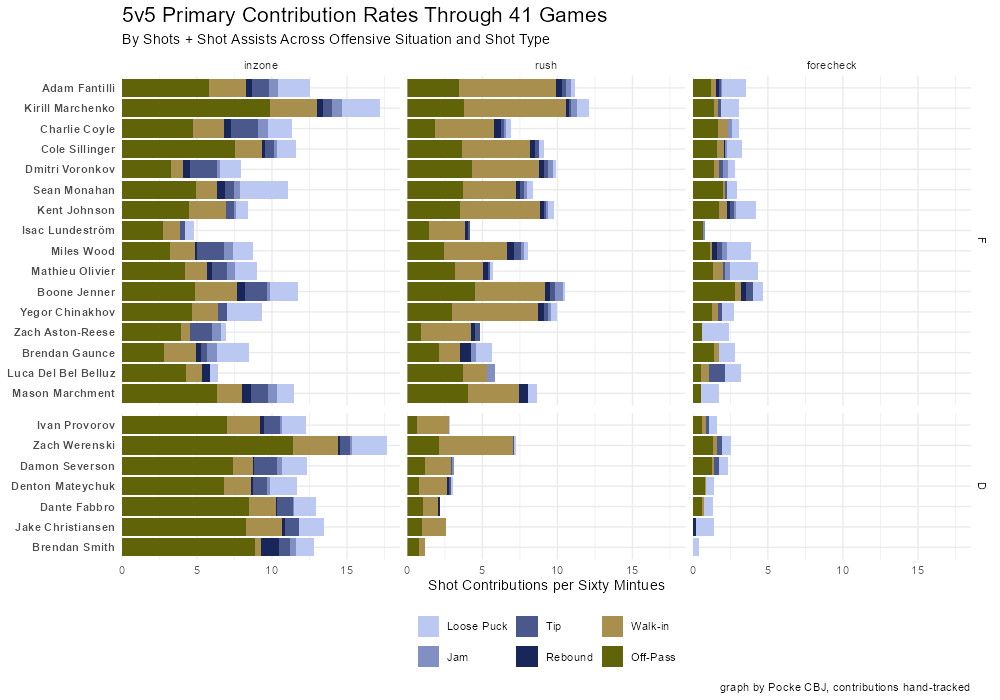
Across situations, we see the same standouts. Jenner and Kent Johnson remain the best forecheckers, though Wood and Olivier have surged up there too, whereas Marchenko and Werenski stand out alone in-zone.
Rush offense doesn’t have as much of a differentiation, outside of Werenski among D.
Expected Primary Points (xP1)
xP1 by Contribution Type
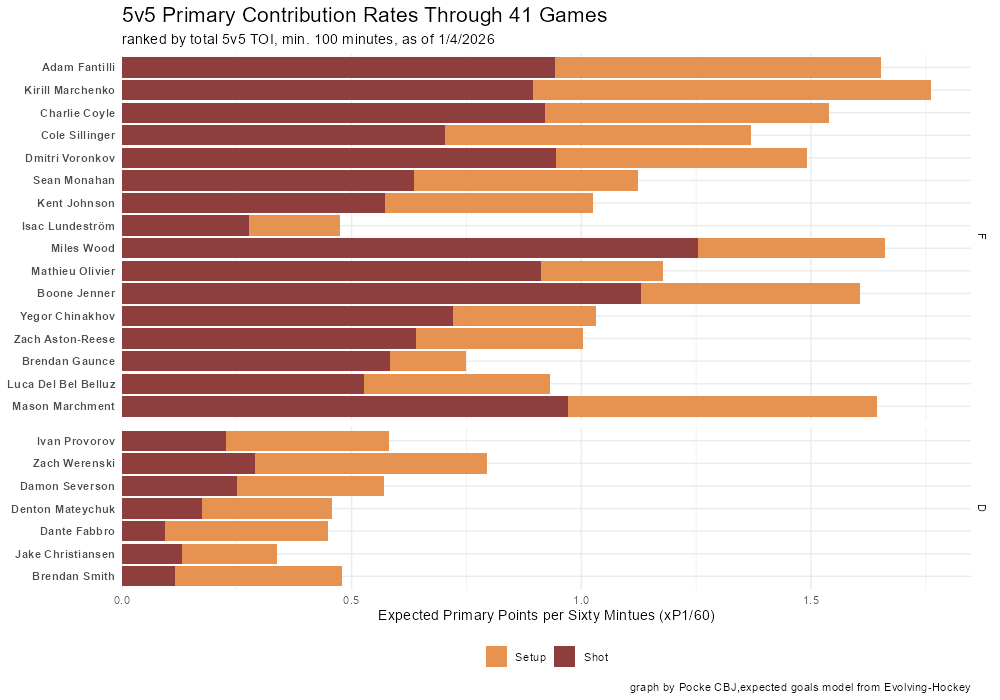
From an expected goals perspective, forwards are not significantly more involved. There doesn’t really appear to be an outrageous pattern. The best offensive contributors also tend to set up the most offense. Only Wood and Jenner shoot significantly more than they “setup”.
The struggles of Kent Johnson now appear in focus as does the runaway success of Mason Marchment. Kirill Marchenko is still him and his playmaking is what distinguishes him from the shooter pack of high contributors in Fantilli, Coyle and Voronkov. He’s just around the play at all times.
xP1 by Shot Type
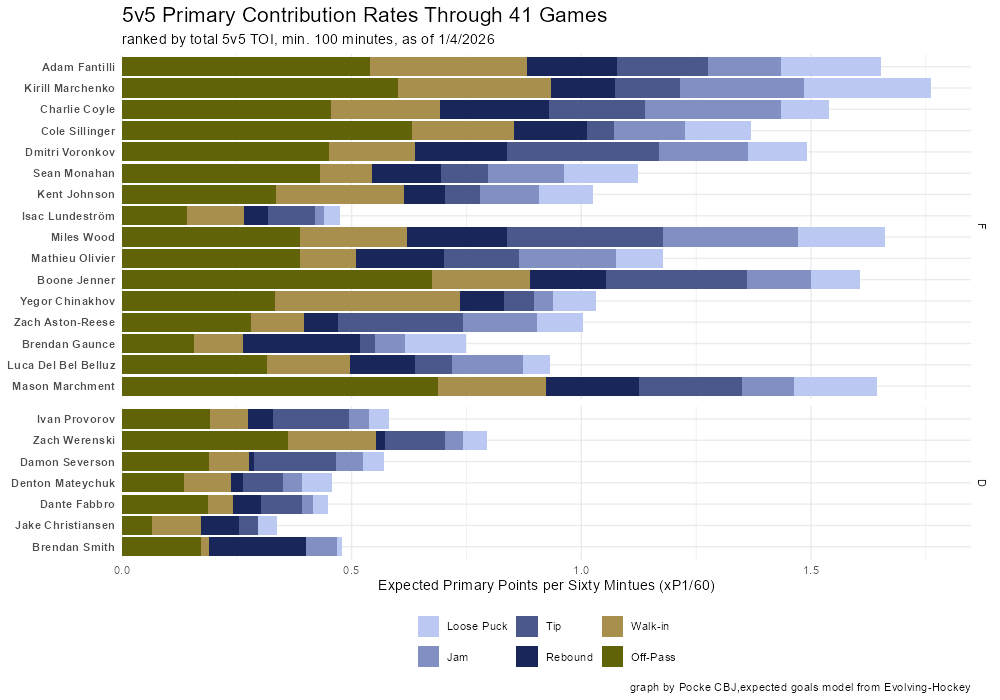
Forwards get a ton of xG off of these netfront situations. We know that, and it’s especially clear that Werenski is much better than the rest of the defensemen at creating outside of that scenario, but it’s made more clear now.
Charlie Coyle is a particular net-front dominator but Miles Wood gets a gigantic amount of his contributions there. Marchment and Jenner, perhaps differently than you’d thing, are competitive with the rest of the top forwards at creating from controlled offense scenarios.
xP1 Across Offensive Situations
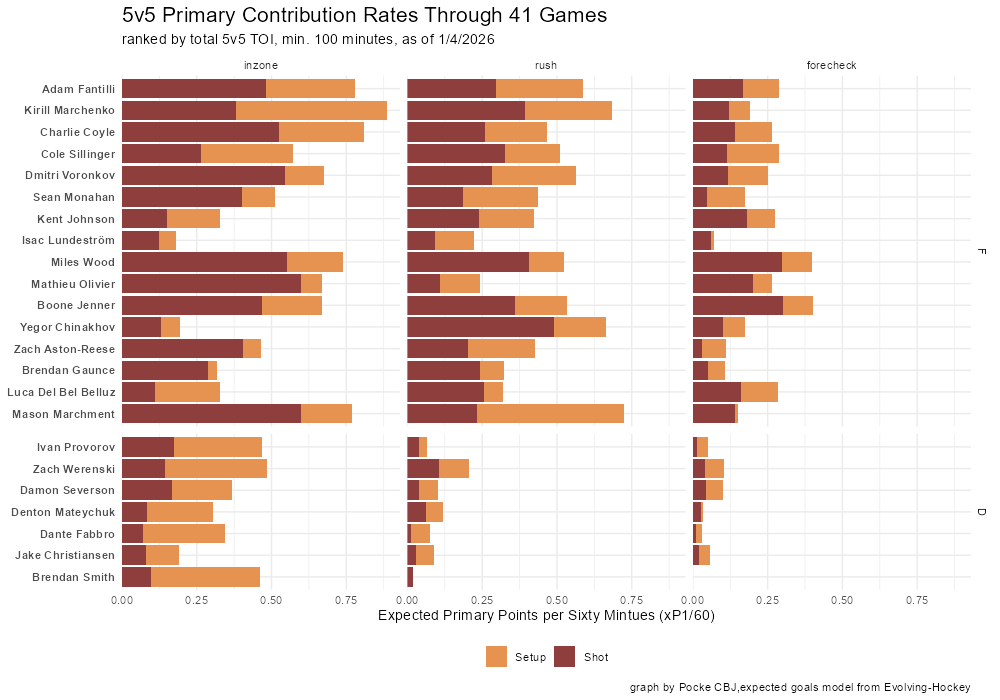
Sample size artifacts are obviously at play for Marchment but it’s nice how well aligned with his scouting report and role asks his early contributions are. In-zone, he creates shooting situations. Off the rush, which he leads the team in, he’s a playmaker and setup man. Perhaps exactly what Fantilli and Marchenko need.
Kent Johnson’s rush game has mostly disappeared but his in-zone game is still ghoulish. He isn’t really helped by his most common linemates either.
Wood, Olivier, Jenner, Voronkov and the aforementioned Marchment are all near exclusive shooters in-zone. I have to think that’s a small space effect but we’ll see more soon enough.
Werenski, in particular, distinguishes himself via rush contributions. He and Severson, active pinchers but also play-joiners, also stand out among forecheck contributions.
xP1 Shot Type Across Offensive Situations
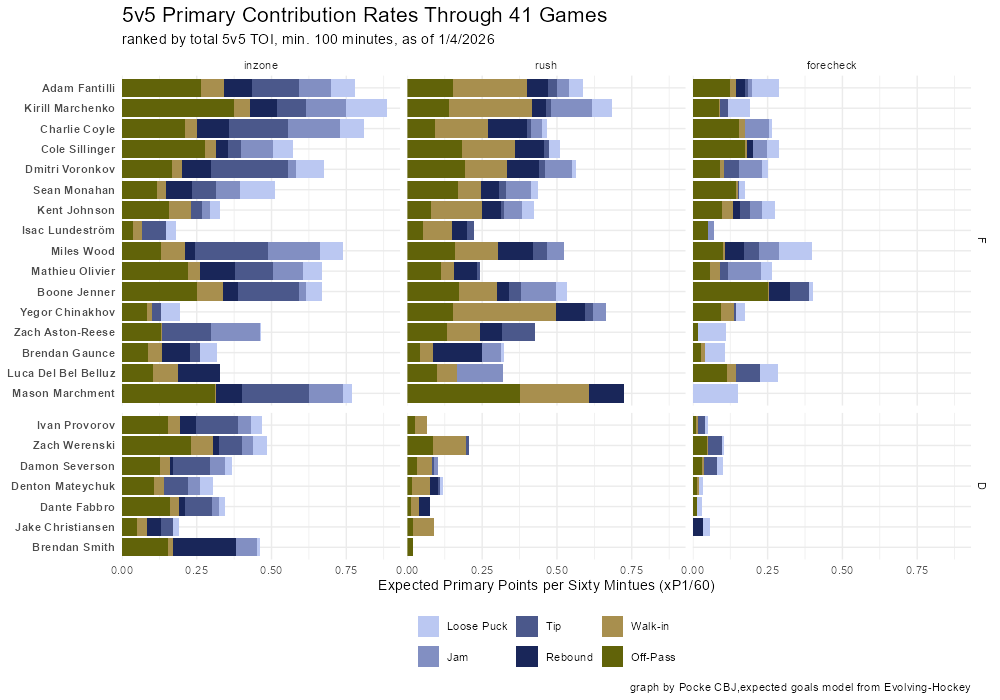
Marchment’s controlled rush contributions are brilliant. He’s been a smashing success in limited minutes and this makes it quite easy to see why. Perhaps those Dallas rush routes really do have magic sauce.
The in-zone offense is notable. Tough Marchment and Jenner create as much controlled offense as anaymore, save Marchenko, their significant contributions are heavily net-front. Miles Wood and Dmitri Voronkov lean heavy into tipping.
Jenner and Voronkov are credited with few putback xGs, Olivier and Coyle higher “rebound” xGs. Am I biased? Or do they have a skill it being intentional in these tight spaces?
It remains clear why Kent Johnson struggles in-zone. He just doesn’t get to the net-front. Room for improvement, perhaps, but his skillset is very much based around motion and gaps and not as much just standing in the crease.
Jenner stands alone as a forecheck creator. It’s all off-pass, rebound and tipping. High danger stuff.
Though Werenski doesn’t particularly distinguish himself in-zone, he is certainly the best controlled offense creator. Given that “setups” are credited by shots that lead to rebounds, I believe there’s strong signal there.
Offense Involvement (xP1/On-Ice xGF)(per 60)
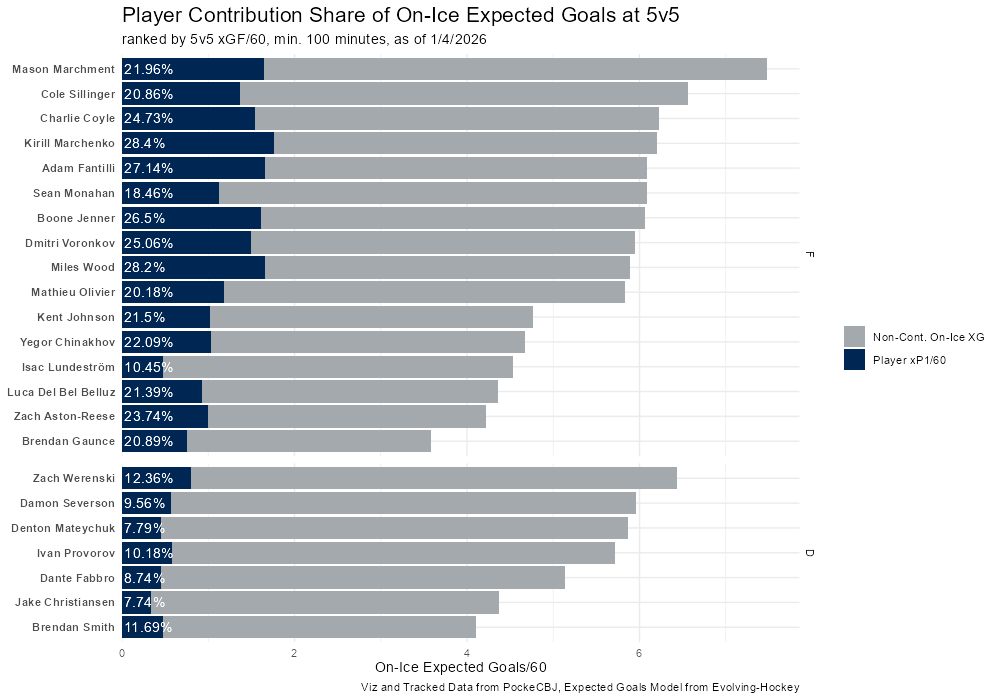
I’m still not sure there’s significant signal in the xP1% but the top contributors of actual offense do tend to be the highest percentage contributors of the most on-ice offense. Sounds obvious, I suppose, but the next chart might help that seem less stupid of a statement.
Comparing Actual Scoring with “Expected” (xP1/60 vs P1/60)
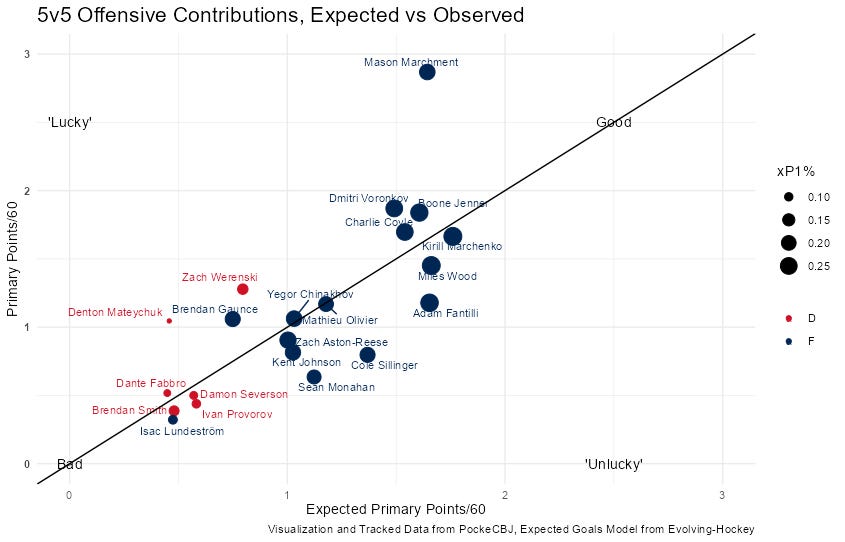
Mason Marchment’s outrageous primary scoring pace (he has no secondary assists at 5v5) caused some axis distortion. I have left the annotations where they were previously so that we get an idea as well.
Kirill Marchenko and Adam Fantilli have room to score more. Voronkov, Jenner and Coyle are making the best of their offense. Their net-front games are excellent. This group, along with Miles Wood, represents the “high xP1% of high on-ice xG group”. It perhaps shouldn’t be a surprise then that they generally ahppen to be the highest performers.
Monahan, Sillinger and Johnson could all score a lot more. Are they unlucky? Doesn’t particularly seem like it but finishing and scoring can certainly be finnicky.
Explaining Denton Mateychuk’s overperformance is difficult. He’s certainly got a fantastic wrist shot and is incredibly active in the o-zone but nothing else about his contributions suggest he should be a top defense scorer. Mid-range shooting might just be like that.
Werenski, in particular, is funny. He’s the best 5v5 points/60 defenseman in the league min. 500 minutes, he and Makar have been first and second for the last three seasons, but he has almost no primary assists at 5v5. He scores a ton of goals, an outrageous amount of goals really, and has a ton of secondary assists. That isn’t to say that his points are bound to regress, he’s outrageously involved in the offense and A2 are more stable for defensemen than otherwise. His primary assist contributions are still great, his teammates just haven’t been scoring on them and he’s buoyed by obscene mid-range scoring talent.
Storylines to Finish the Season:
Jet Greaves and the Goaltending
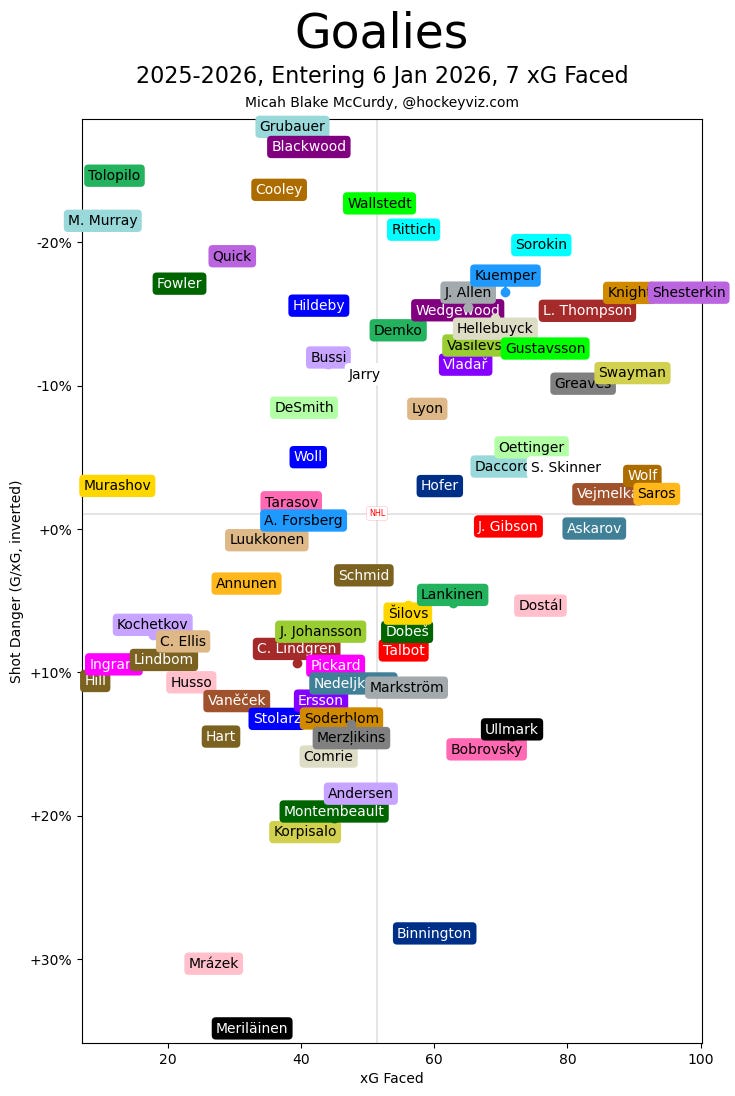
The Blue Jackets’ goaltending has decidedly not been a problem this season, at least when Jet Greaves is in net. Elvis Merzļikins had a promising start but crashed quickly and has been even worse since he started getting spot starts. He complained about the poor playing time in a recent Portzline article but it’s hard to see anyone taking a risk on him at this point.
According to the updated MoneyPuck goals saved above expected model, Jet Greaves ranks top ten among goalies with 9.9 Goals Saved Above Expected. Not all as as rosy as that seems, though. 3.4 of those GSAx came from the penalty kill (ranked 12th) while 3.9 GSAX came from Other (ranked 3rd), which is presumably empty-net and other even-strength situations ( like overtime).
At 5v5, Greaves is just a mediocre goalie. He has 2 GSAx which ranks him 28th among goalies (34th in GSAx/60). That’s not breaking the door down. I’m not suggesting he’s overrated but that he’s not really stealing the Blue Jackets games in the way you might expect.
He’s lightning quick in tight spaces which means he’s smothering the crease exceptionally well. Still, he’s been beat by some shots from distance that are a bit alarming. He’s been wicked unlucky on some of these deflections off of his own defensemen too, though we have no idea how that applies to other goalies, but it’s worth pointing out.
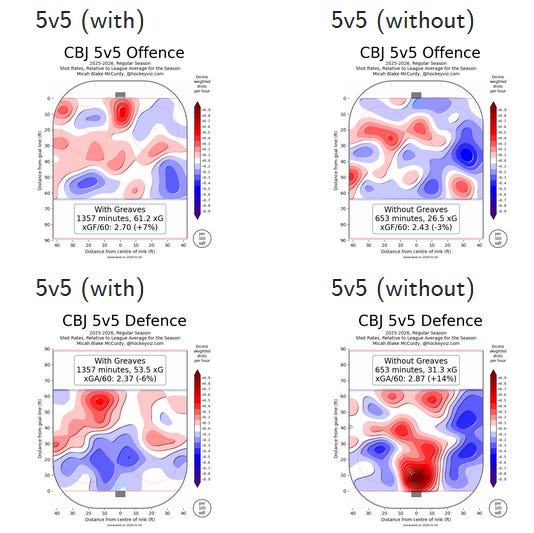
For whatever reason, the Blue Jackets play much better defensively in front of Jet Greaves than they do in front of Elvis Merzļikins. They play better offensively, as well, but never quite found the finishing until recently. I think this is a strange pattern, possibly due to noise, but certainly worth investigating. This would have been a great place to do it but stay tuned.
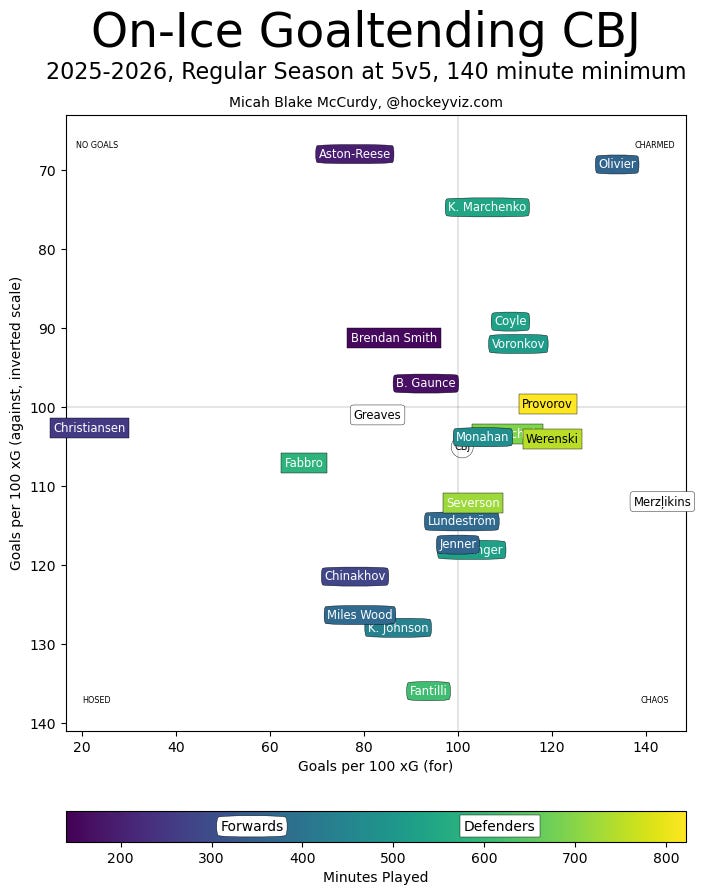
The 5v5 goaltending graph tells the story well. Greaves has been good, not great, and the team hasn’t finished as well for him.
It appears that Dean Evason also believes that on-ice goaltending is a good metric for defensive capability. That might be somewhat true. Perhaps players who have lapses in coverage or make big mistakes contribute to goals against more than whatever their chance-share suggest.
If it doesn’t, though, Evason is a coach stuck punishing and rewarding players based on the randomness of goaltending. That could be a bad cycle.
The Forward Lines are Still a Puzzle
The headline might sound critical of Dean Evason and it’s not not critical but I think it’s worth diving into the “mostly bad options” in front of the Blue Jackets right now.
One of the critical keys to success coming into this season was the Blue Jackets maintaining the level of play they had from their most dominant players: Zach Werenski, Kirill Marchenko and Sean Monahan, while growing the games of Adam Fantilli and Kent Johnson and finding some defensive stabilization down the middle.
While Werenski and Marchenko have passed the test, Coyle has stabilized center-ice and Adam Fantilli has indeed taken a step forward, Kent Johnson and Sean Monahan have certainly not held up their end of the bargain. These factors have conspired to keep the Blue Jackets at the bottom of the Eastern Conference quagmire.
I’ll point to Fantilli here too. The forward lines just aren’t easy to construct given what we’ve seen from the players up to this point. Kirill Marchenko started out the year on complete fire, reinventing himself as a rush dominant creator but, critically, also giving up way too much defensively. He wasn’t as engaged in the defensive zone and his on-ice metrics still haven’t caught up.
Sean Monahan has been a defensive disaster. He’s been a sieve through the neutral zone and often gets caught pivoting and exposing the slot in defensive zone coverage. Gone is the true ice tilt from a bona-fide top-line in Monahan and Marchenko.
What Evason has settled on lately in Marchment-Fantilli-Marchenko has absolutely been working.
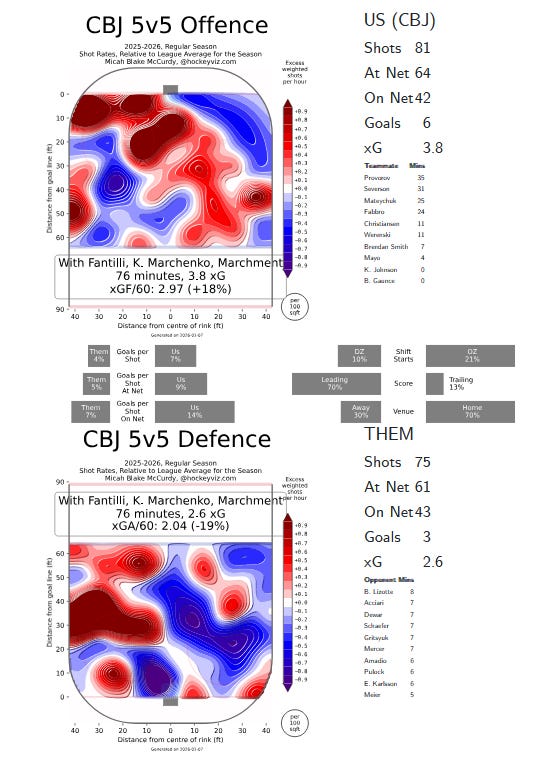
That’s a great differential. The problem? It’s still playing more like a contenders’ second-line, at least in terms of deployment. They play secondary matchups and are put in offensive situations. Not unusual but they weren’t really trusted to close out games either. I mean, how different from Marchment-Duchene-Seguin is it really?
Jenner-Coyle-Olivier has been primarily paired with Zach Werenski as the ultimate matchup takers. They, really, play like the true first line in terms of matchups which means a hypothetical third line is what Evason has left to try to compete for those offensive minutes.
A typical contender has a power-on-power top-line, a matchup-line and a “second-line” typically that also is counted on to score goals. Right now, I suppose even ideally, that’s a Monahan-Johnson line. Unfortunately, they’ve been awful together across a big sample.
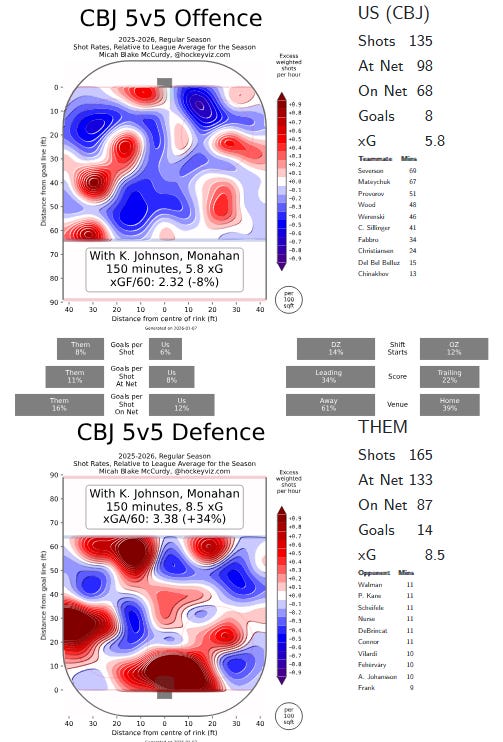
So, we’re back to square one here.
Fantilli isn’t trusted to play and win top matchups. He’s just not that type of player right now and gets loose with his decision-making and makes some mistakes. He’s still, quite dramatically, on the upswing and a player who shows an intense drive to make a difference offensively.
Technically, he and Kent Johnson have been a fantastic duo so far this season.
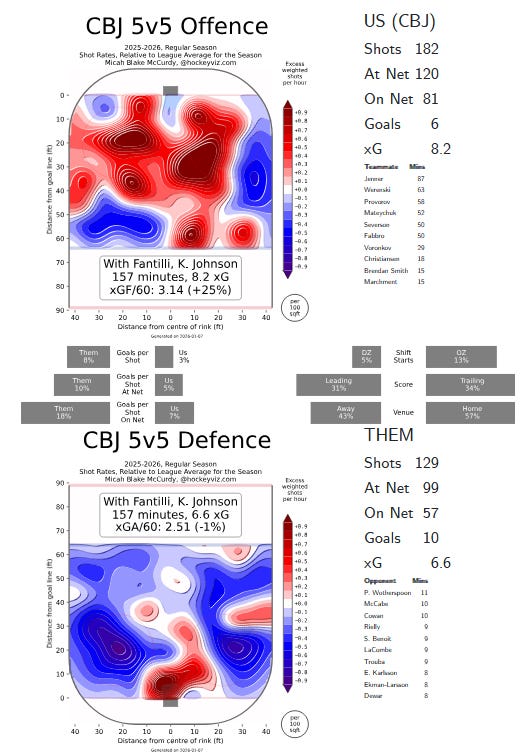
But look at those actual goals, it’s not good. Their third wheels, Voronkov, Jenner and Marchment, are all not particularly defensively conscientious. They make mistakes and Dean Evason doesn’t like that they have ended in goals. Perhaps unlucky considering the expected goals numbers. Jenner’s offensive glow-up has been great, and I liked the line when it was together, but it’s also given chances back.
The problem, then, is the Monahan and maybe even the Werenski-Coyle of it all. I don’t write this to forgive Evason of his deployment transgressions or to say that actually Kent Johnson is just unlucky. I write to say that the suboptimal performance of both Kent Johnson and Sean Monahan is putting Evason in a lot of lose-lose situations that certainly also aren’t helped by some playstyle confusion.
Lately, Marchenko has returned to his defensive zone dominant self. He hasn’t been the rush dynamo, exactly, but Marchment has been filling in some good playmaking that might make it not so important. If Marchenko is back to this style and if Sean Monahan is healthy and ready to defend, and if Evason decides Werenski doesn’t have to play obscene matchup minutes, perhaps the Blue Jackets can start making some good choices. Perhaps reuniting Kent Johnson with Adam Fantilli can provide the young winger the boost that he gave to his centerman just last season.
Which perhaps leads me to the next point.
What is the Deal With Provorov Deployment
I hated the Provorov signing, that much was obvious, but I didn’t expect it to be this bad this fast either. His actual goals numbers are fine but that large dip in team performance, of consistent 5v5 chance share losing, came on the heels of Provorov being attached to Werenski and them playing absolutely all the minutes together.
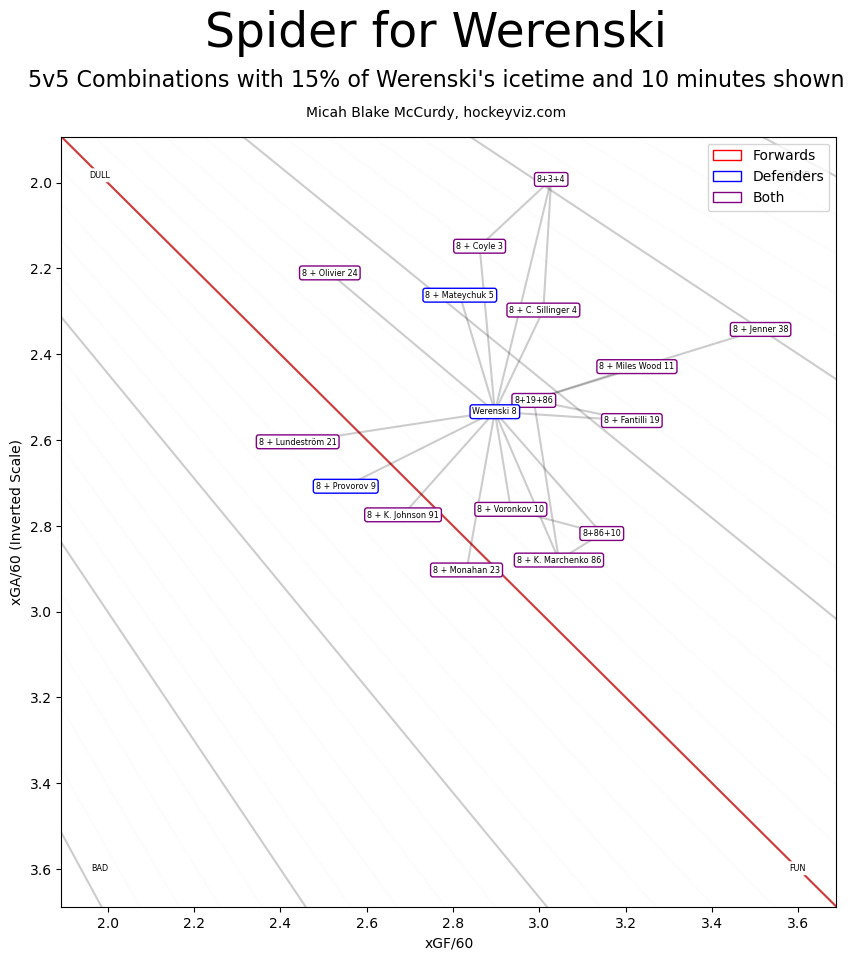
So that pair doesn’t work well, and Evason has moved away from the Werenski-Fabbro pair. The lineup is no longer balanced and the third pair has been unplayable at the same time.
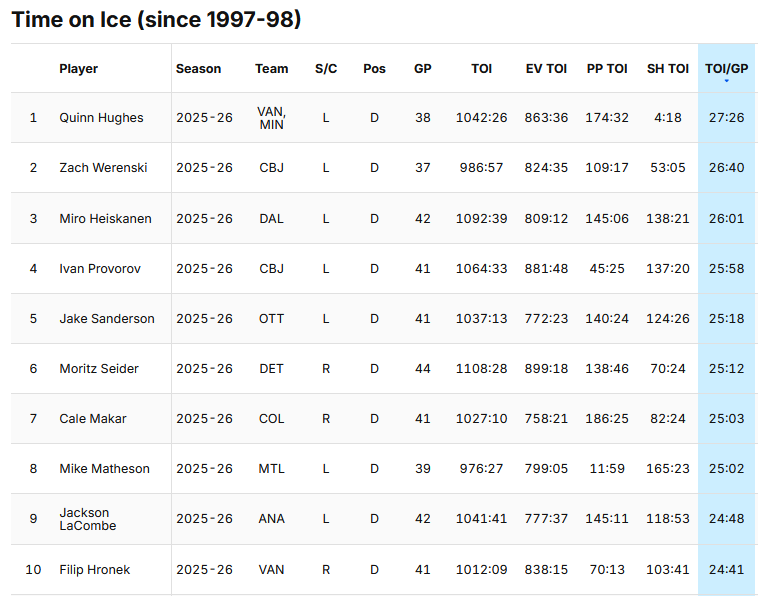
None of this points to it making any sense that Ivan Provorov gets 26 minutes a night. He’s literally top four in ice-time per game. Overpaid for what he brought last season, Dean Evason has decided to lean in and somehow make him more critical to the team. I must say I’m at my wits’ end.
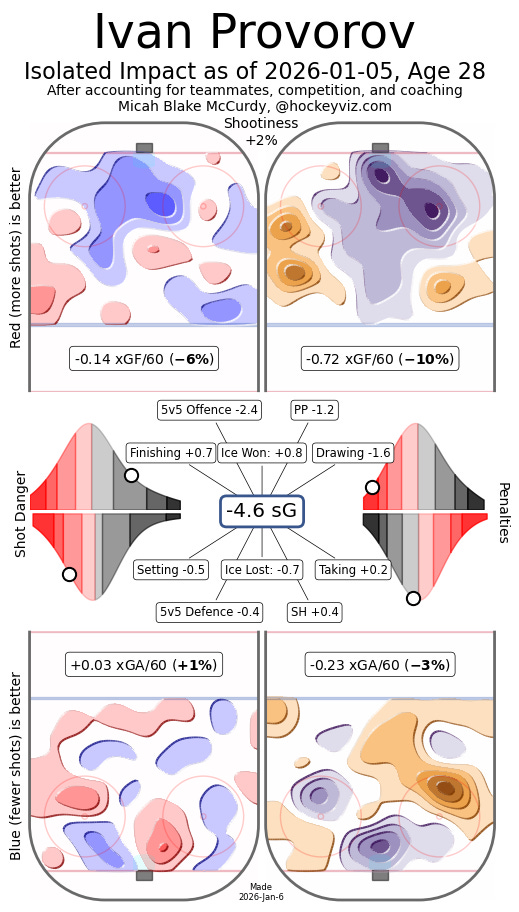
He’s struggling under this load. His penalty killing is okay but he’s a negative in nearly every other category. Perhaps he has been along for the ride of too much of the Marchenko self-discovery journey and his poor defense an unfortunate side-effect of some defensive looseness. Still, it’s hard to find good minutes for the team when Werenski is top-matchups with Coyle and the Blue Jackets have a minute munching third pair quality defenseman on the ice for the rest of the time.
It’s great that Mateychuk is being leaned on but it doesn’t make sense to me that Damon Severson, only reverting to his bad habits in flashes, hasn’t been rewarded for his ice-tilting by any stretch of the imagination. In any case, why this divergent? It’s not like the wins are flowing.
To circle back to the above: Waddell built a roster that desperately needed large breakout seasons from Fantilli and the rest of the youth and for Sean Monahan to repeat as a Selke-lite true Top Line Center. Instead, Coyle took that role but plays mostly with good solid veterans instead of offensive weapons. Johnson, though he hasn’t been helped, clearly didn’t take a step forward and build on his breakout season.
Evason doesn’t have fantastic roster choices to make, he’s working with a difficult roster, but he’s not really making the best of it either.