
Jackson Smith Film Study

Jackson Smith is an exciting NCAA defenseman with outrageous measurables and athleticism. He was drafted at 14th overall last summer and, depending on when you talk to Don Waddell, either top four or top seven on the CBJ internal draft board last season. Depending on which of those metrics (actual draft location vs CBJ’s evaluation of the prospect) you put more weight on, you might have wildly different expectations on what he might provide, and when, to an NHL club.
The Stats
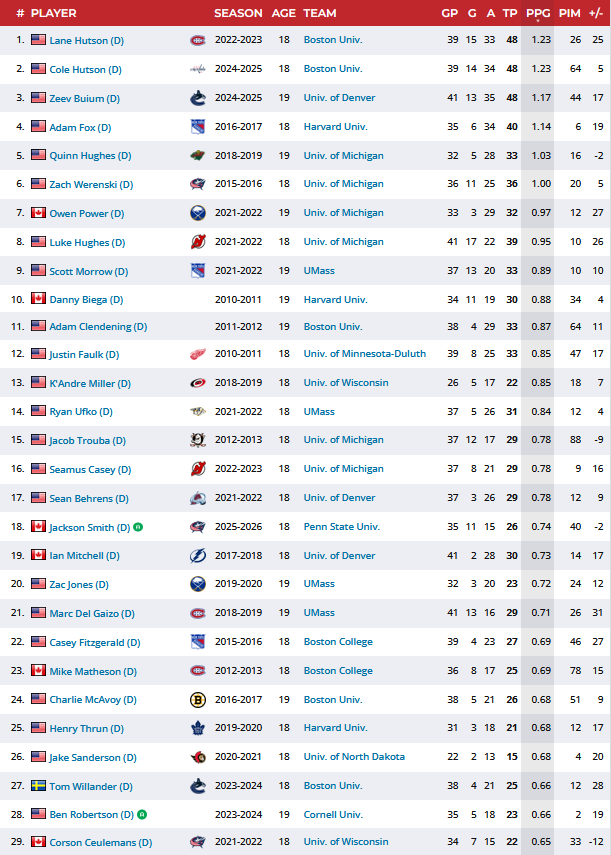
When considering production in D+1 seasons in the NCAA, he finds himself in good company albeit just outside the loftiest realms of players who have become significant defenseman in Norris conversations in the NHL.
Similarly, he finds himself caught between some other more archetypal players: K’Andre Miller, Charlie McAvoy and Jake Sanderson. Each of those have become, more or less, top pair defenseman who are each considered excellent by way of their defense.
Jackson Smith scored a ton of goals, including a leading 7 goals on the powerplay, and did that far in advance of his assists. Though he didn’t score quite as many points the goalscoring line, and even vs powerplay split, is the same as Zach Werenski’s at a similar age.
Before we get too carried away, we absolutely have some extra information to include here thanks to our favorite prospect tracking project.
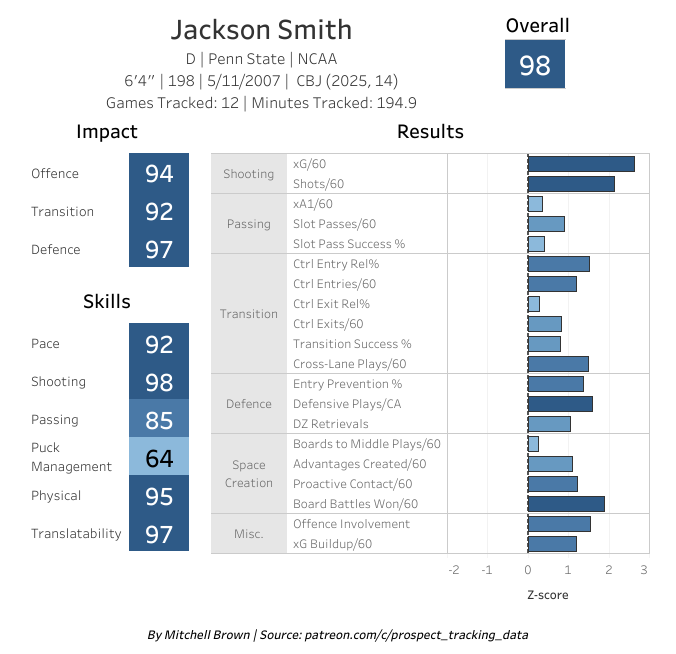
From the high level perspective, very good. Extremely shot oriented when it comes to offense but generally positive in every category that matters. A couple of weakpoints that I’ll be sure to touch on later but mostly a welcome sign for a player who the Blue Jackets sort of need to be good. He’s huge, fast, shoots and scores goals and even has plenty of underlying positives, what’s not to like?
While the underlying data is good I want to make sure that we don’t want to get carried away and to pump the breaks on a “top four prospect” time expectation. That isn’t to say he’s a poor prospect but there are certainly some areas that needed to be addressed before he reaches anything close to the potential of some of these comparables.
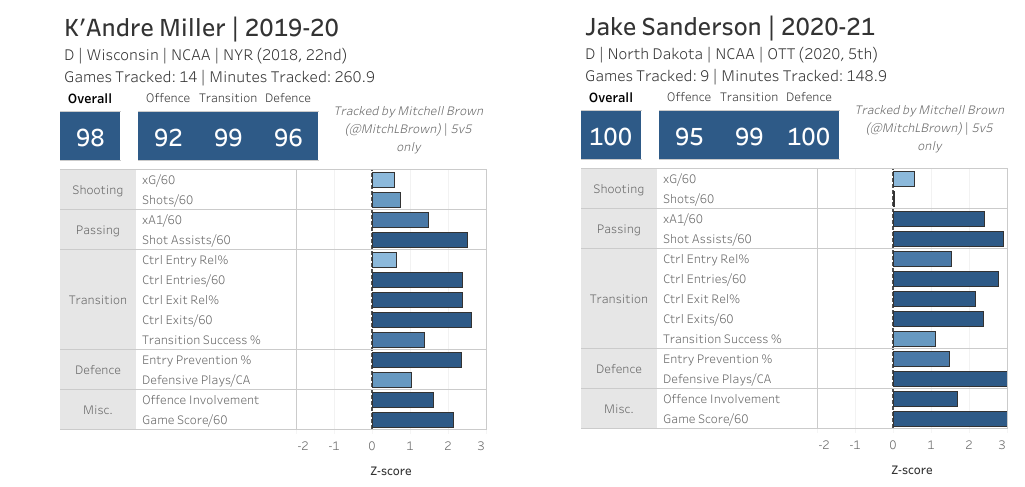
First we can start with the “lower scoring” defensemen who are now some of the premiere rush defenders and fantastic examples of everything about where the position is going. When you think of sizable athletes with brilliant skating, that’s these guys. Important note, this data is K’Andre Miller’s D+2 season whereas it is Sanderson’s D+1. Miller’s Wisconsin, a non-premiere NCAA club without a strong history of development, probably has more in common with Smith’s Penn State than Sanderson’s North Dakota.
In comparison to Jackson Smith, they have a couple of key differences. First, dominance in transition. This is the purpose of ice coverage and skating and a hallmark in modern defense. Smith, relative to these two at least, is good but not quite fantastic.
Second, and I think important for any player who prides themselves on defense, passing orientation. In the offensive zone, defenseman shooting is good. It is, generally, better to be able to pass pucks into dangerous areas simply because of common role asks of the position.
Zach Werenski breaks that mold which is something important for us to consider, especially relative to systems. Smiths’ Penn State system didn’t necessarily get him involved as much as the Blue Jackets’ system does with all of their D. Bowness might be changing that again but I think NHL teams require more of defenseman and there’s plenty of room to think
I’ll talk a bit more about projection and comparables later because there are a few outside of top ten but still first round defensemen that might make for interesting comparison.
The Tape
In order to get the best look at Smith’s game-tape I had to take a sample across the season. I didn’t have any early big games to draw from as an initial impression like I did Lindstrom, so I had to consume it all together. That’s been the story of the past couple of days for me.
Games clipped:
Long Island University - 10/17
Michigan State - 11/8 (same as Lindstrom)
Michigan - 2/13
Wisconsin - 3/06
Minnesota - 3/11
Michigan - 3/14
Minnesota-Duluth - 3/27
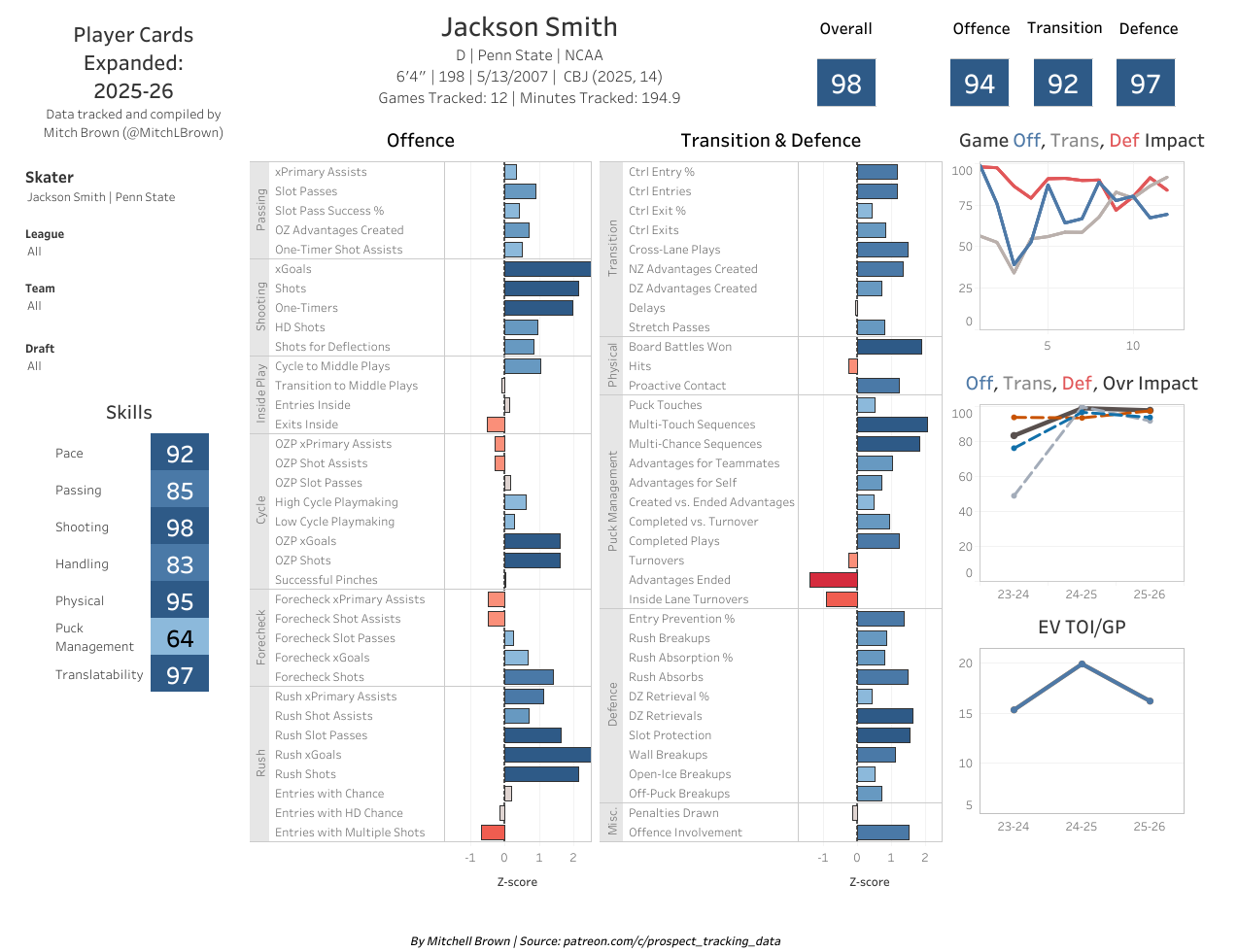
As you can see above in the more advanced tracking card, Jackson Smith grew more involved, especially in transition, as the season wore on. Given it was such an obvious area of progression, I think it’s a good place to start.
Transition Involvement
Retrievals
We should start with one of the better aspects of Smiths’ game. He is, genuinely, quite good at picking up pucks on the wall and making simple plays to get possession recovered. Wall pickups under pressure are very difficult and, given they’re one of the first actions taken in a retrieval, a very important stepping stone for everything that comes after.
The perhaps first stepping stone is the initial pivot and skating to get first touch, Smith is good here too. He’s powerful and large, though I’ll get into some doubts later, and that means this first little nucleus means there’s big room for him to grow into an effective NHLer because of how stable the base is.
There are some heavy Penn State system interactions here that mean we don’t really know how good Smith is at some of the higher level retrieval actions. Zach Werenski and Denton Mateychuk are perhaps unfair examples because they can do some of everything and modulate what they’re doing at a very high level, but Smith doesn’t really have the opportunity to do some of the more difficult stuff.
As such, we don’t necessariy see him beating the first wave of the forecheck through connection with teammates. He doesn’t drag player to create space and then play his teammates into that space, no particularly creative ideas on the wall and basically no plays to the middle lane. I think that’s well represented in the tracking data by way of limited “boards to middle” plays
Perhaps that means I’m overrating some of his retrieval ability but mostly I think his true quality is obscured.
The other object of concern is his decisionmaking. This concern overarches most of his game but specifically may erode a game that doesn’t have the more difficult retrieval → breakout connection. Some times, he simply rimmed the puck away from his teammates and straight to the other team. Pre-touch reads and information processing are of critical importance for this skill once they get to the NHL. Penn State’s simplified system might be obscuring some of his ability/deficiency in that specific regard.
The best Jackson Smith retrievals all come from early skating, clean wall-peels and follow up skating excellence as well. NHL forechecks might not let these situations happen as frequently but it’s at least a good base.
Off-Puck Activation
Smith’s speed threat and good route selection often helped his team improve their general threat in rush sequences. It’s not exactly a tendency that is often rewarded with points, and we’ll see Zach Werenski and Damon Severson do much of the same, but something that helps other players create post-entry. The best sequences involved him building a significant head of steam and really pushing the back layer backwards to create space underneath.
This movement, along with some of the middle-lane drive forechecking, is really the ultimate way to leverage big skating potential and have an impact across the ice sheet. Impact via ice coverage used to be limited to the center position and is now a hallmark of the best modern defensemen. Jackson Smith, at least from a pure movement perspective, is poised to bring that impact.
Post-Entry Chances
His most positive contributions to rush offense came when he received pucks later in sequences, either near-to or just after entries. Early in the season he found a ton of middle-ice trailing shooting opportunities. He didn’t necessarily create many actual goals while doing it, especially at even-strength, but they were certainly his most dangerous chances.
At the NHL level, his space finding will likely be utilized more effectively. Some of his creative play ideas post-entry will be a significant strength. The clips against Minnesota, specifically, demonstrate an activation nucleus that should be actively nurtured.
His better sequence came in the first game, where he surfed across the zone and found a solid playmaking lane, where the same situation happened later in the year and instead he pivoted into a very wide shot.
That’s the drawback here even still, when he gets involved in the play he sometimes has trouble finding on-stick playmaking ideas that end in the middle of the ice. In the NHL, you cannot control the puck across the blue-line and expect to shoot more often than not.
NZ Build Up
He isn’t exactly limited to pure activation and off-puck impact. As a neutral zone regroup quarterback he showed plenty of passing acumen. While his vision and play selection weren’t brilliant he showed capacity to access passes that demonstrate he’s not inept either. I would say there’s still plenty of room to improve as a threat in this category but it might be a while before it’s actualized as a pure passer for reasons I’ll get into later.
Turnovers
The problem with Jackson Smith as a forward-activating agent was that he frequently degraded play with overwrought skating maneuvers and ran into dead-ends in his ability. Far too frequently, especially when he chose to carry the puck himself, his ideas sequences ended in turnovers. There are genuinely few instances in the games that I reviewed where Smith was successful in creating entries off of his stick, though they did occur more frequently later in the season. Even the best movements, where he passed wide in good tempo and attacked for a recovery, often failed and the worst, where he carried the puck coast-to-coast, very often ended in a failed handling move and direct chances against.
He has some very specific limitations in his skating effectiveness but moreso in his capacity to project motion and puckhandling. There are certainly some hockey sense concerns in that it’s not clear what his ideas or purpose are as he tries some of his entry ideas. Extended carries lead to more organized defenses, at least without blistering speed or very creative routes, and his puckhandling limitations mean he has trouble then solving that increased structure post-entry.
I think perhaps the best way to illustrate this is a sequence of powerplay entry attempts against Michigan.
First, Jackson Smiths’ attempt. He gets past the forward and into a strong lane in the neutral zone. As he’s moving around the foward he carries the puck on his-backhand and enters a glide where he erodes some of his speed. Still, he pulls a bunch of the Michigan PK into the middle lane and finds a wide pass. Unfortunately, the skating threat and timing of his pass do little to stress the entry defense and his teammate doesn’t make much of it.
Contrast that entry with McKenna’s just after. He, perhaps frustrated and desiring some offense, hustles back early and takes control of the puck himself. Through very similar motion McKenna gets decidedly different results. Instead of stopping into a glide to get around the first checker, McKenna steers a bit extra wide so that he can keep his feet moving and attack across horizontally. While he might not have the raw output of Jackson Smith he makes much more intelligent use of it.
He keeps handling the puck while threatening the angling entry defender, attacks the middle more directly which means the final Michigan entry defender’s feet are pointed toward him. When he makes the pass to the wide anchor, he drives in between which buys him a little more time and creates a clear passing lane.
Two passes later and Jackson Smith shows off his shot for a goal.
While this isn’t a perfect illustration of all of the issues it’s clear that, despite superior athleticism, Smith’s outcomes aren’t close to as effective as McKenna’s. The forward is the presumptive first overall pick, so we shouldn’t necessarily expect them to be the same caliber of effectiveness, but I think the point holds. In the end, there are some quite invisible differences (at least in the vacuum of solely watching one player) in routes/approaches, in option selection, that can make a very big difference in outcomes.
The positive, even despite some of these specific carry-entry turnovers, is that he could eliminate them entirely in the NHL and still be a good offensive defenseman. He has already shown some of the more advanced and projectable ideas, kicking the puck wide and driving for space or forechecking, that suggest over-carried pucks can simply be eliminated from his game without much issue.
Defense
Jackson Smith’s defensive game is conceptually extremely appealing. He’s huge, can skate, unafraid of “getting involved” and, via data, gets plenty of stops. There remain some of the same question marks in all of the connective moments between these details much like his offensive game.
I have gone back and forth how best to present this information, and in what order, because there are specific roadblocks to some of his performance that come from consistent habitual errors. Given they are expressed somewhat differently in each domain, I decided to simply break it out into offense and defense rather than the “bottlenecks” or “building blocks” first.
I’ll mention and define them here so that you can use them through these clips.
First, his base posture. This is more of a habit than I think necessarily a deficiency that is guaranteed to last but he has a tendency to default to very upright positions and to keep his feet close together. This isn’t a problem, plenty of high minute defensemen find moments in between to rest, but it might help explain some of his movement idiosynchrasies.
Second, movement forecasting. This is a more complex concept but it involves both his understanding of how other players can/will move and how he can move his own body/feet to interact properly with theirs. Another small piece is the sort of “movement” or “route” planning that is a massive key in a volatile sport like this one. Essentially, whether he picks the right speed, or the appropriate number of strides, to properly eliminate options for the puck carrier and other threats.
I think this second one is important but I have genuinely no idea how it changes through a players’ development journey. Conceptually, even small skills are teachable but whether or not they will be taught is something that’s highly dependent on coaching and offseason development.
Rush Defense Concerns
The concept of Jackson Smith, especially if we allow comparisons to K’Andre Miller or Jake Sanderson, is that of an ice-coverage rush stopper. As of this moment, I don’t think he controls all of the details in between and time will tell how he sorts that out as he scales up levels.
I have pulled out some of the “poor” clips to help illustrate some of my concerns. There are a couple of recurring tendencies that I used to come to the above conclusions.
First, his play inside contact. Rarely do his hits seem outwardly effective and rarely does he truly dictate contact on his terms. He’s huge and strong, yes, but there’s not much of a purpose and the point of contact is usually shunted off to the side.
The second, is his tendency to “lose races” or really to have his movement ideas end with opposing players just behind his hips. This means he’s usually found in a vulnerable position and has to pivot late. Sometimes, these sorts of moves are healthy for a balanced “on the edge” style of defense and mean he’s selecting the right option. Pivoting too early has it’s own exposable issues as well.
Third, he has a general or resting posture that ends fairly straight up and with his heels together. I wouldn’t say this is explicitly a problem, finding a resting position is important for high minute defensemen, but it did seem to have some deleterious feedback effects on the rest of his game. He didn’t seem exactly “primed to move” as well as you’d like and it wasn’t the “balanced” and “loaded” athletic posture that the games best rush stoppers take in moments between events.
Fourth, his general ideas on creating turnovers in the neutral zone come from “stabbing” like takeaway attempts that are very much lead with his stick rather than a result of controlled gapping, eliminating options and then decisively separating the puck from the carrier. There wasn’t necessarily a lot of “insulation” for takeaway attempts. I think these tendencies, especially some of his less explosive backwards skating adjustments, might all sort of come from the same postural place.
These all sort of come together to ask the same questions. There aren’t that many stellar defensive plays to really write home about and while he does have some quite earnestly impressive gap closes, he doesn’t really seem to have the acumen to play within consistently tight gaps. He isn’t smothering or sticky despite his capacity to get some stops. His defensive stopping isn’t necessarily integrated in the way top players are. The fine skating adjustments needed to angle, or perhaps even just initial projection, to get contact into the most effective part of the body are (is) not trivial.
To this point, he looks like a player that might be leaning a bit too much on previous athleticism and there’s going to be either a big learning curve come NHL time or he’s going to need some time to grow the actual more “skilled” parts of his game.
In Zone Defense Concerns
Let’s just say that some of the same concerns plague him in the defensive zone. The “stabbing” takeaway attempts are there, and were occasionally exploited, and worse was his resting posture resulting in some disconnection from his check and sometimes a resulting “rubber band” effect of undershot distance to his check, followed by overshot and more general chaos.
The more concerning situations came when he started chasing the game. His soft gaps and upright posture would sometimes result in circuitous recovery routes, rather than hard stops and more effortful recoveries, which often turned into open slot opportunities. He especially had a tendency to overstay his welcome along the walls and get beat on return routes.
Most of his worst shifts, and the greater breakdown of his in-zone play, came off of extended time. That’s more or less normal but the delta between early-shift Jackson Smith and late-shift Jackson Smith was sometimes very large.
The most important habit to correct is his tendency to disengage after the first play is made. He is caught in that high posture and watching the puck rather than continuing to play through. Some of these instances lead to goals against and don’t show the activity and engagement level of a player you’ll be counting on to insulate your team defensively.
Michigan Lowlights
I think the story of Smith as a defensemen is best told by this unfortunate selection of lowlights against the University of Michigan across the two games I watched. While there are some poor plays against UMD as well, the second UM game eliminated Penn State from the Big 10 tournament.
In these sequences I think Smith neatly demonstrates the flaws apparent in his game. Most of them exposed best by Canadien’s prospect Michael Hage. He is a much smarter player than many in the NCAA but possesses the details and skilled game that most NHL teams will have at least once on their roster. He’s not as big as Smith, not as good of a skater, yet doesn’t have much of a problem creating some very big chances through Smith either.
General Positives
We should absolutely step back and appreciate the general competence of a young freshman in the NCAA and perhaps acknowledge that many of the improvements we’d like to see might come from more time and adaptation to the level. Being a top-flight killer requires confidence on top of competence, playing very tight gaps is not for the faint-of-heart. Perhaps his late season offensive burgeoning was just the first stepping stone towards more and better placed aggression.
In terms of general defensive competence there are still plenty of sequences to take away that suggest Smith belonged at that level. He wasn’t a PKer but he did show some proactive slot protection and awareness with his stick and used his body to eliminate options at the same time. More times than you’d expect, he got a clean stick on slot passes and helped turn them quickly into exits.
I think that will ultimately be the defensive identity of Smith at the next level. He might not be a stabilizer but he’s big, fast and physical enough to work best as someone who minimizes zone time. As his strength and conditioning improve (I still have questions about the efficiency of his skating relative to easily soaking very heavy NHL minutes), we might see less degradation through shifts and elimination of those bottom end sequences.
While I have some criticism about the top-end of his defensive ability, and especially the tendency to stab towards takeaway attempts, he wasn’t necessarily routinely exposed behind in the way that sometimes a player like David Jiricek was.
NHL coaching staffs can’t always teach certain things reliably but adherence to defensive structure is one of them. If we assume all players will, eventually, trend towards that structure then Smith’s tangible separators might make all the difference at the NHL level.
In-Zone Offense
Talking about Jackson Smiths’ contributions to offense is tricky. We should note that we’ve already covered a good chunk of it in the transition involvement phase and this is one of the bigger differentiators among D-men in the NHL already. The rest of the offense, though transition too, is heavily constrained by the system in which he plays and on that front Penn State didn’t exactly generate ideas for their defense either.
For the most part, we can lean on the actual production and tracking data to do the bulk of the big-picture evaluation work. He’s a goalscorer which is great because he’s almost entirely shot oriented at the same time. While the temptation to compare him with Zach Werenski is therefore impossible to completely defy, I want to pump the breaks on that comparison too. That isn’t to say he’s not a shooter or doesn’t have a good shot but that there’s a limiter in his game at the moment that makes it difficult that I’ll get into after this section.
Chances and Scoring
The scoring highs for Smith can certainly feel quite high. There are a few creative and backdoor passes but most of the damage is done through shots off of his stick. His shot comes off hard and he has the ability to beat goaltenders clean in the right situation. I’d say his off-puck rush shooting is significantly more threatening.
Located in the clips above are a few sets of “tips” where he finds himself an unusual amount when exiting some of his activations. This is a cool tendency, and demonstrative of his good hand-eye coordination, but given the high xG nature of these plays, I wonder if they exaggerated some of his expected goals rates.
Otherwise, there was one big pattern that lays over the top of plenty of these chances and shot attempts we’ll see plenty moving forward: rotating over to the weakside and a very strong preference to mohawk skate into a loaded shot. Frankly, he really only has one move and this applies across the ice. He really wants to put the puck on his left toecap and either toe drag, handle or load and shoot from that position.
When comparing him to many of the top NHL d-men scorers, Werenski especially, they don’t really lean on a long-release that way. In order to translate his scoring to the NHL level, and especially to get some of his shots on net, he’ll need to find a quicker release out of more dynamic postures.
Distant Shooting
Those tendencies are especially noticeable as he shoots from further away from the net. I won’t say this isn’t a viable method of scoring, I think we should accept that he has a very strong wrist shot and might be capable of beating the goaltenders from this position, but it might explain a lot more about why his shot took so long to become a threat in his draft year.
Blue Line Skating
While Smith is a brilliant and creative skater, there’s not much he does to overly weaponize that skating while in the offensive zone. There are certainly some Penn State constraints at play. He mostly just finds himself stationed at the left point and often the forwards often play amongst themselves. As he moves up ranks, offenses will be more structured and his opportunities perhaps a bit more clear.
All that said,, there’s certainly not an abundance of lane creating and playmaking through point-walking either. To that point, both Lane Hutson and Quinn Hughes are pre-eminent blue line walkers. While Smith has a reputation as an A-grade skater, he does not create as much from this position as either of them do.
Pinching
Jackson Smith is an alert defenseman in the offensive zone. Though he is often found standing straight up at the point, he moves well when the situation calls for it. Penn State’s system certainly asked him to collapse the zone when in the opposite corner, though not necessarily the freedom to interchange with forwards. This means evaluating “pinching” is difficult. We can see above that he does it, and there are some good results from it, but I don’t believe trying to kill exits in a vacuum is something we can properly evaluate in this system. Without specific system design intentions, we are left to defensemen making difficult reads in high leverage situations.
His Wisconsin goal above is perhaps the best illustration of how his default position on the “short porch” can lead directly to offense and there’s plenty of his neutral zone defending that starts from there as well.
The Stickhandling Limitation
The biggest single limitation holding Jackson Smith back from being a more impactful defenseman is his stickhandling. He has a limited range of comfort/execution in his stickhandling and habitually, prefers the puck in the pocket just in-front of his left foot. It’s a fairly rigid preference and appears as an almost default habit.
While he’s comfortable at executing a variety of moves from this default position, and especially while he’s heel-to-heel skating, the outcomes of the handling moves aren’t very consequential and he really leans on a simple wide-through-feet toe drag to get around pressure.
In doing so, he constraints his ability to react dynamically to the threats in the environment in front of him and, as a result, makes him a fragile problem solver in key situations across the ice. When all you have is a hammer, everything looks like a nail.
I think this offensive sequence illustrates the problem well. Instead of preparing his body to pick-up the puck, he instead reaches for it and orbits around it. The end result is perimeter play under pressure. Skill expression without condition improvement.
Here, he deploys it alongside his skating to get around the net but without any forward skating momentum, which means there’s no layer being challenged or lanes created, he has to chip the puck out on his backhand while looking rather uncomfortable doing it.
While these clips aren’t the complete account of this move/habit having a deleterious effect on the conditions of play, I would encourage re-watching some of the above breakdowns (especially the rush turnovers) under a new lens, it has a big impact across the ice.
Make notice that, once the puck is on his backhand, he has limited degrees of freedom in his handling and he often loses possession. There aren’t minor adjustments to change attack angles and get slip passes through triangles.
The habitual preference to this handling position exposes the puck to easy stick checks, especially in tighter spaces on the off-wing. A few sequences during retrievals or even forechecking have possession thwarted before he can really even make a play.
Similarly, I wonder how much this is related to his feet and that high heel posture. The skating is very creative, and not often used by players with his size, but the ultimate effectiveness of the moves leaves something to be desired.
This mini clip illustrates the relationship between both well. Here, his heel-to-heel skating allows him to keep the puck in the same position as he orbits around it. The angle is being changed but his space is being diminished. In this sense, he doesn’t demonstrate a good separation of upper and lower body though he accomplishes a rudimentary version of a more threatening play.
I wonder if this skating quirk betrays an inability to work his skating with each foot independently. Some of these moves feel like a person hopping into a two-footed jump for height rather than someone using their momentum and jumping off of one leg. Like an athlete who only squats the bar rather than incorporating the single-leg lifting that helps build balance.
Perhaps early growth and relatively weak muscles forced him into this habit and simply extra strength through his legs will help more stable skating, across both offense and defense, to emerge.
If Jackson Smith wants to continue to be a threatening offensive player, or even puck retriever, he’ll need to find ways to get comfortable with the puck away from his body and across it without distorting his movement capability.
Projection
Though I don’t expect prospects to be moved on early, and find more joy and stimulation in examining the avenues of improvement, I think we still need to check in and ask the fundamental question of: “What do we expect out of this player?”
Given the nature of prospect analysis and projecting their impact to the NHL, it’s fraught with risk and prone to failure. This is a critical period of learning for all young athletes and so much can change so fast.
Generally, the projection to the NHL should be positive, I think. He’s a big skater who has the capacity to make an impact. Given the flashes of what we’ve seen, there’s no reason he couldn’t thrive in an NHL system that asks more of defensemen and it might even be reasonable to expect “more” offense should he join a team with structure that supports that style.
I think the general issue I have with Smith’s performance at this level is that it felt like many of his mistakes came from meeting his limitations, especially via stickhandling, rather than active exploration and experimentation on his part.
On that front, he looks like a difficult defenseman to break into an NHL roster that’s trying to be competitive but, given athleticism and strength, one that coaches are eager to like. Without adaptations, he feels hard to trust in key situations. Bubble teams don’t often dole out bottom pair minutes if that player makes big mistakes and Smith might need to make some mistakes to grow at the NHL level.
Still, the biggest sign of positivity is that he didn’t look out of place on the ice sheet, certainly wasn’t out of place in terms of scoring, and most of the sane-feeling comparables are all very good players in the NHL. Perhaps there’s a danger to that, and we are blind to similar players who didn’t really work out, but errors in future projection are part of the ballgame.
Middle First Round Comparisons
Comparing him to some of the middle first round draft pick defensemen who became top-pair players isn’t trivial. It doesn’t appear he has the raw linear output or balanced rush stopping of K’Andre Miller (and especially not some of the true top flight defensemen like Jake Sanderson).
His scoring is comparable or even favorable to Charlie McAvoy who also had some hockey sense concerns. Unfortunately, I don’t have data to assess how they looked “under the hood” but that’s a lofty comp to live up to and the Blue Jackets are not the defensive insulating environment that the peak Boston Bruins were either.
At the current moment, McAvoy has some playmaking reads and stickhandling smoothness inside of play sequences that looks a step better than Smith is capable of. To be expected of a now veteran defender but that’s about all we have.
In his draft year, Smith got plenty of comparisons to Thomas Harley who, conceptually, could offer a great stylistic comp as a big and powerful athlete who scored well but not as well as his current NHL production suggests. Harley took a long time to make the NHL, spent a lot of time in the fantastic Stars development system, and the payoff has been astounding. On that front, Smith could follow a similar development trajectory.
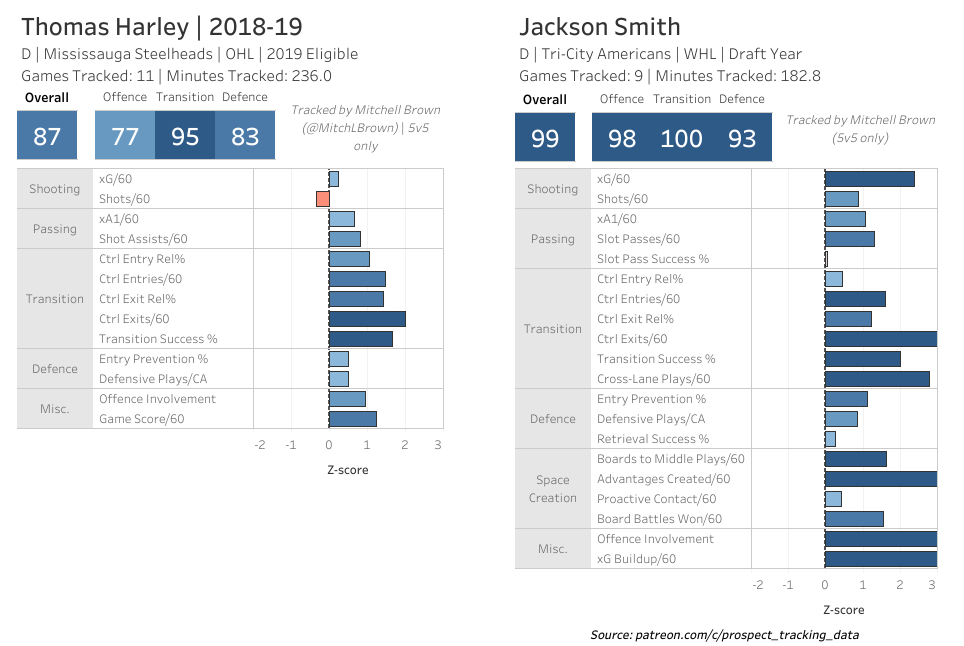
Compared to their draft years, Smith should be a much better projection than Harley. I can’t say I was overly tuned into Harley in his draft year or anywhere in his journey prior to joining the Stars but thankfully we have scouting reports to look back upon. Since David St. Louis uses film and doesn’t simply print platitudes, we can look back at that his scouting report.
Harley, at least relative to Smith, was an active creator through playmaking. The data doesn’t necessarily show it but through David’s scouting report we can see that his passing and play creation through playmaking was a draft year strength. The video comes against CHL players rather than NCAA, so not necessarily an easy translation between there and here. More importantly, Harley demonstrates capacity to link moves together with purpose and find solutions relative to the environment. I think that’s the difference, at least in my observations, between the two players. His passing/offensive risk-taking was exploration and limit testing whereas Smith preferred skating and mostly failed in the same situations because his handling limits him as a problem solver.
While the comparison makes sense, I wouldn’t say anyone should expect Smith to reach that level. That would be like saying we expected Zach Werenski to become the best defenseman in the NHL after his career in Michigan finished. In hindsight, perhaps his instant adaptation across every transition (USNTDP → NCAA → AHL Playoffs → NHL) should have been a clue but there was still time between his magnificent debut and what he is now where it did not look inevitable.
Smith’s most interesting stylistic comp is Jakob Chychrun. While he was projected to be a very high pick he fell through his draft year due to a combination of factors including otherwide mediocre scoring. This year in the NHL he scored 24 goals with 34 assists which is a scoring ratio similar to what we saw from Smith in the NCAA.
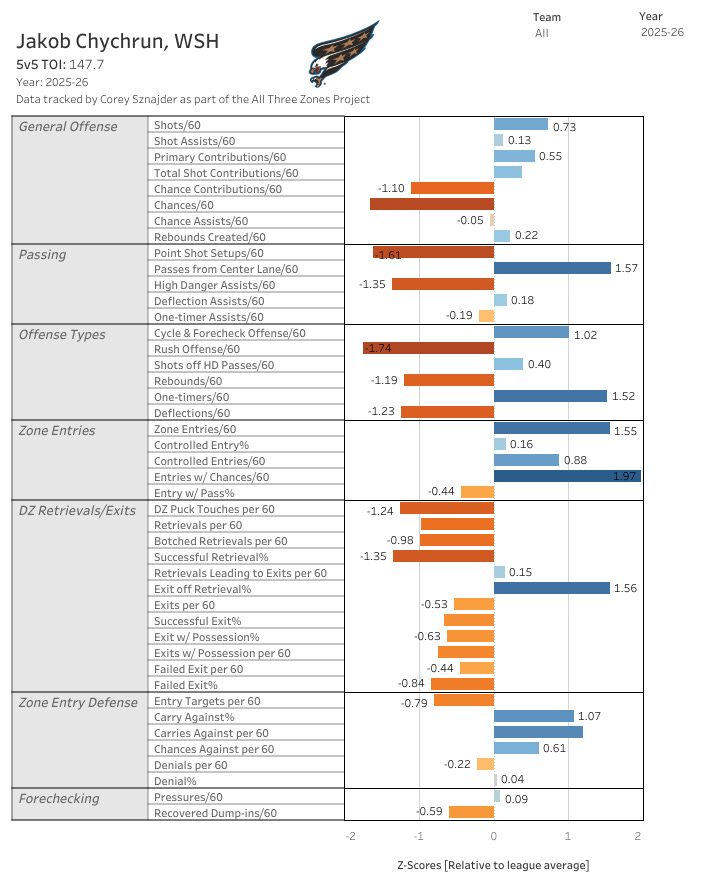
Though we don’t have a fantastic lens on his prospect performance at that time, it’s conceptually easy enough to buy Chychrun as a top end!! comparison. He’s been mercurial at the NHL level with seasons of excellent rush stopping, a ton of jumping into scoring positions and shooting, good skating, excellent strength and an up-and-down career across different situations. Generally, he’s comfortably graded out as a top pair caliber defenseman but never as a uniform #1D who leads the team from the front.
I don’t know that there are adequate low-end comparables, partially because usually only the top players express very coherent identities, but the Blue Jackets could be looking at a Jack Johnson or even a sort of offensive Kaiden Guhle. Generally, I would expect better outcomes but he’ll require adjustments.
In any case, he doesn’t necessarily look like a player who is going to rescue Zach Werenski from defensive burden any-time soon.
Impact of Being The Guy On Penn State
All of the above comparisons require underlying improvements for Smith to reach this level of impact. The biggest factor in him reaching his ceiling might come from interactions relative to role at Penn State. Gavin McKenna won’t be there anymore, and plenty of other players left too, so he’ll be severed from his primary source of scoring.
With those departures comes an increase in importance if not role (he already played massive minutes). If he doesn’t get the requisite offseason work done, or doesn’t learn and adapt well, he might drown in this extra responsibility. If either he or the coaching doesn’t take his capacity to influence games seriously and it turns into a low-stakes playground, this could go quite poorly.
If we can connect some dots, this might be reason to see an increase in transition involvement commensurate with some of the other top level defenseman. Penn State’s system didn’t necessarily require D involvement in transition and instead Smith relied upon his own reads to find these situations himself. That he increased his involvement as the season wore on is a point for significant optimism on that front, the game against Minnesota was very tantalizing, but remains a double-edged sword.
In order to be the guy and take risks going forward, you have to make sure you control the factors prior to these situations and anticipate your opportunities well (Werenski and Harley are NHL leaders in this regard). While a certain degree of inefficiency will thereby be excused as the result of a “dictating outcomes” burden, finding the cutting edge line between acceptable-mistakes and unacceptable-excuses isn’t easy. On that front, Werenski is perhaps the best example of being forged through the crucible of immense burden and coming out as controlling transition from its earliest moments so that he can dominate later as well.
If Smith reacts similarly well, we could see a player that comes out more versatile who consistently finds ways to impact the game, drive play and set his teammates up for success. As that player, he’ll have an outrageous number of puck touches from which to learn these responsibilities. In a sense, with this burden comes the opportunity for quick maturation.
If the environment is poor and the burden becomes lack-of-accountability rather than deep exploration for improvement, like it was for Corson Ceulemans as a team-leading-scorer-as-defenseman-on-mostly-talentless-team in Wisconsin, the Blue Jackets might need to dial up a program and prepare for some more AHL time.