
CBJ Weekend Review

The Blue Jackets played two games that felt almost entirely different. A dominant win against an inferior Seattle team that added a sort of legitimacy to their “contender” status and a low-event struggle against a do-or-die New York Islander team.
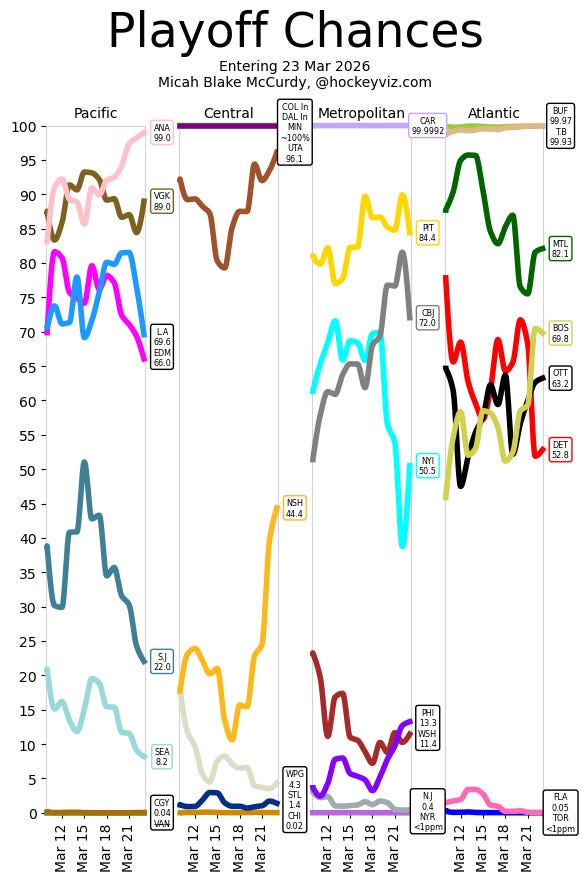
At the end of the weekend, the Blue Jackets are very much still in the driver’s seat with a good probability to get a playoff spot. That large convergence, though, tells the story of what could have been. A win would have vaulted CBJ into a 90% make probability and plummeted NYI to a 30% make probability.
As much as we would have preferred a different result, I think it’s fantastic that the Blue Jacket get some experience playing in a game that was as intense as that one and yet have not lost their season. Perhaps exposure to that environment will help them in the coming weeks, especially if they can learn their lessons.
Normally, I do a deep dive on a single game and try to peel apart the layers and examine player and tactical interactions. There’s still plenty of room to do this again but I think looking at the patterns between both might be instructive too.
Seattle
The Blue Jackets were clearly the better team against Seattle. They’re a somewhat soft-team and I don’t mean that in terms of “hitting” or “physicality” but in terms of sturdiness of checking and intensity. Sometimes these are conflated but I think the game against New York illustrated the opposite.
The Blue Jackets tend to be very good against these softer teams. In particular, their depth of talent really took the forefront. The “matchup line” alongside the “literally everything top-pair” of Werenski-Severson really stole the show. Seattle couldn’t really solve the problems posed by the top players.
Islanders
The Islanders game was entirely different. The “switch” was pretty much flipped. That wasn’t to say that the Blue Jackets didn’t get chances but instead of imposing their pressure, they were instead imposed upon.
Frankly, this game felt a lot more like what I expected the Carolina game to feel like. Worth mentioning, though, that the New York Islanders did this to them previously. They have a “hard” team with true star forward talent and a young player in Matthew Schaefer who is simply different. Perhaps the best young defenseman we’ve ever seen.
Themes
Top Pair Dominance
Rick Bowness has loaded up the top pair in Zach Werenski and Damon Severson. He has also assigned them the toughest matchups. When these two are on the ice, the Blue Jackets are up big. They are two independent play-drivers with a ton of offensive spark. Severson has had an underrated season and has squashed so many of his worst bad habits. Now it’s just benefits.
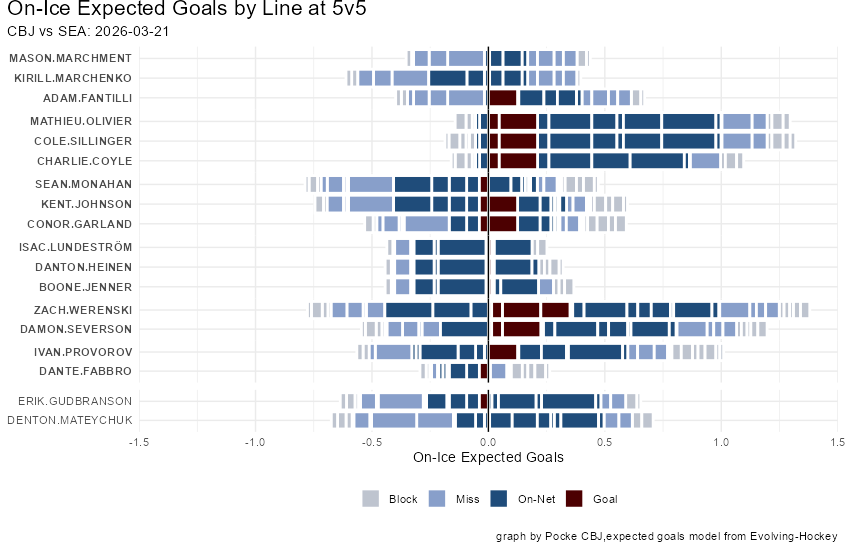
During the Seattle game, they clearly drove outcomes. A large chance-share win and positive contributions on four on-ice goals.
In particular, this game was an excellent showcase of just how brilliant a playmaker Zach Werenski is. He beats layers consistently and puts his teammates in fabulous positions to play hockey.
Both players are such brilliant skaters that attacking offenses have to be nearly perfect to get clean chances through.
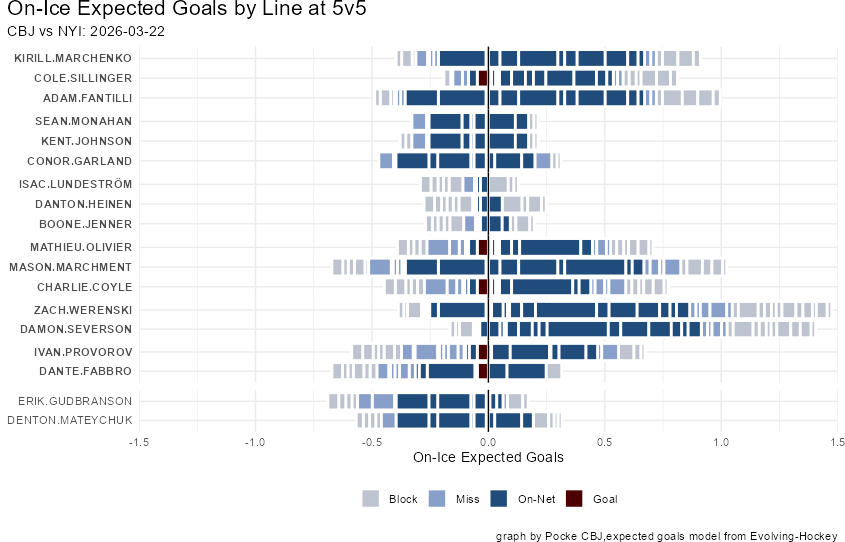
The game against the Islanders was more of the same, except no goals. They dominated possession and on-ice chance share. Bailed out, perhaps, by a strange goaltender interference call but also unlucky to not have found the back of the net as well.
This game had a different bend. Werenski was indeed involved but the differentiator for them here was less offensive plays but moreso the impeccable play killing of Damon Severson, his last-back interventions were absolutely critical, and the duos capacity to solve pressure.
The late-game surge by the Blue Jackets may have been nothing more than Rick Bowness slamming this pair on the ice with limited breaks between shifts.
The problem then has been the significant struggle of the team away from this pair. It was evident in the game against Seattle but back-breaking against the Islanders. Bowness has, perhaps unintentionally, given this pair a monopoly on skating, neutral zone defense and pressure solving.
The early struggle by the Blue Jackets really showcased how much trouble Provorov, Gudbranson and Fabbro have with those three aspects.
The Left Wing Lever
Rick Bowness, lately, has really had only one lineup move: swapping Cole Sillinger and Mason Marchment between the Blue Jackets’ top two lines. He says it’s for increased balance but it hasn’t been a particularly effective change.
Each player, in their natural positions, contributes positively to the on-ice environment but neither are perfectly efficient players.
The problem, then, has been that the top line has been living and dying by Mason Marchment’s game. When he’s on, it’s chances flow and he’s playing both Fantilli and Marchenko into attacking space, the perfect complement to their games. When he’s off, as he was against the Islanders, they’re stuck in the mud.
The above are a few clips where plays die on Marchment’s stick. One particular sequence, of multiple neutral zone turnovers, stands out. This was a nearly identical sequence to the one that facilitated the line-switch in the first place. Bowness was not happy.
In-game when these changes are made, Marchment has a tendency to respond very well next to Coyle and Olivier. Perhaps there’s something to be said about their reliability but I think there’s a general pressure and pace of play issue here as well. That isn’t to say it’s a unique to Marchment problem but that making the plays Fantilli and Marchenko want him to make, and anticipate him making, require spacing and movement that assumes success. It’s simply difficult and requires a degree of risk. When met with sturdy pressure, it’s been faltering.
This might just require a recalibration of how we evaluate the line. It might just be more-or-less prospecting for goals. What I mean is that it’s not a line that generates steady chance wins shift-after-shift but one that tries to link together big sequences of passing plays until they strike gold (strike goal? goald?). The moments in-between might be a little… non-traditional, perhaps Bowness has experience here with Connor-Scheifele-Vilardi who is very much an analytics anti-darling line.
In any case, Bowness’ “solution” poses some of the same problems. Cole Sillinger’s battle level and pace is impressive and certainly and absolutely fits alongside Coyle and Olivier but his puck management exposed this line to far too much risk to be worth the offensive gains. He took a tripping penalty himself and dropped the puck to Fantilli for a turnover that ultimately resulted in a Marchenko penalty. He got some chances but doesn’t really have the finishing touch that you’d want from a player on a line that Bowness relies on heavily for offense.
Bowness has discovered what the top-end of line chemistry looks like but he’s got four players that are still wickedly underutilized with plenty of offensive talent: Dmitri Voronkov, Kent Johnson, Conor Garland and Sean Monahan.
I can’t say for sure, but perhaps a loss might signify a need for further exploration of line construction.
Then again, a different finishing outcome might mean the team is still good as constructed and overreactions unnecessary. Maybe even a single powerplay can make the difference in a game as tight as this.
Neutral Zone Struggle
These games felt so different primarily because of the quality of neutral zone defenses between the two clubs. Seattle was loose. Matty Beniers is generally good but Chandler Stephenson has to be one of the most poorly engaged neutral zone defenders I’ve ever seen. Seattle doesn’t really have a defensemen who is the caliber of Schaefer, nor of Werenski or Severson, and there’s one specific aspect that makes that relevant.
The Blue Jackets struggled heavily to get through the neutral zone against the New York Islanders. The context perhaps is that they just got torched off the carry by the Montreal Canadiens and played a very dense block around the blue-line. Perhaps a renewed focus got better results but the Blue Jackets looked a little unprepared for the looks they saw. They dumped the puck in, often to the wrong corner, and few players could make plays that maintained their teammates’ speed at the blue line (often dumping only after they had come to a complete stop).
Noticeably, the top line wasn’t sharing the puck and creating passing breakdowns in the same way as they are when they’re performing at the top level. They did, occasionally find solutions through the early pressure but the rare times they had comfortable looks with speed at the blue line, they had a tendency to run into the same player: Matthew Schaefer.
I expected Schaefer to come in and surprise people. I thought he’d be an instant Roman Josi type force off the rush, he jumps into space extremely well and has the stickhandling and pace to play like a forward in any positions.
What I didn’t expect was his defensive stick to translate instantly. His skating is breezy and his rush coverage generally good but consistently getting stops and intervening in the defensive zone like this is simply special.
Whether it’s gameplanning from the Blue Jackets or situational recognition from specific players, it’s easy to see this one rookie as the reason that the game felt so tightly contested. Their normally quite poor defensive environment was instead met with a high percentage of plays targeted through the most capable player to defend them. Hockey is just like that sometimes.
Similarly, and in tandem with some of the Schaefer clips, Simon Holmstrom is also a force in the neutral zone. His pace and stiffness, his commitment to backchecking, was a significant problem. That’s exactly what a “matchup” wing looks like and is a player archetype I think will be highly valuable in the coming years. As far as prospects go, Michael Brandsegg-Nygard feels a lot like that.