
CBJ vs MIN 12/18

The Blue Jackets squandered an outrageous performance from Zach Werenski but largely suffered from the same problems that plagued their last game against this team. It’s not all bad but the excuses and patience are running out for a club that wasted early points and, though playing better, still can’t find wins.
The Game
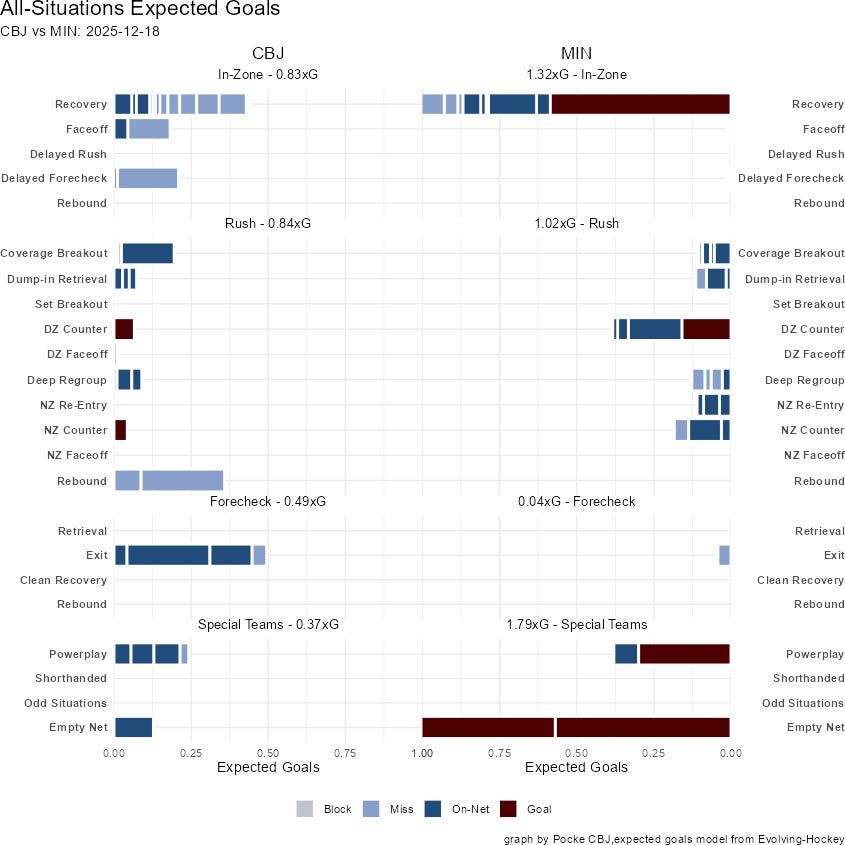
The Blue Jackets were mostly blown out of this game. The Wild had free reign through the neutral zone, a ton of counter offense of different varieties, and ultimately scored on their best chances.
The Blue Jackets had Zach Werenski.
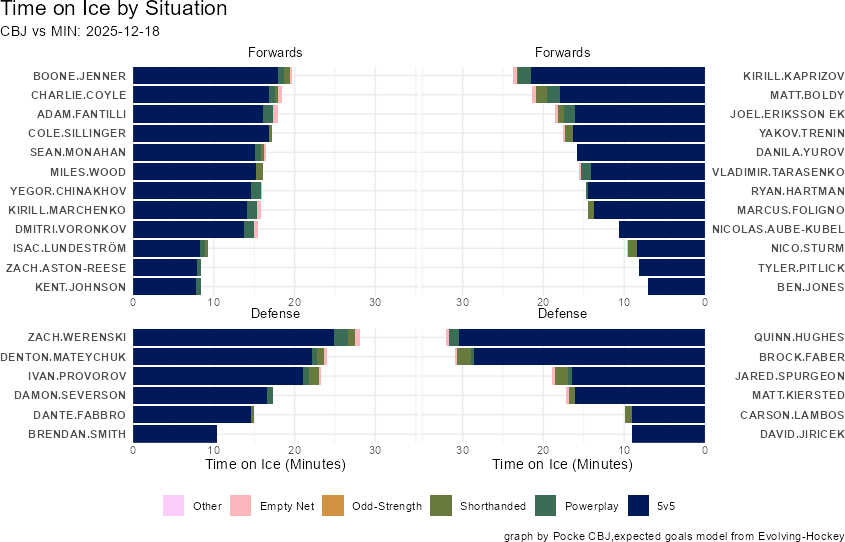
The Wild recently acquired defense superpower Quinn Hughes and their already outrageous usage for Brock Faber is now perhaps entirely out of hand. We’ve seen similar of late from the Blue Jackets, who have done stupid things with Werenski and Provorov paired together as well.
By most advanced metrics, Provorov is a better defenseman than Faber, though both seem to have a reputation for “minute munching” that most perceive to mean they’re actually not all that good. The point of this breakdown isn’t to compare the two but Faber has, at least, some AllThreeZones microstats that point to him fulfilling very important transition role asks.
In any case, Werenski played with Denton Mateychuk anyway and is far better for it.
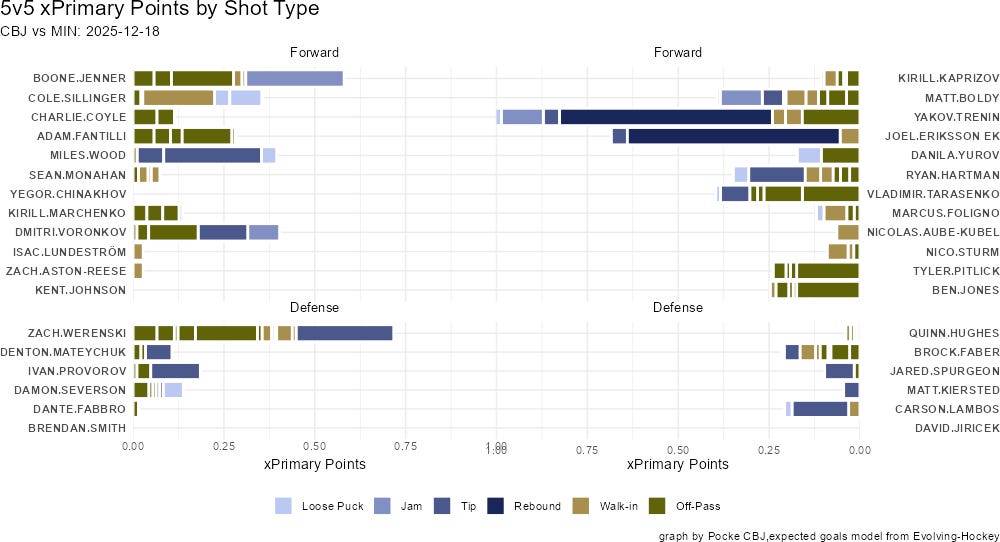
In all-situations, but especially 5v5, it was the Zach Werenski show. Trenin and Eriksson-Ek got greasy, as did Boone Jenner, but the Blue Jackets’ defensemen did about everything he could.
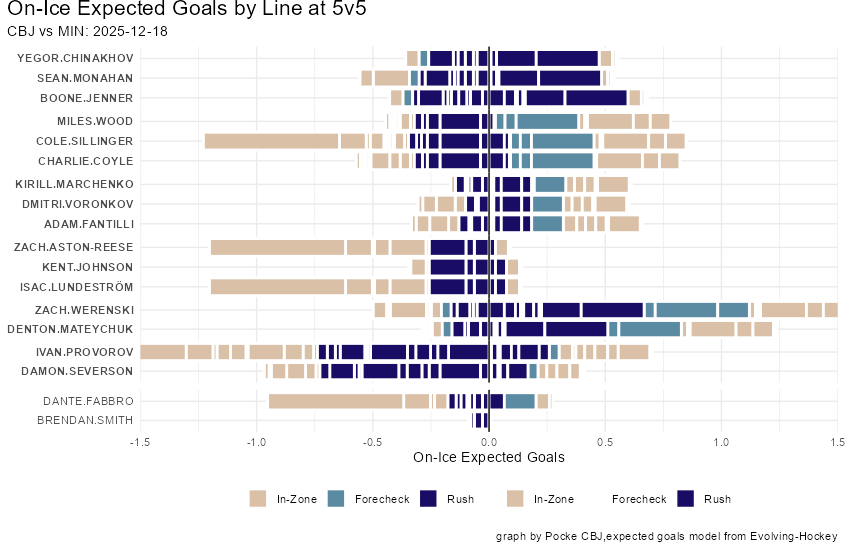
The on-ice data tells the story as well as I ever could. The top pair was brilliant, the second pair dreadful. While the Wild found rush offense at will, big chances against certain lines and heavy quantity against the top-line, it’s clear that one defense group in particular were to blame.
Dean Evason recognized and split the pair in the third period only for the two he deemed better, Provorov and Fabbro, to get pulverized into the ground.
All of the lines, save for the fourth looked good for most of the game. Isac Lundestrom made a few critical errors and Cole Sillinger got caught out for the Joel Eriksson-Ek net-front grease goal xG extravaganza.
Zach Werenski

There is quite clearly one story of the game and it’s Zach Werenski. While I put together the main beats in the above tweet (Blue Sky has an unfortunate video restriction there), it’s worth diving into on extra detail. In case you don’t want to venture onto the hellsite, I’ll share the information here as well.
Full Mixtape
The highlights themselves tell us enough, honestly. Werenski created a dangerous mix of middle distance shooting chances but most spectacular was the sequence of stacked shifts leading to his second goal of the night.
End of Second Shift 1
The Blue Jackets are down a goal, Werenski is simply one of the most fascinating players to watch in the NHL when his team is trailing because he dials up the aggression and motion to 11 and teams just aren’t used to defensemen being where he is. There is 3:16 left in the second period when the clips start.
It started with this shift. Not only does Werenski kill two exits but he does so in a linked-way that allows the Blue Jackets to create offense in the immediate wake of these turnovers. Dangerous chances, each could have been a goal on their own. A full shift, ends with a frozen puck.
Except wait, Werenski doesn’t get off the ice, he’s primed and he knows it.
End of Second Shift 2
Zach Werenski does not leave the ice after Minnesota scores until the Blue Jackets score and he does it in commanding beauty. It’s got everything to love about the defenseman in a single dose. He doesn’t just win the puck, he plays through the stick in calm and fluid motion and comes out striding. He’s streaking down the ice on his off-wing and puts it past Jesper Wallstedt.
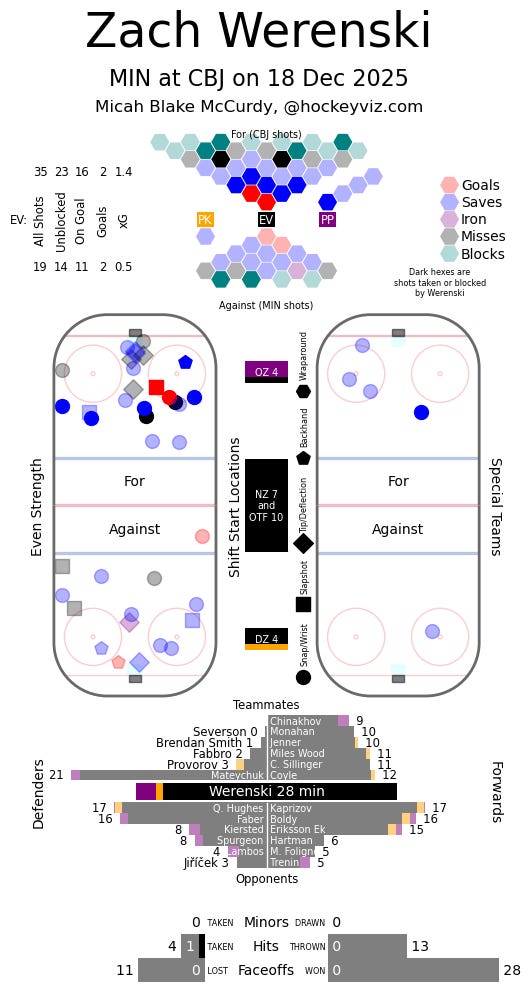
What’s most impressive is not just what Werenski individually accomplished but also who he did it against. The Wild’s top unit is formidable. Kaprizov, Eriksson Ek and Boldy are a nearly perfectly formulated line and Hughes and Faber are about as powerful of a duo as you can get.
You can probably put this up against any other singular top unit, Lehkonen-MacKinnon-Necas-Toews-Makar, Finnie-Larkin-Raymond-Edvinsson-Seider, Hyman-McDavid-Draisaitl-Ekholm-Bouchard and they won’t feel out of place.
The Blue Jackets, at least this season, don’t have the top-unit the way they did last year with Voronkov-Monahan-Marchenko-Werenski-Fabbro. Instead, this game at least, they used two lines to share the matchup burden: Wood-Coyle-Sillinger and Jenner-Monahan-Chinakhov.
Frankly, this is the best the teams’ top-nine has looked all season especially in how they problem solve the neutral zone. I’ve written plenty about how this year is a little different for the Blue Jackets, but these two lines look a lot more like the 2024-25 Blue Jackets and they lean on Werenski in the same way.

Last season, Monahan and Marchenko made frequent use of what I called “loose-puck neutral zones” where they played at a consistent pace and use their speed, stick and teammate to wrangle territorial advantages. They weren’t precious about possession. In doing so, they would sometimes break down or, at the very least, wouldn’t move full speed through which afforded Zach Werenski the opportunity to be a one-man weakside speed differential.
Loose-Puck Neutral Zone → Weakside Werenski
Listen to Jody’s words here, I think they’re quite illustrative of the difference. Jenner doesn’t go fast for fast’s sake, he slows down and finds Werenski “like a slingshot”.
Here’s the clip Jody is referencing. Monahan’s movement here is textbook play from last season. Except from my above linked article:
If that first forward can’t win the possession contest they move forward on their toes, driving back the defender/retriever with them, to create soft-space just behind them. If they do their job correctly, the following forward in the bracket has plenty of time to pick up the puck. It enables forward skating aggression by giving them a sort of if/then decision matrix that accounts for sub-optimal outcomes.
Monahan moves forward, interferes with the defense gathering the puck but mostly takes the body and creates soft-space behind him for the second wave. Jenner gathers the puck and instead of entering in a straight line, finds Zach Werenski with an east-west passing play.
Up to this point in the season, it was really only Charlie Coyle, though Miles Wood, Cole Sillinger and Mathieu Olivier are obviously important linemates there, who played the sort of loose puck neutral zone that this newly formed line is also demonstrating from last season.
There are two more players, here, whose contributions I don’t want to lose.
Mateychuk Complement
I’ll bring more of the clips here but notice how Mateychuk’s contributions shape Werenski’s opportunity. At the beginning of many of the above awesome Werenski clips is usually Mateychuk doing something small: beating pressure, moving the puck or even just retrieving the puck and chipping it out. These small contributions are fantastic but it’s in the liberation of having to do it in the first place that it has the best impact on Zach Werenski. He can’t be the weakside activator if he has to chip the puck out.
It goes further than that for the young defensemen. He works especially well because of how he jumps into space and takes a high activity level when reading off of Zach Werenski. There’s no hesitation, no delay or worry just action. When Werenski can’t fully complete a play, or kill an entry or win a retrieval, Mateychuk is there ready to make a difference.
When he jumps up the ice, the Blue Jackets have good outcomes too, especially in the offensive zone. Here his readiness to act helps attract attention away from Werenski allowing him to find space in that middle distance. Once again, he helps maintain or accelerate play tempo which only serves to help everyone.
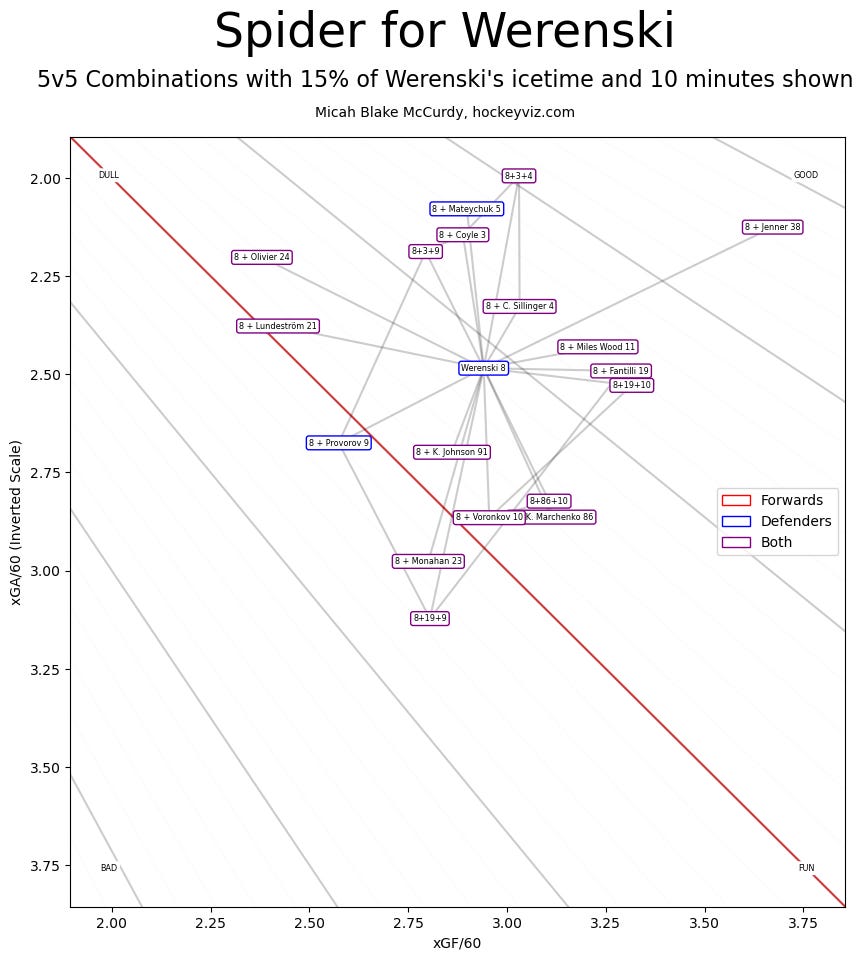
Plenty of time left in the season, but Mateychuk and Werenski have worked together well so far.
Yegor Chinakhov
I don’t want to leave this review without mentioning Yegor Chinakhov’s role in the success of the Monahan line. I thought this game in particular was a good example of the exact type of hockey Chinakhov can play to bring success to the Blue Jackets. If you squint, Jenner-Monahan-Chinakhov shares some of the characteristics of Chinakhov-Monahan-Marchenko and I thought his performance this game had echoes of it too.
Quinn Hughes is a one man breakout machine and Yegor Chinakhov’s skating made life as difficult as possible for him. He came out with few clean wins but in most of these forecheck opportunities the Blue Jackets came out on top. Head-to-head, Chinakhov spent 8:51 at 5v5 against Hughes, in those minutes the Blue jackets were up 9 to 4 in Shot Attempts (69.23 CF%), or 0.44 to 0.14 in Expected Goals (75/73 xGF%).
More of this is more of Chinakhov heading in the direction of his NHL potential.
Kent Johnson
Kent Johnson hardly had an impact on this game. He was on the ice for a goal against without the opportunity for involvement and otherwise had a few puck touches in difficult circumstances. That said, he had some decent puck touches.
The sum total of these contributions is nothing that matters. The last interaction he had in each of these situations, though the beginning and middle featured plenty of things to like, were blocked or disrupted by Minnesota.
Kent Johnson is just not making quick decisions, perhaps overthinking, and the result is that he’s easy to slow to pull the trigger and easy to read. Are his teammates helping? Not that much but the time between recognition and action is far too long for him to be successful in the NHL.
Skilled players like to get in a rhythm and build confidence, especially so that the pressure on each individual puck touch isn’t so great, and that might be hard with him relegated to the fourth line. But if it continues like this, it’ll be hard for a coach to want to elevate him further as well. He’s in the bottom of a negative-feedback loop and there’s no one coming to get him out.
The solutions are simple, make plays to open hands quickly and act decisively when you’re in critical space, but finding them is easier said than done.
Hot take: Zach Werenski is the best defenseman in the league. I never want him to leave.
Another huge issue is that Marchenko seems to have cooled off. Does the data support that? Might he be dealing with an injury?
Maybe you already covered this, but do you think Johnson's struggles are due to the systematic decrease in rush offense? It seems to me that Evason is making the same mistake as Vincent did, namely not coaching to the team's strengths.
Also, though I suspect there's nothing to it, their record has been especially terrible since Olivier got hurt.