
CBJ vs Boston 2/26
Werenski-Severson Ice Tilt, Coyle F3 Dominance, Top Line Offense and Pastrnak v Werenski

The Blue Jackets’ first game back from break told us, mostly, what we already knew: they’re not a magically different team. There are a variety of different storylines coming from this game that are simple continuations of everything about this team from this season up to this point.
The Game
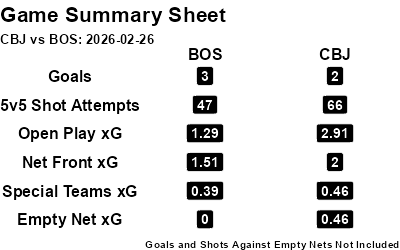
We’ll start at the beginning. The Blue Jackets were the better team this game though the result didn’t follow. As much as it was frustrating to see expected weaknesses show themselves prominently, the gestalt takeaway should absolutely be positive.
The Blue Jackets lost because: they took too many penalties and got extremely poor results out of a third period mistake from Zach Werenski.
Whether you feel good or not coming out of this game, then, likely depends on how you feel about the general “process” of the team. Rick Bowness, out of an extended break, started Elvis Merzlikins instead of Jet Greaves who is the demonstrably better goalie. There is no rest excuse anymore.
Miles Wood and Mason Marchment took poor penalties and the powerplay conceded to an incredible unit whereas the Blue Jackets couldn’t score on the powerplay (though they had excellent chances).
Still, the Blue Jackets also saw some of the same positives heading into the break and also a new one that is critical for success going forward.
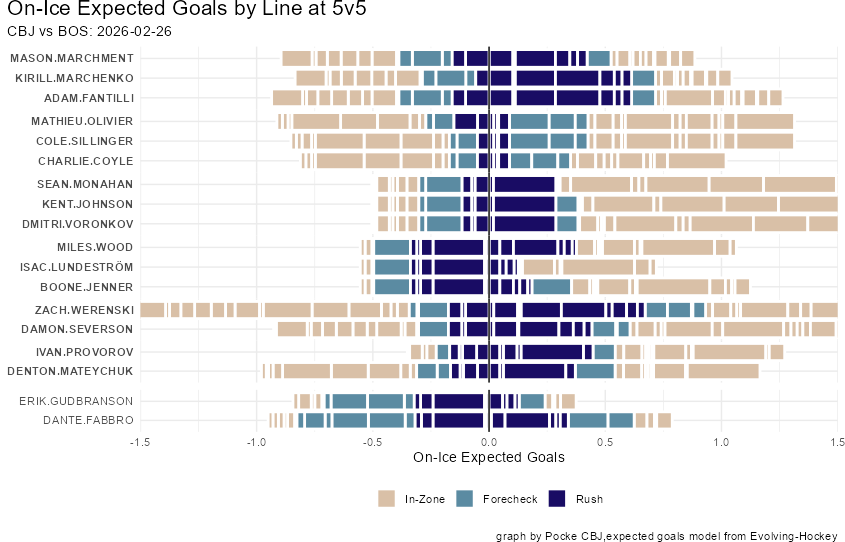
The “old one” is that Zach Werenski and Damon Severson were outright dominant in terms of chance-share once again. Their “actual goals” haven’t caught up yet, as they conceded twice, but I’ll let you be the judge of whether those goals were due to randomness or a concerning process between the two.
Werenski-Severson Goals Against + Bad Shifts
The two were dominant on the ice, but you’ll notice the distinct difference in Werenski vs Severson’s on-ice xGA. It’s tempting, sometimes, to say that they just played “high event” minutes but really they just had a couple of big and bad shifts. These were caused by:
Cole Sillinger fumbling a puck on exit leading to a Marchenko penalty
Cole Sillinger skating through Denton Mateychuk’s stick leading to an extended shift (the shift that lead to the on-ice difference)
Elvis Merzlikins falling over on a rim-retrieval
From a goals-conceded perspective: that’s an Isac Lundestrom double-slot coverage into own goal angle and a Werenski block into Damon Severson stumble into Sean Kuraly rush slapshot goal angle.
The games won’t always be this good but those are some pretty unlikely circumstances all around. Remember, Boston is ahead of the Blue Jackets in the playoff race.
Werenski-Severson Ice Tilt
Still, this was a vintage Zach Werenski-everywhere making the game easy to play via excellent defensive play, brilliant easy puck-moving and threatening offense with Damon Severson filling holes when his time comes. That makes Severson sound bad, and he was mostly great this game, but it’s just the nature of him not being exactly Zach Werenski about it.
These two are connected to the other “good” things, so I’ll mention them here before going further. Charlie Coyle was a defensive force and Sillinger and Olivier were fantastic forecheckers.
Coyle F3 + Matchup Line Heavy Offense
Everything good about Coyle was on full display. His presence as an F3 made his linemates’ decisions easy, his puck protection beneath the goal-line was brilliant, his defensive interventions in his own zone, combined with puck moving to get it out, was critical.
Sillinger and Olivier mostly served as supportive offensive tissue here and they did it well. Their finishing remains an issue, I suppose, but there was legitimate slot-action. They played heavy which is an excellent counter-punch considering the other options the Blue Jackets have.
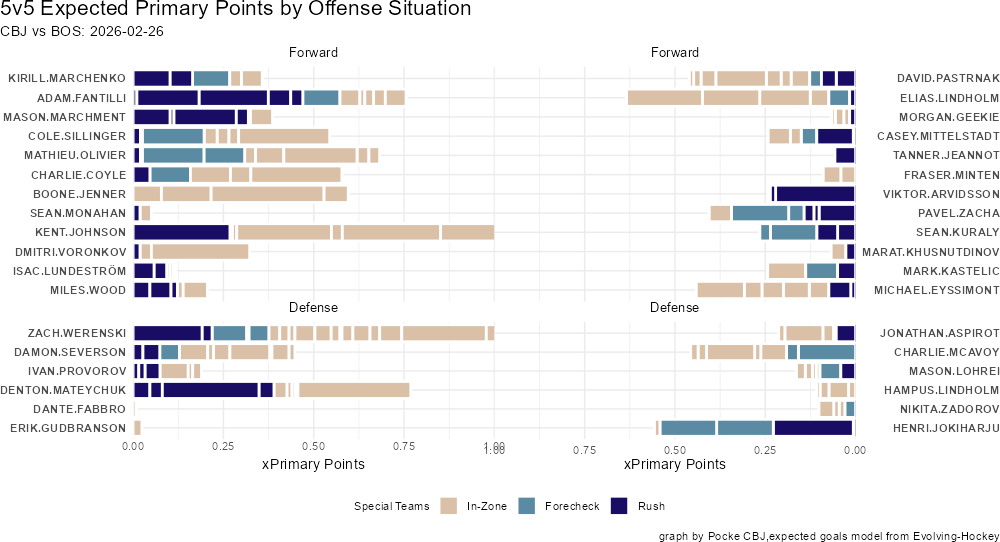
The bigger positive is the excellent emergence of offensive creation from the top line. Marchment-Fantilli-Marchenko found a ton of danger and created plenty off the rush as well. Adam Fantilli could have easily had a hat-trick. That was a big concern heading into the second half where this line really struggled to find the incendiary chemistry underneath Evason’s more structured transition offense.
CBJ Top Line Offense
They generated a cavalcade of chances from a variety of situations. Many came from rush counterattacking, which should be a strength considering their makeup, but enough came from solid cycle situations here as well.
Notice the involvement of Werenski and Severson as well. Their play on the walls lead to plenty of these follow-up chances and their work on dump-in retrieval lead directly to that second goal as well.
A promising start to a critical window but one that suggests that some of the teams’ problems may just remain so.
Pastrnak vs Werenski (and Coyle too)
So many aspects of hockey are random and outcomes difficult to predict given the inputs to interactions. When two superstars go head-to-head, we get a peek at what the game could be if more players had the capacity to play the game with more agency. Of course, it’s performance under increasing pressure and decreasing time that is the distinguishing factor, so purely improving their skill wouldn’t make the “game better” but would just highlight players who need less to exert impact but I digress. These players exert a control on the ice that nearly all other players don’t so the specific interactions between their intentions is all the more fascinating, Werenski and Pastrnak this game were no exception.
David Pastrnak is one of the few position-transcendent superstars. Sometimes McDavid and MacKinnon feel obvious in their dominance and, to a degree, that makes them less interesting to analyze. What is there to learn from “be an unstoppable skating force” is great, and reductive of their talent, but not so much if you want to understand hockey better. Players like Nikita Kucherov, Leon Draisaitl and certainly Pastrnak feel different in that they don’t necessarily rely on obvious gifts but instead dominate within details.
Not everything that I love about Pasta stood out this game in a way that makes it easy to talk about but it’s all still there. The foremost detail, this game, was in his capacity to manipulate posture, use that posture as a form of information-witholding deception and then make plays through it.
He holds the puck next to his stakes and nearly behind him. He puts it into this location almost immediately as a form of puck protection. What’s special is his capacity to make space passes out of this position. Not only is his awareness of the passing lanes special but his capacity to exaggerate those lanes, to reduce the defense’s capacity to react once they are actualized, is incredible. I think this also serves to make Charlie Coyle’s breakup of the slot pass to Khustnutdinov more impressive, a very fun cat-and-mouse game where each player comes out on top differently in different situations.
His powerplay passing to Minten and for the slot chance and Geekie to the goal both demonstrate this principle differently. He’s not making exaggerated head fakes or dramatically selling false-information, he’s just weaponizing the lack of information he’s giving with an on-ice awareness and capacity to act that is hardly matched in the league.
It’s really this awareness of how hockey works that underpins just about everything. The passing lanes, yes, but his capacity to catch pucks in the least-able-to-be-defending positions, the awareness of defense approach vectors and how he can subvert angular momentum, all of it is brilliant. His multiple puck recoveries and slot drives on Charlie Coyle the most apt demonstration in this game specifically.
What I like about this specific style, this preturnatural skill, is that I think it might be more advantageous to a team than some of the more obvious dominators. McDavid and MacKinnon cannot be stopped and pretty much everyone knows when they’re beat. With quiet anticipators and deceivers, their danger also lies in the fact that they’ve beat the defense before anyone else on the ice realizes it. There’s significant danger in that false security.
On this sequence, Werenski wins the cat-and-mouse. His defensive stick position sells the idea that Pastrnak will have an angle later and then micro-lifts prevent the sharp angle shot. He pivots to threated the hip pocket but slides over with his skates to prevent the easy rim and acknowledge Olivier’s threat. They disengage and Werenski ultimately breaks up a McAvoy pass to kill the sequence.
Later, though, it’s Pastrnak who comes out on top. Werenski is undermined a bit by Fabbro’s decision to give him the puck in poor tempo. He allows, or doesn’t recognize, that Morgan Geekie is already in pursuit of Werenski and that sets of a difficult chain of events for Werenski. He moves behind the net and is now, essentially, 3v1. Pastrnak realizes this, lets Werenski see the wall window, and jumps into the lane to steal the pass.
As soon as he intercepts the pass, he’s into puck protection mode with darting stick handles that not only prevent Werenski from creating a second wave opportunity but also open a passing lane for a backdoor chance. Absurd playmaking vision.
Werenski finds the puck and moves behind the net to create space. Pastrnak is already in pursuit, anticipates this move from Werenski and gets a head start on pressure. By the time he clears the net, Werenski has a poor angle and no time to make a pass. Werenski, here, is still brilliant. With absolutely no stick motion he lofts a space pass to Sillinger for the exit and dodges Pastrnak’s interception attempt.
Sillinger can’t handle the pass and Pastrnak leverages his missed attempt into a backdoor one-timer look.
These interactions, ultimately, didn’t make a big difference in the game but I still find it fascinating to watch two of the best players in the game lock horns in battles of wit and anticipation.